M29 Weasel
 USA (1942-45). 15,124 units built.
The M29 Weasel was an innovative, fully-tracked light military transport vehicle developed by the Studebaker Corporation during World War II. Originally designed to cross deep snow, the Weasel's incredibly low ground pressure allowed it to traverse mud, sand, swamps, and even active minefields without triggering anti-tank mines. Some 15,000 were mamnufactured during the war, and thus, the still served in Korea, berfore replacement by the
M76 Otter, and later the
M116 Husky.
Development
The core idea came, not from Studebaker or an American, but British inventor Geoffrey Pyke, for Project Plough. The same Pyke, which created the "pykreye" a form of hardened ice-concrete mix (Projet Habakkuk). The initial plan was for a lightweight, fast and air-transportable vehicle for commandos teams in order sabotage vital German-occupied hydroelectric plants in Norway. A very niche assignment indeed, so snow was its primary terrain. While never deployed for its original exact purpose, Studebaker manufactured more than 15,000 units from 1943 and 1945 that saw action in multiple threaters.
Pyke and Project Plough
 T15/M28 in its initial factory appearance, all white with a tarpaulin.
Operation Plough generated not only the final Weasel, but an even more radical screw-propelled early prototype of the same, probably Armstead snow motor fitted on a Fordson tractor and featuring a lightweight driver's cabin. After the invasion of Norway indeed, the idea of transporting soldiers rapidly over snow led to the development of a radical screw-propelled vehicle at first. It was not completely Pyke's idea but recycled an old patent, the the Armstead snow motor. The vehicle ran on a pair of lightweight cylinders shaped like screw cylinders, which spiral flange was ideal to dig into the snow when turn in opposite directions to go forward. Pyke suggested a small force of such vehicle spread wide to occupy attention and make a breakthough.
The vehicle was unproven and the idea was rejected so by October 1941, Louis Mountbatten, which replaced Roger Keyes as Chief of Combined Operations, had different views on the matter and a talent for unusual talents and ideas. Mountbatten saw value in Pyke's ideas and adopted the plan, which became Operation Plough, "First Special Service Force." PM Winston Churchill noted "Never in the history of human conflict will so few immobilize so many". The project was then superseded by the Canadian development of a far more conventional transporter, the Weasel tracked personnel carrier. It was developed for the American-Canadian commando unit, part of the First Special Service Force, which trained for Norway but ended in Italy.
Genesis of the M29 Weasel

The M29 Weasel was designed in Canada for operation in snow and inspired by Canadian wilderness vehicles fitted with very wide tracks (now they would be called "snowmobiles". Indeed all the way back to 1928 Joseph-Armand Bombardier (A Quebecker from Valcourt, at the root of today's aviation company) invented a different caterpillar track system suitable for all kinds of snow conditions. He created a toothed wheel covered in rubber and rubber-and-cotton track wrapping around the back wheels. His B-7, which was an enclosed, 7-passenger vehicle produced from 1937, was effectively the first modern Snowmobile. He also introduced the B-12 (12-passenger) in 1942. The B-7 had a Ford V-8 flathead engine and the B-12 a flathead in line 6-cyl. Chrysler. In all 2,817 units would be produced until 1951, some used as specialized army vehicles in World War II.
How much the B-12 influenced Geoffrey Pyke is unknown but the vehicle was anyway considered to hamper the German nuclear weapons program as a fast, light mechanized vehicle transporting small commando troops of the 1st Special Service Force across snow and be air transportable, to be dropped by parachute and carry not only passengers but also explosives and supplies. Pyke is generally credited to make a small version of the B-7, but heavily modified in order to be amphibious as well, if fitted with additional fore and aft floats. However the only question remaining was of production. Studebaker was awarded a contract for these and more specifications changed the type specifications, now to be usable also on sandy, muddy, and desert terrains and capable of towing all sorts loads. They wooild notably saw action much later at Iwo Jima and Okinawa which volcanic sank and pebble was not friendly to traditional vehicles.
From the T15 to the M29

The initial prototype was called T15 and it featured a rear engine, and front wheel drive. It rested on 15-inch Kégresse-style tracks (A type of semi-flexible rubber track invented by Adolphe Kegresse before WWI). It had a 2-passenger capacity only and a rear wheel drive system. The standardized M29 Weasel had wider, 20-inch tracks, as well as larger passenger and load capacity, plus much improved amphibious capabilities. Then came the M29C "Water Weasel", even more amphibious, with added buoyancy cells, twin rudders. It was unable to tackle open seas however, only inland waterways. The bogie wheel arrangement then started to change between the M28 and M29.
The first 2,103 Weasels were indeed designated T15. They were later standardized as the "M28 Cargo Carrier". The T15/M28 had as seen above the initial "narrow" 15 in (380 mm) Kégresse-style rubber-band tracks. The later M29, which represented the bulk of production until 1945 swapped them for even wider, 20 inches (510 mm) tracks, still usingthe same format. Also the T15/M28 had a rear engine, front wheel drive, four bogie wheels per side and the hull had only a two-passenger capacity. The M29 still had a (beefier) front engine, but now rear wheel drive and a new style of bogie wheel arrangement. The hull was changed to accommodate a larger passenger or payload capacity. Also the M29's idler wheel at the front was lower than the taller drive sprocket at the rear, giving it a "backwards" running look.
Design

The M29, which is the object of the present article, was by far the better known and most produced aside the M28, as it was larger, more powerful, more capable, versatile, and with better amphibious capabilities. The Standard M29 was however considered "semi-amphibious". It had a very low freeboard. An M29C "Water Weasel" had indeed fore and aft buoyancy cells and twin rudders. Still these caissons only allowed it to operate in inland waterways. It saw limited action in surf conditions in the Pacific and took part in the landings on Walcheren in Europe.
The final M29 was powered by a 2.8-litre, 6-cylinder Studebaker Champion flathead gasoline engine rated for 70 horsepower. It Weighed 3,800 lbs (dry) with a length of 10 feet 6 inches, versus the M28's 3,800 lbs (1,720 kg). The M28 measured 10 feet, 5.75 inches to 11 feet (approx. 3.20 to 3.35 meters) for a width of 5 feet, (approx. 1.52 meters) and height of 5 feet, 7 inches (approx. 1.70 meters) to the top of the canvas/windshield. With its top and windshield folded it was down to 4 feet, 8 inches (approx. 1.42 meters). Its gound Clearance was between 11 to 12 inches (approx. 28 to 30 cm).
The M29 weighted 4,451 lb (2,019 kg), so some 400 kg more, and when shipped uncrated respresented a volume of 340 cu ft (9.6 m3); 57.7 sq ft (5.36 m2) wthout its flotation halves. Ground clearance was 11 in (280 mm). It could reach 36 mph (58 km/h) on land, with an operational range of roughly 125 to 165 miles. The Ground Pressure was under 2 psi (approx. 1.9 psi) at 1.9 psi (13 kPa) so it performed very well across unstable surfaces.
Its pintle height, loaded, reached 27.125 in (0.6890 m). Unlike the M28 as said above it was built for a crew of 4, two in the forward cab, two in the rear cab with extra space for payloads, with a capacity of 1,200 lbs. In addition it could even tow up to 3,800 lbs. The M29 came out also with an electrical system of 12 volts and it featured mechanical brakes using external contracting in differential. The engine was coupled wih a 3 speed Studebaker transmission to the rear drive, along with a 2-speed transfer case.

This engine, the Studebaker Model 6-170 Champion, was a 6-cylinder 169.6 cubic inches (2,779 cc) and 4-stroke which ran on 72 octane gasoline. It delivered 70 bhp at 3,600 rpm. Fuel capacity was 35 US gal (130 L). On average it consumed 5 miles per gallon) for a rannge of 165 miles (266 km). Its maximum gradability was 100%, with a turning radius of 12 ft (3.7 m). The M29C water weasel full flotation on water with its halves mounted, but without it could ford 36 in (91 cm) and climb a 24 in (61 cm) obstacle. It was also capable of 36 mph (58 km/h) with a max load of 3,800 lb (1,700 kg).
The M29 Weasel was open top, like most WW2 military vehicles to simplify prodution. It had a folding windshield and tarpaulin. The M28 (T15) was designed with a fixed windshield and dedicated tarpaulin wit insulation for winter and snow operations, then the M29 had a more generic all-threater standard tarpaulin of a large size in order to cover the wider and longer compartment, notably dowwn to the rear seats. It used simple frames and was mostly a top (an back) cover, with optional side covers for winter operations, likely with plastic wondows. Also, given its nature, the M29 Weasel was not armed, nor armoured. There was no provision anywhere for a machine gun. However in a few occurences, it was.
In Official U.S. Military Armed Variants (Type A, B, and C) around early 1945 three distinct armed variants were developed on the M29C Water Weasel chassis, explicitly to provide light amphibious infantry squads with integrated heavy firepower:
• M29C Type A: Armed with a 75mm M20 recoilless rifle mounted on a center pedestal in the middle of the hull.
• M29C Type B: Armed with the same 75mm M20 recoilless rifle, but shifted to a rear mount to clear up the middle cargo space.
• M29C Type C: Armed with a center-mounted 37mm M3 anti-tank gun (the same main gun found on the M3 Stuart light tank).
Original U.S. Ordnance Department test photos and manuals clearly depict these vehicles undergoing firing trials. Because the recoilless rifle relies on venting propellant gases out the rear breech to eliminate recoil, the lightweight, thin-skinned hull of the Weasel did not require heavy, reinforced mounting structures. None entered service.
There were also documented field-Expedient Troop Modifications depending on te theater from from Western Europe to the Pacific. Its rear compartment had a flatbed that could be customized by attaching standard infantry weapon mounts:
• Machine Guns: Numerous historical photographs show M29 and M29Cs equipped with pintle or pedestal mounts carrying a .30 caliber Browning M1919 or a heavy .50 caliber Browning M2 machine gun for self-defense and reconnaissance fire support.
• Mortars: Some units used the open rear area of the Weasel to carry and rapidly deploy 60mm mortars.
The French Foreign Legion for the First Indochina War, also modified the M29C they nicknamed the "Crabe" in the marshy deltas and rice paddies with photographic evidence showing them retrofitted with protective armour and dual machine gun arrangements with thr 7.5mm FM 24/29 light machine gun and Browning LMGs to fight off ambushes. But this remained anecdotal.

M29 Weasel specifications |
| Weight | 3,800 lb (1,700 kg) dry |
| Dimensions | 10 ft 6 in x 5 ft x 4 ft 3 in (3.20 x 1.5 x 1.68m) |
| Propulsion | Studebaker Model 6-170 Champion 6-cyl. 70 hp (52 kW) |
| Transmission | Suspension Tracked |
| Top speed | 36 mph (58 km/h) |
| Max range | 165 mi (266 km) |
| Crew | 4 |

Variants
- T-15 prototype
- M28 (G154): Early prouction (). Rear-engine placement and narrow 380 mm tracks.
- M29 (T24) without float tanks (G179) standardised configuration as seen above and 510 mm (20-inch) tracks
- M29C with float tanks, "Water Weasel". Most widely produced semi-amphibious variant with front and rear buoyancy cells
- M29C Type A: Center-mounted 75 mm M20 recoilless rifle, prototype
- M29C Type B: with (T106) rear-mounted 75 mm recoilless rifle, prototype
- M29C Type C: with center-mounted 37 mm Gun M3 prototype
- M29C Wasp: Canadian flamethrower as used on Universal Carriers
In service
The M29 Weasel was deployed globally across multiple fronts by the US, British, Canadian, and French armies. They were utilised during D-Day, the Battle of the Bulge, and the Scheldt Estuary to resupply front lines and operate as an ambulance. They were also extensively used by the US Marine Corps during the brutal beach conditions of Iwo Jima and Okinawa. They saw action in the Korean War and in Indochina by the French military. Surviving, surplus units were later used in Arctic exploration and by civilian ski resorts for more decades, until replaced by moe modern snowmobiles.
In US Army Service
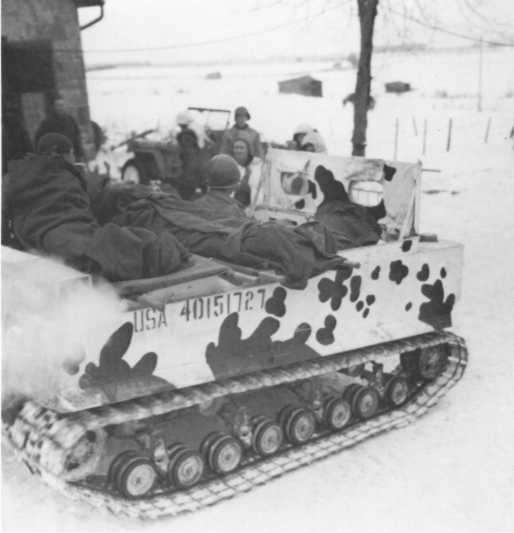
With Pyke's Norwegian mission cancelled, the Weasel was never used for its original purpose in Norway, and instead production vehicles from 1943 were used by US Forces quite widely in both Italy and on the Western Front. They were notably used to supply frontline troops over difficult ground as most wheeled vehicles were bogged down. Given its excellent tenure over sand it saw action notably in Normandy (flooded by the Germans) and notably saw action during the breakthrough at St. Lo. Later in the harshest snow conditions in a while in Belgium, they proved very useful in the Battle of the Bulge, and later the spring mud of the Ruhr basin and around the Rhine. In Italy it proved adept to get supplies high in mountainous terrain, specially in winter.
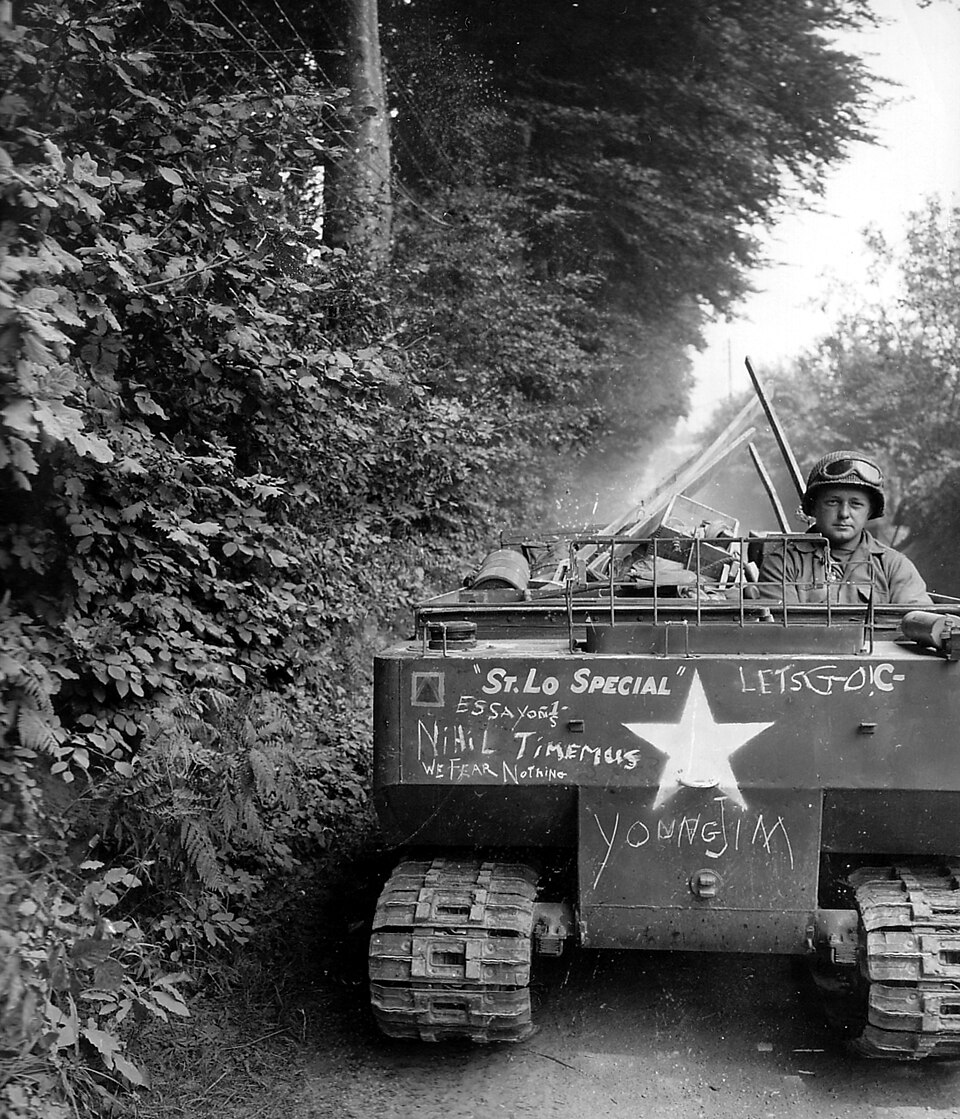
The M29 in all these cases was obviously never redployed on the frontline, rather used primarily a cargo carrier on supply lines, but it was declined into multiple field variants, proving quite adaptable. It was indeed used as a command vehicle, radio platform, and signal line layer, and wa improvized soon as an all-terrain ambulance, going places impassable to Jeeps. It was also realized, specially in Italy, that with such a low ground pressure, it could go and cross minefields. Reliability however remained a constant issues, notably in the European summer and after long trips on hard roads. It was so bad the commander of the 87th Chemical Mortar Battalion reported during his action at La Ferté Macé on D-Day:
All companies are having a great deal of trouble with the M-29 Cargo Carriers on long movements such as the ones Companies C and D have made in the past several days. The Cargo Carriers have been overheating and, in several cases, the water has completely boiled out of the radiators. These vehicles were made to operate in arctic temperatures. The motor becomes so hot that the oil in the transmission literally boils and boils out. Plates are coming off the tracks and the cables that hold the tracks together break on these long movements. All in all, the efficiency and mobility of this battalion is greatly reduced by our being required to operate with such a vehicle, not only because it is inefficient but because it was never intended to operate in this climate or on hard and paved roads.
As the war ended in Europe, M29s became surplus. Instead of repatriating them back to the US (many were still resoled in the US and Canada) they were sold to allied countries: Overnight Norway, Sweden, and France became operators. It might looks surprising for the latter, as apart mountain ranges like the Alps, Vosges, Pyrhenees, the vehicle was used, especially the M29C water weasel or "crabe" in Indochinese swamps and ricefields. The M29 and M29C also served in the Korean War alongside standard 1/4 ton 4x4 cargo vehicles.
With harsh winters and mountaineous terrains they were quite useful indeed. At last, the Military and state agencies used the vehicle in Arctic and cold weather operations, like for the development of Alaska, operations in Greenland, until retired by the U.S. army inventory in 1958. They were resold to civilians and municipal organizations. Some for example took part in the VIII Olympic Winter Games in 1960.
U.S. Marine Corps
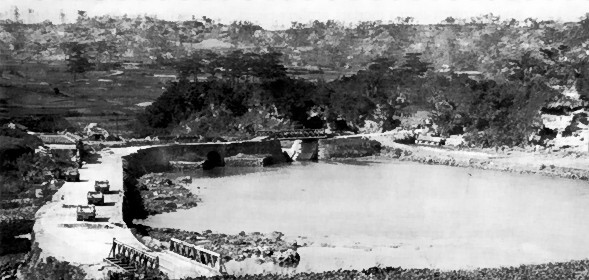 Weasels at Machinato, seen shortly after the action of 19 April. Three Weasels on the road (left) were knocked out. In background (left) Buzz Bomb Bowl slopes up to Urasoe-Mura Escarpment.
The amphibious and sand-crossing capabilities of the vehicle filled a gap in procurement, alongside the armoured and armed "big boys" of the LVT (Landing, Vehicle, Tracked) family. The latter had narrow track and a high ground pressure. Instead the M29 was so light it could even negociate coral fields in some cases. But its depolyment came late: Only by November 1944, the 3d, 4th, and 5th Marine Divisions were equipped with the vehicle, that proved invaluable at Iwo Jima, which volcanic sand crippled other vehicles. As the fight solidified inland, it brought well needed supplies (half-ton loads) across the island. Conditions were about the same but at a much larger scale on Okinawa.
On monsoon wet muddy tracks the vehicle also proved invaluable. As they could also pull trailers and artillery over these terrain barred from wheeled vehicles they were deployed constantly. Production continued at Studebaker in planning Operation Oympic. Most of the vehicles were repatriated, but many also ended in a devastated Japan, for the same missions, now for occupations troops. They were also deployed in the Aleutian Islands and a few took part in the campaign of 1943. The remainder were shipped to Alaska.
British Army
M29 Weasels were used by 4th Special Service Brigade (commandos) for the Walcheren operation, supplementing LVT Buffalos. The 79th Armoured Division used non-amphibious variant to clear anti-personnel mines and the Lovat Scouts were trained on them at Jasper, Alberta, to mountain warfare tactics, after training in the Scottish Highlands and North Wales. The Weasels were also used by the British Forces in the Saar-Moselle Triangle and remained in storage or for training postwar.
Canadian Army
The T15 Cargo Carrier or "Snow-jeep", was in Operation Cottage by 1943, part of the Aleutian Islands Campaign. Fifty T-15 Cargo Carriers were sent to Nanaimo by June by the 13th Canadian Infantry Brigade. The T15 were supplied to replace earlier Canadian Motorised Transports for joint operations and to avoid meddling with the Canadian maintenance system. Afterwards, the M29 Weasel was used by the Canadinans by the fall of 1944, notably at the Battle of the Scheldt and in the marshy Scheldt estuary, up to the Port of Antwerp. Later M29s thyey progressed through flooded areas in Germany as well an those repatriatd ended in the Arctic.
Postwar Use
French: Indochina War
The first example is the First Indochina War, in which the French 1st Foreign Cavalry Regiment in charge of fighting Viet Minh guerrillas in the Mekong Delta deployed the M29C in its 1st and 2nd Escadrons. They came originally from the 13th Demi-Brigade of the Foreign Legion in 1947. Initially they were unsuccessful when crewed by inexperienced recruits and using poor tactics, deployed without infantry (high losses). The 1st regiment of "chasseurs à cheval" had a full Squadron of M29s in 1949-1953. They were deployed after LVT-4s and LVT(A)-4s and in 1950, moved with stronger infantry units. By September 1951 the 1st Groupement Autonome was created with two escadrons of Weasels (33 each) and three of LVT-4 (11 each) plis six LVT(A)-4 for support. The "Crabes" were armed with Châtellerault M1924/29, Bren or Browning M1919 MGs as well as 57mm M18A1 recoilless guns and 60mm mortars for more flexibility. At least one weasel remained in service at the French Dumont d'Urville Station in Antarctica until 1993. Some were allegedly also used by French mountain troops and Gendarmerie in the 1960s.
Korea: US Army and 1st Marine Div.
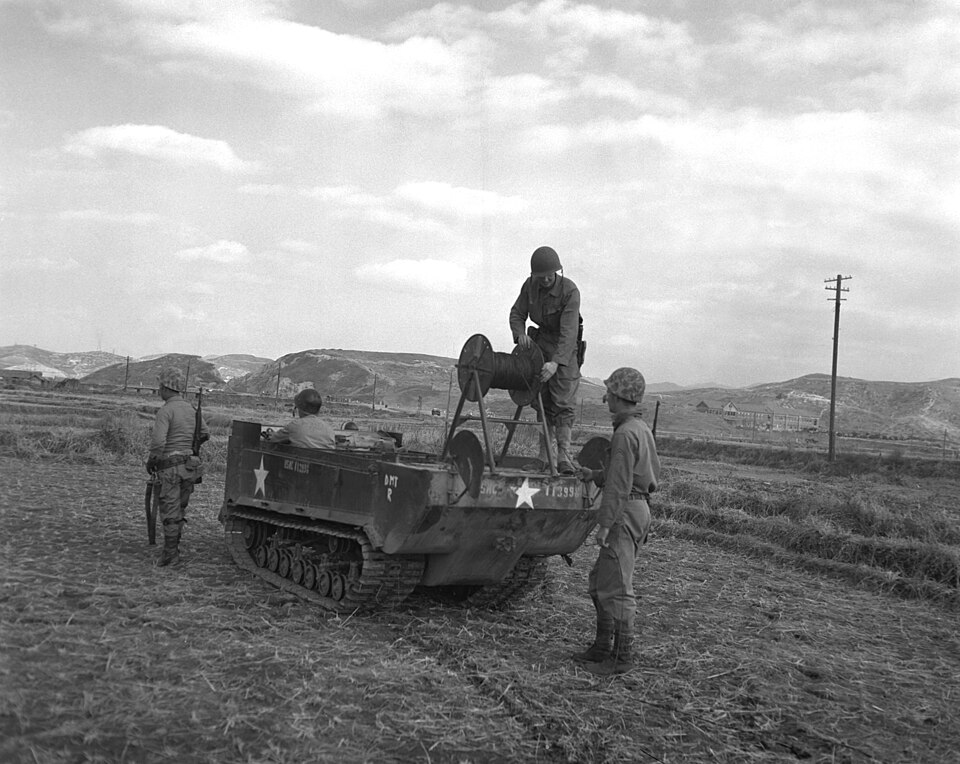 M29 of the 1st Marine Division used as signal vehicle 8 November 1950.
During the Korean War (1950–1953), both the standard M29 and the amphibious M29C Water Weasel were heavily utilized by United States forces—particularly the U.S. Army and the 1st Marine Division. They soon proved to be an indispensable asset in brutal sub-zero winter temperatures, deep snow, and thick, muddy terrain. They replaced the 1/4-ton 4x4 Jeep in icy mountain passes, heavy snowpacks and frozen rice paddies. They were used by the 1st Marine Division as specialized signal line layer. They were used to rapidly reel out and lay down tactical telephone lines across terrain that was entirely inaccessible to standard trucks. Both the Army and Marines also used it for all-Terrain Medical Evacuation, though deep mud and steep ridges, from remote hilltop outposts back to field hospitals or Mobile Army Surgical Hospital (M.A.S.H.) units. They also regularly transported ammunition, rations, and fuel to extreme forward positions, nearly 1,000 lbs (approx. 500 kg) and/or towing specialized supply trailers.