Raupenschlepper Ost (1942)
 Germany (1942-45) - Utility Tracked Vehicle - 23,000 built
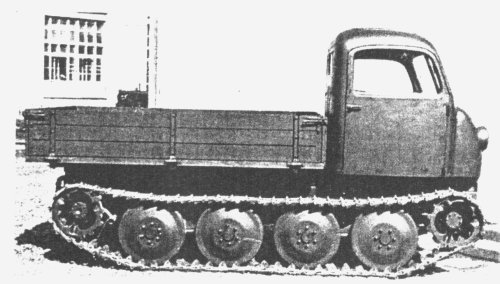
In short, the Raupenschlepper Ost (lit. "Caterpillar Tractor East") abbreviated as RSO) was a fully tracked, lightweight cargo vehicle intended for Wehrmacht, designed by Austrian manufacturer Steyr after the poor performances of the German logistic train on the mud and snow of the 1941–1942 Eastern Front winter. The Rasputitsa and heavy winter snows, the absence of good roads was a nightmare leading to the adoption of more half-tracks, and conversion or existing trucks (Maultier). Steyr in response designed a very simple and rugged, small and cost effective tractor based on elements of the Steyr 1500A, but with full tracks. It drew inspiraton notably from Soviert tractors such as the STZ-5 and had a modest payload of 1,500 kg and equivalent towing capability but only at 14–17 km/h.Over 23,000 were manufactured across all versions by 1945 with production changes and simplifications over time. The most lethal was the RSO/PaK 40An improvised tank destroyer, albeit a handful were made.
Design development 1942-43
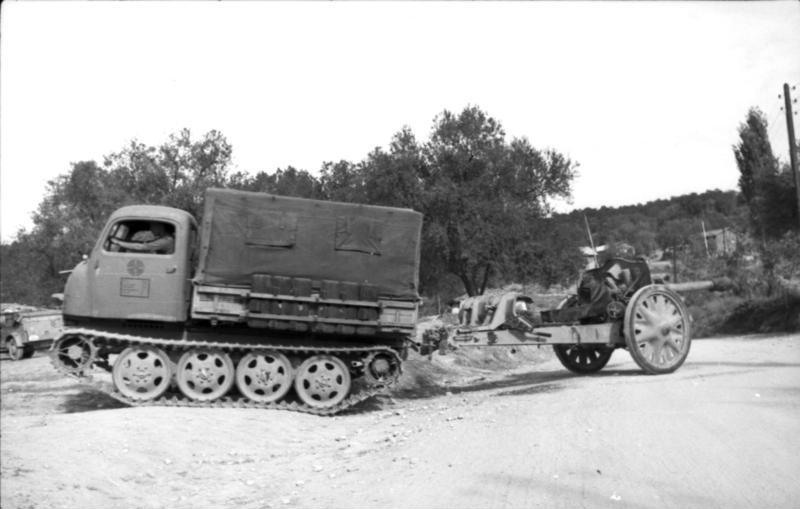 In Albania, towing a field gun
The real origin of this vehicle lays in the harsh conditions encountered in Russia before, during and after the winter 1941/42. Before and after were the Rasputitsa, and wheeled trucks on these primitive roadways and tracks that were the majority in the USSR completely hampered the moves of the German logistic train. This was a major reason in the loss of momentum in the Wehmacht time table which planned to take Moskow by December. Deep snow and extreme cold were also etrimental, even rubber freezed over.
In general, the need for fully or partilly tracked vehicles seemed obvious. So specifications for a small, cheap, simple fully tracked supply vehicle that could be mass-produced to replace existing trucks (a very eclectic park) was ordered to maintain mobility. Steyr, which was in Austria, less subjected to allied bombings, had extra capacity and proposed a small, fully tracked vehicle based upon its 1.5-tonne (3,300 lb) truck. The Steyr 1500 light truck was one of the standardized 1.5 ton payload lorries selected for mass-production. This vehicle was already in use in the army and so adapting it with a fully track chassis while keeping all the rest seemed a good idea. The project was eventualy called the Raupenschlepper Ost (abberviated RSO).
However if the prototype could be ready in the spring of 1942, the army had a heavy test and evaluation program. Here is some overview of the process:
- Late 1941: Reports of disastrous performance of wheeled and half-tracked vehicles in the first autumn mud season (Rasputitsa) and winter
- Mid-1941 to Mid-1942: Steyr design the protoype under the direction of the German Tank Commission, and Dr. Ferdinand Porsche, using components based on the Steyr 1500A light truck.
- Summer 1942: Steyr submit the first successful prototypes and concepts meeting the Army's specifications.
- September 1942: Official mass production of the basic cargo/artillery tractor variant (RSO/01) commenced under Steyr.
- 1942–1945: Introduced into active military service on the Eastern Front, functioning primarily as a light artillery tractor and supply carrier.
- Mid-1943: Development and introduction of variant adaptations, including the self-propelled anti-tank version mounting a 7.5 cm PaK 40 anti-tank gun (RSO/PaK 40), as well as alternative engine designs like the Deutz diesel (RSO/03).
- Summer 1944: Production of the vulnerable RSO/PaK 40 tank destroyer variant was canceled by Hitler due to front-line crew vulnerability and low speeds, though standard RSO production continued.
- 1945: Production ended with the conclusion of World War II, totaling approximately 23,000 manufactured units across all versions.
Production
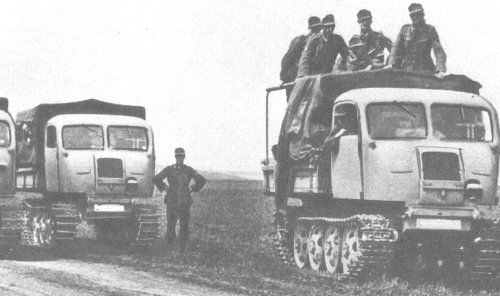
If the RSO was accepted for service in late 1942 were in production between October 1943 and May 1944 and soon indeed the orders for the RSO surpassed Steyr's production ability, and more manufacturers joined the vehicle's production in order to meet the ever increased demands.
-Steyr-Daimler-Puch produced 2,600 vehicles
-Klockner-Deutz-Magirus (KHD) manufactured 12,500
Auto-Union made a further 5,600
Graf & Stift constructed 4,500
Design
 RSO/01
The base vehicle as seen above started with the chassis of the Steyr 1500 truck. It was geared out for simplicity, sharing many parts with the truck, maximizing common commercial components while offering high ground clearance to tackle deep mud and snow.
Chassis
The chassis featured a rigid, rectangular, welded steel frame derived heavily from the Steyr 1500A 1.5-ton light truck. However it had a track & Suspension Layout. It was chosen to drop the complex overlapping Schachtellaufwerk wheels used on standard German half-tracks. Instead, the RSO would make use given its light weight a much simplier arrangement of four large pressed-steel disk wheels per side. They were paired together on quarter-elliptic leaf springs. For mud and ice mitigation, there were no return rollers. The tracks ran straight across the top of the road wheels.
This arrangement prevented mud and snow from clogging or packing together and freezing solid the tracks in Russian winter conditions, ensuring functional used of the drivetrain in any condition while being cheaper to produce. The design offered an immense 55 cm (22 inches) of ground clearance. Early models routed power to the rear drive sprockets through an automotive-type differential unit with a lock. Later production iterations (RSO/03) upgraded to a Cletrac-type final drive, which significantly improved track handling and turning control.
Cab Designs
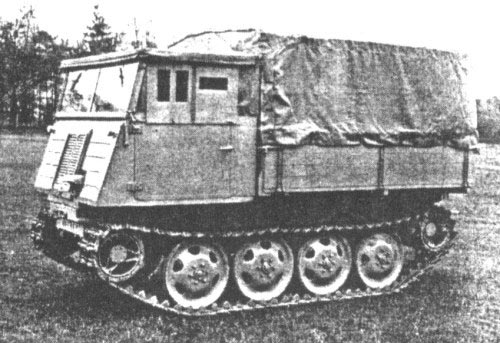
The original model had a pressed-steel cab, with a truck-like configuration. The next two versions, RSO/02 and 03 to simplify production were given the much sipler panelled metal slab-side cab with a soft-top. The windhield could be folded down, and in winter, flexible plastic and canvas windows could be fitted to completely enclose the cab. Whatever the variant in the flatbed all had wooden, drop-side cargo beds using the same parts and systems as truck flatbed of the era. The dashboard was truck-like, very simplified, and the seats for the driver and co-drivers were simple padded, vinyl-like covered or canvas material, and the simple seat chassis was sprung. The cab was small but it was not unheard of to have two men seating left of the driver.
RSO/01 (Early/Mid): Utilized a fully enclosed, deep-drawn pressed-steel rounded cab with a typical commercial truck layout. It featured an unconventional "cab-over" setup where the driver and codriver sat directly over or alongside the engine housing. But the RSO/02 and RSO/03 of late production reflected materials scarcity, so the complex pressed-steel layout was swapped for a simplified, slab-sided, soft-top metal and wood cab. These cabs were blocky and angular, allowing for quick assembly without major stamping machinery. The engine was mounted directly on the cab floor. Steering was handled purely via two upright mechanical levers linked to hydraulic brakes on the drive sprockets and rear idlers.
 RSO/02
The most common was indeed the rounded style cab, better isolated especially in winter. It had folding side windows, a top mounted rear mirror on the driver's side only, a split, fixed windshield, two small direction lights on top of the short bonnet, and a larger Notek light in tight side cutout aide the radiator. The latter was in the center, with five louvre panels with variable opening for cooling, and two road lights under caches. There was a forward hook to be towed, two towing hooks either side of the bumper, but no winch. The doors hinged forward and the unlocking handles were shared with many trucks. There has been provisions for a roofrack, never mounted in production. The cab was stout, short, almost a "semi-COE" due to the very short bonnet.
Propulsion
The original truck, was powered by a Steyr V8 3.5-liter (3,517 cc) air-cooled petrol engine rated for 85 hp. So it could reach 90 km/h on roads (45 km/h cross-country) with a road range of 400 km. The same engine was adopted for the RSO as well, the same Steyr V8 3.5 L giving 63 kW (85 PS). Speed however due to te all-track system fell rapidly down to 20 kph at best. On the later RSO/03 from Magirus the engine was replaced by a 49 kW (66 PS) Deutz air-cooled diesel engine as Steyr could not provide its V8 in large enough numbers.
nlike tractors and tanks, the driver had no track-blocking levers. Instead the vehicle was driven through the forward 3-branch drive sprocketsthrough a classic handwheel, shared with the original truck, completed by the gearbox levers (see below) and accelerator, clutch and brake pedals. The engine was mounted on the floor of the driving cab. The drive was taken through a single plate clutch, to the transmission. The latter had four forward gears and one reverse. The later model asso used a Cletrac-type final drive instead of the original automotive-type differential unit identical to trucks. This simplified driver's training and transition from truck to this type, and this ater version also had many other improvements.
The suspension consisted of four large pressed-steel disk wheels on each side, mounted in pairs with elliptic springs. Steering involved upright steering levers to four hydraulic brakes on the sprockets and idlers. There was spring-loaded pintle fitted at the rear. Top speed on trials, on road, unladen was 30 kilometres per hour (19 mph). In service, on bad roads, mud, snow and fully loaded it fell to 15-20 kph or even a crawl. The vehicle in reports was criticized as being underpowered, lacking torque. It was not the case for the Dutz engine however. The Deuts engine provided by Magirus was a 5.3-liter (F4L514), 4-cylinder, air-cooled diesel rated for only 66 hp (PS) but torquey, and fuel Economy awas 3 to 5.5 miles per gallon. It was significantly more fuel-efficient cross-country.
Top Speed was roughly 17.2 km/h (10.7 mph) to 30 km/h (19 mph) on flat roads for petrol versions but diesel RSO/03 was limited to roughly 14 km/h (8.6 mph) due to its lower gearing and lower horsepower profile. It still boasted a powerful first-gear pull of 6,700 pounds (approx. 3,039 kg). The whole tractor had an unladen weight around 3.7 to 3.9 metric tons. It could haul a 1.5-ton cargo payload in its rear wooden drop-side bed while simultaneously towing medium anti-tank guns like the 7.5 cm PaK 40 or a 10.5 cm light field howitzer. The max operational Range with its standard fuel was roughly 250 to 300 km (155 to 190 miles) depending on payload and terrain density. Some carried extra gasoline (or diesel depending on the versions) barrels in the flatbed, taking extra space and wieght from the regular payload.
Variants
RSO/01
The RSO/01 was the defining initial model manufactured primarily by Steyr starting in late 1942.Distinct Features: Recognizable by its fully enclosed, pressed-steel rounded cab with integrated metal doors and a distinct truck-like appearance.Powertrain: Driven by the 3.5-liter Steyr V8 petrol engine putting out 85 hp.Utility: Outfitted with a drop-side wooden cargo bed and cloth canopy tarpaulin, serving as the frontline baseline artillery mover. Around 4,850 units of this layout were produced
RSO/02
The Simplified Utility Variant was introduced as Germany faced compounding shortages of stamped sheet metal and factory hours, the RSO/02 transitioned the vehicle to a utilitarian aesthetic.Distinct Features: Swapped the rounded, complex metal cab for a slab-sided, angular "Ersatz" (substitute) cab made of flat metal sheets or wood planks and fitted with a soft canvas top. Powertrain: Maintained the exact same internal layout, track infrastructure, and Steyr V8 petrol powerplant as the RSO/01
RSO/03
The Diesel-Engine Variant: The RSO/03 looked identical to the blocky, canvas-roofed RSO/02 on the outside, but it incorporated the most vital mechanical shift of the entire vehicle family.Distinct Features: Primarily produced by Klockner-Humboldt-Deutz (Magirus), it dropped the petrol engine entirely. It had the 5.3-liter Deutz 4-cylinder air-cooled diesel engine. Though its absolute horsepower was slightly lower (66 hp), the diesel motor delivered significantly higher torque. It was also Much more reliable and fuel-efficient on deep-mud cross-country missions, surviving heavy loads without overheating or bogging down.
7.5 cm PaK 40 auf RSO
This was the tank Destroyer Variant: By 1943, standard infantry anti-tank units suffered severe equipment losses trying to pull towed artillery away under active enemy fire. The PaK 40 auf RSO was engineered to make the standard anti-tank gun completely self-propelled. The cargo bed was replaced with an open, flat metal platform surrounded by drop-down armored shutters. The standard cab was deleted and replaced by a low-profile, lightly armored steel box protecting only the driver and commander. It featured a standard 7.5 cm PaK 40 anti-tank gun mounted directly to the center of the bed floor on a pedestal, giving it a full 360-degree firing traverse.
Though it provided exceptional field mobility over snow and mud, front-line infantry disliked it. The crew was entirely exposed to artillery fragments, the silhouette was dangerously tall, and it was terribly slow. Production was quickly shuttered in the summer of 1944 and an estimated 60 pre-production vehicles were ever sent to the frontline with the full production never ordered. By October 1943 Steyr was ordered to stop production of any vehicle and concentrate instead on ammunition. None of the few production vehicle, already improved, reach the frontline. Steyr was working in 1944 on the much improved Pz.Jäg. K43. It had a more powerful V8 petrol engine and carried the 88 mm PaK 43 L71 gun, but saw no production either and remained at prototype stage.
7.5cm Gebirgsgeschütz 36 (7.5 cm GebG 36)
A rare dapatation of the 7.5 cm PaK 40 auf RSO to carry instead the 7.5cm Gebirgsgeschütz 36 mountain gun for artillery support. To mount it on the cargo bay the spades at the end of the split trail legs were removed, the legs were cut down to allow the back tail gate to be raised, wheels were bolted to the wooden floor in special semi-circular frame to held them in place with the recoil. So it could no longer be dismounted. That made it a Selbstfahrlafette Geschuetzwagen, self-propelled artillery gun prototype. Four were built and tested in 1943-44. This led to the design of the 7.5 cm GebH 36 auf Gebirgsraupenschlepper (RSG) as well.
Prototypes:
Beyond mass assembly, the German military used the highly adaptable chassis for various front-line field conversions and experimental trials:
Schwimm-RSO: An experimental fully amphibious version equipped with an extended, watertight hull and water propellers.
Sanitäts-RSO: A small series featuring enclosed box structures behind the cab to transport wounded soldiers out of inaccessible muddy areas.
2 cm Flak 38 auf RSO: A limited number of field-modified units featuring an anti-aircraft gun mounted to the cargo bed to guard infantry columns.
The Raupenschlepper Ost in combat
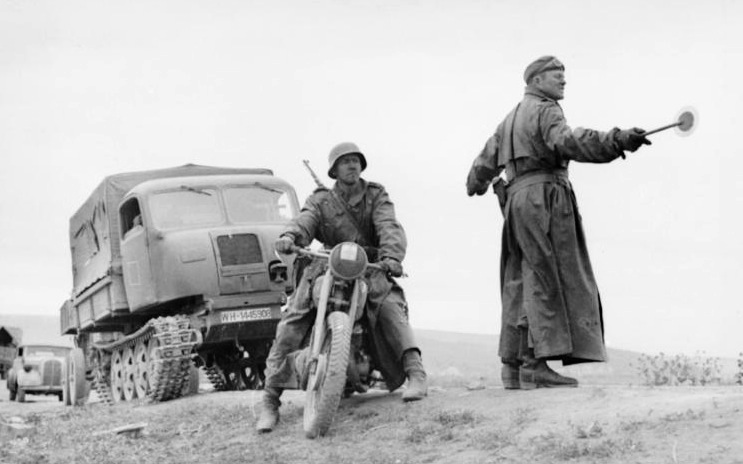 RSO in Russia, Bundesarchiv
Initially designed as a prime mover and artillery supply vehicle, the RSO eventually served in a wide variety of roles. It was used for general transport duties and gave outstanding service. It was indeed reliable, ease to maintain unlike half-tracks, could take over a variety of roles on all types of terrain and any seasons. Much appreciated by the crews were their simlified four road wheels per side system as part of a "slack-track" with no return rollers. The much simpler suspension system could also better handle the rasputitsa season or tackled deep snow in the dead of winter. Mud or snow rarely were freezing and clogging the drivetrain unlike the Schachtellaufwerk suspension from standard half-tracks.
However even if it started to be deployed eventially on the battlefield, the RSO, which only critic was being too slow as seen as an alternative to common trucks for seasonal logistc managements. In short, trucks were used in the summer, part of the spring and autumn, then the RSO and half-tracks took over for the remainder. But the development time had been too long. Impreparation over over-confidence about Operation Barbarossa led to the absence of such vehicle in the winter campaign of 1941/42. Its absence was also remarked on the net winter 1942/43 as production was just started by mid-to late 1943. Thus it only arrived in numbers in late 1944, by the time, after Operation Bagration in June, the Wehrmacht was in full retreat and the issues of base Soviet roads was less a consideration. In short, the RSO arrived way too late to make a difference.
The Raupenschlepper Ost (RSO) saw extensive service from late 1942 (pre-production tested) until the end of World War II. Its exceptional cross-country capability eventually led to its deployment across all major European theaters. Its Primary Strategic Role was and remained the Eastern Front. The RSO was rushed to the Eastern Front to solve a critical logistical crisis, as the Ultimate Mud-Crosser. Between its generous ground clearance, wide, low-ground-pressure tracks, the RSO could navigate deep, clay-like mud and heavy snow banks that immobilized nearly every other vehicle in the Wehrmacht inventory.
It startted to replace horses and light trucks as primary tactical transport for infantry divisions, bringing precious ammunition, food, and medical supplies to the absolute front lines. It was thus often used for the "last mile" from trains stopping at the rear of the frontline and truckc on the rare practical roads.
Rather than being concentrated in elite armored (Panzer) divisions, the RSO was primarily funneled to standard Infantry (Infanterie) and Artillery (Artillerie) Divisions where mobility options were most scarce. Each infantry regiment was ideally allotted a small fleet of RSOs within their heavy weapons companies to move heavy infantry mortars, machine guns, and supplies. For Artillerie Regiments & Pak-Abteilungen the RSO's primary tactical job was acting as a prime mover (light artillery tractor). It was the backbone vehicle used to tow the 7.5 cm PaK 40 anti-tank guns, 10.5 cm leFH 18 light field howitzers, and Nebelwerfer rocket launchers.
There was an expansion to Other Theaters in 1944–1945. Though it was explicitly designated for the East, the worsening strategic situation for Germany forced its deployment to other fronts: The Italian Campaign: The mountainous, rugged terrain and poor unpaved roads of the Italian peninsula made the RSO an invaluable asset for logistics, especially during winter operations along the Gothic Line.
On the Western Front: Following the Allied invasion of Normandy in June 1944, RSO units were deployed to France, Belgium, and the Ardennes to move artillery and equipment through forested and muddy terrain.4. Combat Performance & LimitationsSoldiers universally praised the RSO for its reliability and its ability to get through any terrain, but it suffered from notable operational drawbacks in high-intensity combat:
Extreme Slowness: With a top operational cross-country speed hovering between 14 to 17 km/h, it could not keep pace with fast-moving motorized units. If a line collapsed, RSOs were frequently overtaken and abandoned because they simply couldn't retreat fast enough. The Noise Factor: The Steyr V8 engine and track layout produced a distinct, incredibly loud mechanical clatter. Soviet troops could easily hear a column of RSOs approaching from kilometers away, sacrificing the element of surprise.
Underpowered Engine: The early petrol engines struggled under the strain of pulling max capacity loads up steep grades or out of deep ditches, frequently leading to mechanical strain until the higher-torque Deutz diesel variants arrived late in the war. There were oter users of the vehicles as well, Romania purchased 100 RSO/01 tractors in 1943, used for towing anti-tank guns. Finland — Purchased between 30 and 50 RSO/01 tractors in 1944 as well.
Raupenschlepper Ost specs. |
| Dimensions | 4.425 x 1.99 x 2.53m (14 ft 6 in x 6 ft 6 in x 8 ft 4 in) |
| Weight | 2.5-3 t |
| Crew | 2 (including Driver assistant) |
| Propulsion | Steyr V8 3.5l Petrol 85 PS, see notes |
| Top speed | 30 km/h (19 mph) |
| Payload | 1.5 ton |
| Transmission | 4+1 |
| Suspension | 4 quarter-elliptic leaf springs |
| Range | 300 km (190 mi) |
| Production | 23,000 |
Post-World War II Developments
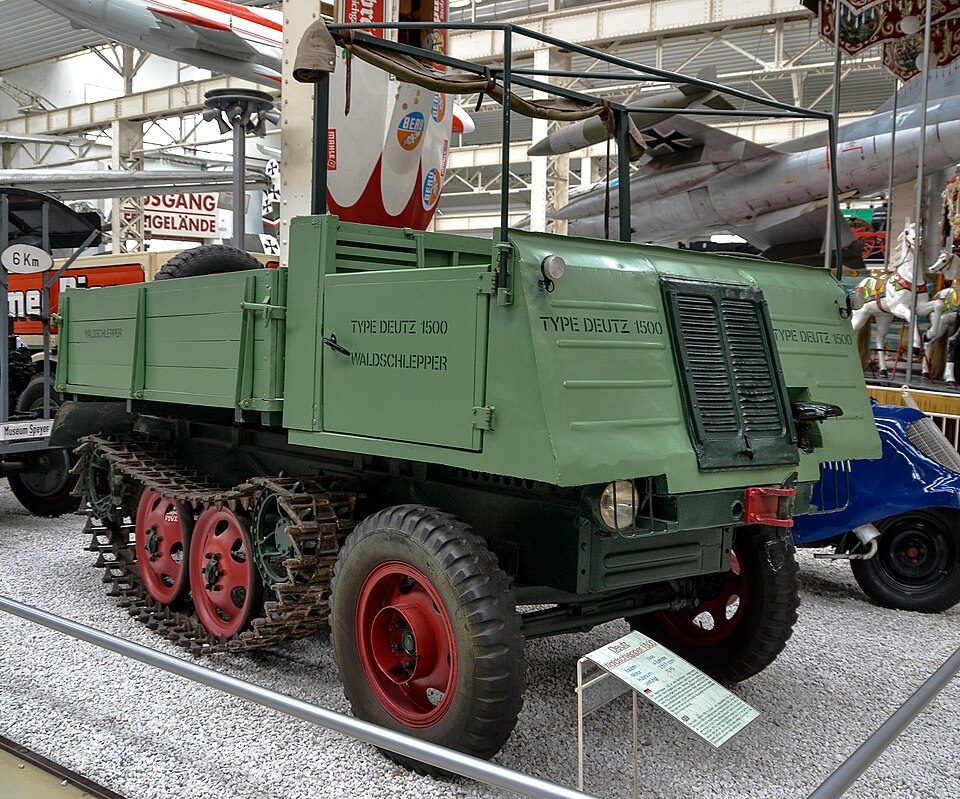
RS 1500 Forestry Tractor
After the war, efforts were made to resume production of the Raupenschlepper Ost (RSO)—originally a tracked vehicle for the Eastern Front—for German agriculture and forestry. In fact, in 1947–48, Klöckner-Deutz delivered approximately 1,000 half-track vehicles equipped with air-cooled engines and marketed as "forestry tractors" (Waldschlepper); these were derived from the RSO.
KT-12
In the Soviet Union, a forestry tractor was developed based on the Raupenschlepper Ost. Designated the KT-12, the vehicle was produced initially at the Kirov Plant starting in 1947, then at the Minsk Tractor Plant from 1951, and finally at the Onega Tractor Plant (*Onezhsky Traktorny Zavod*) in Petrozavodsk from 1956. It featured a modified body and the engine from the ZIS-5 truck, which had been converted to run on wood gas. Later versions utilized diesel engines. The model underwent continuous development and remained in production—under various designations—even after the dissolution of the Soviet Union in 1991.[
Hacker "Motormuli"
With the "Motormuli"—a well-sprung, load-carrying tracked tractor designed primarily for forestry (specifically timber extraction) and produced in Molln (Upper Austria) starting in the early 1950s—Oskar Hacker drew upon two of his earlier designs: for the first series of the Motormuli, he utilized his Austro-Daimler *Motor-Karrette* (ADMK) from the 1930s, while for the later series, he utilized his Raupenschlepper Ost. Equipped with auxiliary units or special superstructures, the Motormuli also proved its worth in other applications—such as for transporting passengers in alpine regions during winter (operated by the Austrian Post’s bus service) or as a "Wallack system" snowblower (a role it continues to fulfill to this day). The Motormuli company was later acquired by Österreichische Saurer AG, which was subsequently taken over by Steyr-Daimler-Puch AG; consequently, Saurer-Motormulis and Steyr-Motormulis also exist.