9A83 TELAR (1983)
 Soviet Union
Tranport Erector Launcher (1983), c1,000 built
The 9A83 is part of the S-300V combat system, as its primary tracked TELAR (erector launcher). It was the launch vehicle with illumination radar for 9M83 missiles, 4 per battery, in service by 1983 and now mostly retired. The whole program started in 1969, and state trials started in 1980-83. Both the 9A82 and 9A83 and other vehicles part of the combat system were in service at the same time. The S-300V1 as introduced comprised also the 9S457-1 Command post vehicle, 9S15 Obzor-3 early warning radar, 9S32-1 engagement radar. Next came the S-300V in 1988 still counting the the 9A83.

Development of the 9A83
The whole S-300V project went back to 1969 when a new, mobile surface-to-air missile system intended to shoot down high altitude assets like the XB-70 Valkyrie (later abandoned) or later the B1b Rockwell planned to succeed the B-58 Hustler. The entire weapon system S-300V coomprised a mix of tracked TELAR, radar vehicles or reload ones, and specialized trucks. The whole S-300 program started in 1967 but work on the S-300V complex, first system in the family, started later. Indeed, the S-300F was the first validated, with a production starting in 1975, and tests for the S-300P being completed in 1978.
Then tests for the S-300V variant were conducted in 1983, with all vehicles in the complex, including the 2A83 TELAR, centerpiece of the complex, starting its official state evaluation and field testing in 1983. NATO reporting name was "SA-12 Gladiator". Unlike wheeled TEL trucks, this mobile surface-to-air missile system was tracked to ensure deployment or larger payloads on all terrain. Despite its tracks however, the 2A83 was only partially lightly armoured (cab in thicker steel).
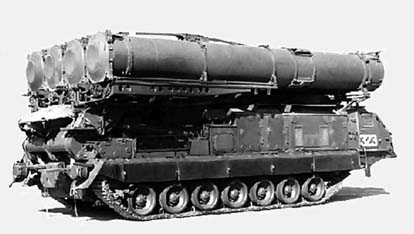
The S-300V, starting with the 9M83 missile entered service in 1983 but was only fully integrated in 1988. The 9M82 and 9M83 missiles were designed by NPO Novator with the "V" suffix standing for Voyska (ground forces). This top-tier army air defence system was launched to replace the 2K11 Krug and provide a defence against ballistic missiles, as well as cruise missiles, and aircraft. The 9M83 (SA-12A Gladiator) missile have a maximum engagement range of around 75 km (47 mi), with a warhead around 150 kg (330 lb), and its carrier was a tracked MT-T transporter for better cross-country mobility than the S-300Ps on 8×8 wheeled transporters. The use of tracks, reducing the ground pressure, enabled to carry additional systems for tracking within the S-300V complex, more distributed than the S-300P. The 2A83 and 2A82 are pretty similar overall and share a lot of components, except the second launched the larger 2M82 "giant" missile (only a pair carried).
Design of the 9A83

Unlike traditional Transporter Erector Launchers (TELs) that rely entirely on centralized battery radars to lock onto targets, a TELAR carries its own built-in radar system:
-The Radar Mast: The 9A83 features a unique, high-elevating X-band target illumination and guidance radar mast. Stowed between the missile containers during transit, it raises significantly when deployed to improve low-altitude target tracking and overcome terrain obstacles.
-Armament: The 2A83 carries four 9M83 "Gladiator" missiles inside cylindrical launch tubes. These missiles are dual-role, optimized for intercepting aircraft, cruise missiles, and lower-tier tactical ballistic missiles (see below).
-The Chassis: The vehicle is built on the heavy-duty Item 830 (specifically GM-831) tracked chassis developed by Kirov Zavod. This heavy cross-country platform was chosen to ensure the air defense battery could keep pace with fast-moving Soviet armored and mechanized formations.
The chassis

During development, the Soviet military required an air defense platform capable of keeping pace with forward-deployed T-72 and T-80 Main Battle Tanks (MBTs) over severe cross-country terrain. To achieve this, Kirov Zavod designed the Item 830 series by heavily adapting elements from pre-existing heavy tracked machinery, sharing core design philosophy and running-gear components with the 2S7 Pion 203mm self-propelled gun and the MT-T heavy tracked cargo carrier.
The chassis accommodates a gross combat weight of 44 to 47.5 metric tonnes depending on whether the missile tubes are loaded and the X-band radar mast is erected. It is driven by a V-84 series multi-fuel V12 diesel engine (a direct derivative of the tank engines powering the T-72/T-90 family), pushing out 840 horsepower to maintain a power-to-weight ratio competitive with tracked combat forces. It could acheve a top road speed of roughly 60 to 65 km/h and an off-road cruising range of approximately 500 kilometers, albeit speed was controlled not to damage the missiles in their canisters. It used a classic, heavy-duty torsion bar suspension system with seven dual rubber-lined road wheels per side. This enables the vehicle to absorb the intense violent recoil shocks generated by the vertical "cold launch" ejection of 2.5-ton 9M83 missiles as well.
The GM-831 chassis also houses a robust auxiliary power unit (APU) gas turbine dedicated to generating onboard electrical power. This allows the crew to operate the vehicle's hydraulic leveling jacks, raise the radar mast, spin up the electronics, and fire missiles without idling the main 840-hp diesel engine, giving it structural autonomy on the battlefield. As part of the 830 Series it shares components with 2S7 Pion & MT-T. Range is about 500 km (310 miles). As seen above, this is a rear line vehicle, with light steel armor protecting the crew from small arms fire and shell splinters (only the cab), thickness was likely around 6mm.
In terms of passive defenses it could shut down its radar and perform an emergency repositioning. It was unarmed, except for personal's crew weaponry. The crew was 3 to 4-man with a Driver/Mechanic tasked of positioning the massive tracked GM-831 platform, managing the main engine, auxiliary turbine, deploys the hydraulic leveling jacks to stabilize the vehicle before the vertical launch cycle. There were also 2-3 System Operators and Officers housed inside the protected cabin, managing the target illumination and guidance and maintain secure data links with the battery command post, executing the final missile arming and launch sequences.
Deployment

While normally operating under the control of a 9S457 command post and receiving targeting data from the massive 9S32 "Grill Pan" engagement radar, the 9A83 TELAR's onboard radar allows it to operate autonomously. If severed from the main battery, a 9A83 can track, lock onto, and destroy enemy targets independently. A typical S-300V battalion consisted of a target-detection-and-designation unit, guidance radar, and up to 6 TELARs of the 2A83 or 2A83 type. Reloading was performed by a Launcher/loader vehicles (LLV) which were also themselves capable of firing their missiles under control of a TELAR in emergency. In that case, it was the 9A84 LLV holding two 9M83 Gladiator missiles.
Missile: The 9M83 Gladiator
The 9M83 (NATO SA-12A Gladiator or SA-23A Gladiator if modernized) is a highly maneuverable, late Cold War-era surface-to-air missile developed by OKB-8 Novator. Introduced into service in 1983, it serves as the dual-role, primary air defense arm of the mobile S-300V system.
Unlike the larger, anti-ballistic missile (ABM) optimized 9M82 "Giant" that operates alongside it, the 9M83 is designed to intercept a wide spectrum of highly agile targets—including aircraft, helicopters, cruise missiles, and low-observable UAVs—even in environments heavily contested by electronic countermeasures (ECM).
Technical Specifications
-Dual-role anti-aircraft, anti-cruise missile, and terminal-phase anti-tactical ballistic missile (ATBM).
-
Maximum Engagement Range: 75 to 90 km (47 to 56 miles).
-
Engagement Altitude: 25 meters (82 feet) up to 25,000–30,000 meters (approx. 98,000 feet).
-
Dimensions: Length of 7.5 meters (24.6 ft) and a diameter of 0.5 meters (1.64 ft).
-
Mass: Gross weight of approximately 2,500 kg (5,511 lbs).
-
Warhead: 150 kg (330 lb) High-Explosive (HE) fragmentation warhead.
-
Propulsion & Speed: Two-stage solid-fuel rocket motor capable of driving the interceptor to a maximum speed of 6,120 kph (3,800 mph / Mach 5).
Launch Sequence
The 9M83 features a specialized operational cycle tailored for fast reaction times and rapid maneuvering immediately after leaving the vehicle:
1. Cold Launch: The missile is vertically ejected from its sealed cylindrical transport-launch container via high-pressure gas generation.
2. Mid-Air Orientation: While suspended momentarily in mid-air, the missile utilizes thrust vectoring—specifically four steering vanes within the first-stage nozzle—to rapidly pivot and point directly toward the target's trajectory.
3. Main Stage Ignition: Once oriented, the powerful first-stage solid rocket booster ignites, accelerating the missile instantly toward its intercept point.
4. Sustained Flight: After the booster burns out, it separates, and the second stage takes over. Aerodynamic control shifts to eight folding tailfins that pop out to maintain extreme maneuverability during the final terminal homing phase.
5. Guidance: The missile relies on inertial guidance during its mid-course phase, switching to semi-active radar homing (SARH) as it closes in on the target.
Operators
 USSR: Bulk of the production, no exports.
 Russia: Inherited most systems, upgraded some to 9K81M standard, others exported.
 Unknown numbers of complexes (multiple of 4), decom. in 2018.
 Also a few systems, missiles likely all spent as of 2024.
In other sources, they were also exported to China, Egypt, India, Kazakhstan, Syria, Tajikistan, and Venezuela but with a dotation unknown. Might be instead of the 300P and derivative types.
| 2A83 Vehicle |
| Dimensions underway: | 8.71 m (28.6 ft) x 3.42 m (11.2 ft) x 2.72 m (8.9 ft) |
| Dimensions erected: | Canisters: 7.5-8 m. Radar: 10m. |
| Weight: | 44-47.5 metric tons |
| Crew: | 3-4 |
| Propulsion: | V-84 series V12 mf supercharged diesel: 840 horsepower (626 kW) |
| Speed: | 40-50 kph |
| Range: | c500 km (310 miles) |
| Payload: | 4x 2M83 "Gladiator" Missiles |
| Production: | Est. 2,000 total launcher vehicles (9A83 and 9A82) |