Schwerer Wehrmachtschlepper

German army vehicles Germany (1934-45) - Utility Half Track - 825 built
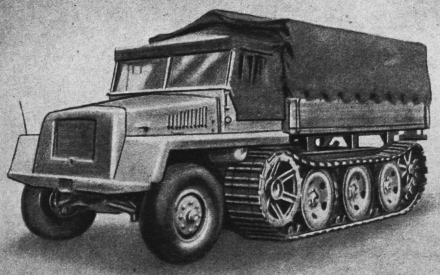
The Schwerer Wehrmachtschlepper (acronym sWS) for "Heavy Military Tractor" was a German WWII half-track manufactured between 1943 and 1945, but designed under orders from Hitler for mass production in May 1942. The present post is about the unprotected model were used to supply the eastern frontline and to haul artillery. However the shortage or armour meant many started to be later converted Armored versions for FLAK or as rocket launching vehicles (Nebelwerfer). Mass production remained a pipe dream and only less than a thousand were built before V-Day. Czechoslovakia designed an improved model, the Tatra T809, which became its early cold war standard APC.

Design development


Genesis 1926-30

In the summer of 1926, Heinrich Ernst Kniepkamp, from the Reich Ministry of Defence, was tasked with the fully motorization of the German artillery and he started testing agricultural tractors from Germany, Britain or the US over three years. In a 1932 trial, an half-track design proved superior and was adopted a baseline for future vehicles. So from 1933 several German companies designed half-tracked vehicles for this task at all towing capacities up to 18 tons. Leading to a range of powerful half-tracked prime movers, the "Sonderkraftfahrzeuge" (Special Purpose Vehicles) 10, 11, 6, 7, 8, and 9.

By late 1939, half-tracked vehicles performed well in Poland, offering better off-road mobility than trucks and higher speeds than fully tracked prime movers, a sweet spot added to the fact training was easy as a truck driver could make the transition easily. They provided versatility in a dynamic combat as part of the so called "Blitzkrieg". However, manufacture proved overly complex and expensive, added to the proliferation of different types. This was by 1938 already considered not efficient for production. The Army Ordnance Office (Grundgedanke) started working on a second generation of half-tracked prime movers and later with heavy attrition, and losses in 1914 with the growing aerial threat to supply units in rear areas on the Eastern Front led to an even more radical approach and development of a third generation, far more simplified and supposed to replace several vehicles at once.

Replacing several Items in park at Once

In 1941 the Half-Track park of the Wehmacht was impressive indeed. In addition to the armoured SdKfz 252 and 251 and all their derivative, there was a range of seven vehicles up to the Sd.Kfz.11 of all sizes, classes, as hauler, suppliers and usable for other roles. They were for the most designed well back from 1933 down to the the start of 1939, when production b several manufacturers took place. When the Eastern offensive started in the summer 1941, successes were so fast, that regular trucks could be used on roads up to Moskow.

However the offensive was bogged down in the Atumnal Resputista and stopped in the dead of winter and very cold temperatures that crippled the logistic train. It was clearly obvious that tracked vehicles were needed fast, especially since the bulk of roads encountered, aparts some exceptions, were no more than dirt tracks. Production of existing half-tracks was ramped up, but the models were complex and costly to produce and shortages started. One solution was to turn the standard Opel Blitz 3t supply truck into a half-track (Maultier) but this was never enough. One thing was clear, a new model that could replace several classes at once and being easier, cheaper to mass produce was urgently needed as the expected spring rasputitsa started to again block any further advance.

Program Start

On 7 May 1942 Hitler ordered development of a simple and low-speed "universal" half-track, with an average load for the Eastern Front. Büssing-NAG, relatively free at the time, at least on the standpoint of design, was selected to develop a new 5 tonnes (4.9 long tons; 5.5 short tons) tractor which took the name of "Zgkw. 5t neuer Art". The main role was to replace the existing, earlier 5 tonnes Sd.Kfz. 6 and 3 t Sd.Kfz. 11 half-tracks by a single model as other vehicles of the same class.

However this dragged on due to more urgent priorities and it was not before late 1942 that definitive specifications came out and final requirements drawn up, based on campaign experience. Büssing-NAG, was selecte to produce five prototypes. Four were for the cargo requirements and there was a slightly longer 5th prototype partially armoured that would become more prevalent after 1944. They were approved by the Heereswaffenamt.

The development program started in 1942 with two basic types, the leichter Wehrmachtsschlepper (leWS) from Adler-Werke and schwerer Wehrmachtsschlepper (sWS) from Büssing-NAG and the new vehicles has been indeed the result largely of supply problems experienced during the winter of 1941/42. The heavy one was thus to be able to tow a 6-ton load and carry a 3-ton payload. The Army Ordnance Office made a decision in July 1942 to phase out production of the 5-ton half-track prime mover for the new Sws.

Thus, the Army Ordnance Office awarded Büssing-NAG a contract for five prototype s.W.S. assigned the chassis numbers 2016, 2017, 2018, 2020, and 2021. The light standard 3rd gen. half track however never progressed beyond prototype stage. Only the schwerer Wehrmachtsschlepper remained, eventually entering production at Büssing-NAG and Ringhoffer-Tatra from the autumn of 1943 (see below).

Production and Variants


Chassis, preserved.

Production started in December 1943 at Büssing-NAG and the earliest vehicle were outfitted with a truck-like, unarmored cabin like earlier half-tracks but with simplified shapes for mass production and sme equipments simplified or omitted. They were already much cheaper to manufacture compared to earlier models. However the rapid evolution of the front in 1944-45 imposed for the latter an armored cabin and engine compartment closer in shape to the Sd.Kfz. 251 armored personnel carrier but simplified and only for the cab. The flatbed was left unchange aparts folding panels with mesh.

Serial production started at Berlin-Oberschöneweide based on contracts 0213-1001/42, 625 vehicles were planned with cargo bodies and 375 with anti-aircraft mounts of either the Flakvierling and 3.7 cm FLAK type and 0213-1003/43 for a grand total of 1,725 units with cargo bed bodies and 575 units with anti-aircraft mounts, serial numbers in this series began with 150001. Another joint contract was awarded later for SS213-1001/43, to Ringhoffer-Tatra in Prague and Wagenfabrik AG in Kolin for an additional 500 cargo-bed vehicle startng with the serial number 250001.


Production planning called for an initial output of 50 vehicles in October 1943, and gradually go for a monthly output of 400 vehicles, by March 1945. Of course this was never achieved, despite Speer's best effort. There were massive delays due to allied bombings and some industrial bottlenecks. In fact the first five delivered, four prime movers, one self-propelled FLAK not delivered until December 1943... Peak production arrived in October 1944 (112 vehicles) and it later declined with a finl batch of 25 reportedly manufactured in March 1945. At that stage when production ceassed due to the allied advance, in 1944 only 724 vehicles were delivered, 649 flatbed and 75 self-propelled FLAK vehicles and then in 1945 some 103 vehicles with about 73 of the flatbed cargo type and less than 5 self-propelled Flak vehicles in including the 97 vehicles from the Kolin plant.

This makes for a grand total of 830 units manufactured before the end of the war, way short of expectation, and thus, never able to replace the tow Half-track types as planned. However the never built and cancelled "light Wehrmacht tractor" was to contribute to parts standardization, sharing components with the sWS and with their cancellation thay could not take part in lowering their logistical burden.

Production in Germany was limited before 1943 at Büssing-Nag facility was historically located at Braunschweig. It had multiple factory sites across the city, such as on Böcklerstraße and Wörthstrasse and took over facilities of Neue Automobil Gesellschaft (NAG) in the early 1930s, manufacturig heavy trucks, buses, and armored vehicles but also used forced labor close to a satellite worker concentration camp system (Schillstraße camp). In 1945, Tatra joined in production, but together they were only capable of delivering 825 vehicles total on V-Day, a far cry to the 3,000+ envisioned. Tatra continued production of the improved T809 poswar (see below).

Design
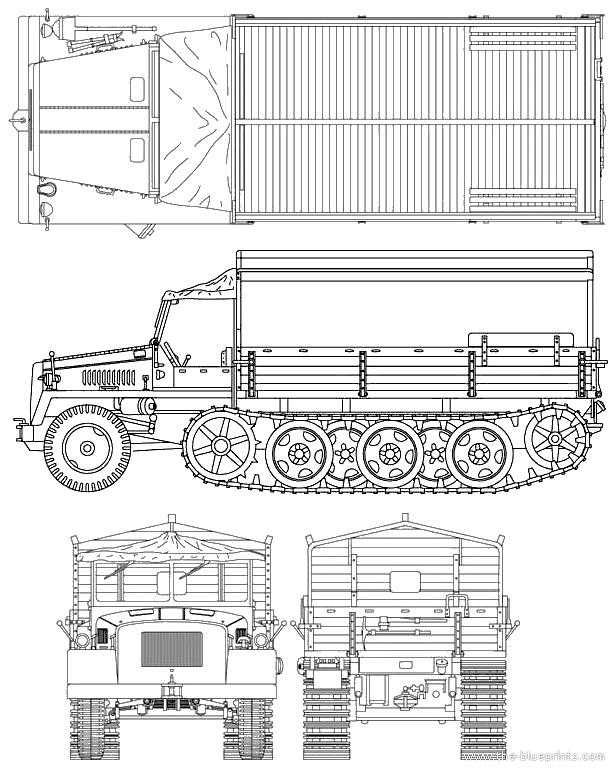

Plans, from the blueprints

The basic engineering called for the same torsion bar suspension, and overlapping and interleaved double road wheels. So far, despite the maintenance nightmare, reports were still ignored and this system was imposed again for production. All the remainder aspects were worked out for the most simplified design and production was approved in Fabruary 1943.

Like the Demag-designed Sd.Kfz. 10, the Büssing-Nag sWS had a Schachtellaufwerk suspension system: It was made of five double roadwheels per side, overlapping and interleaved in the, mounted on swing arms sprung by torsion bars. Lke a Tnank they had idler wheels mounted at the rear end of each track unit to control track tension and drive sprocket forward. The chassis was a ladder-type, wit the driving axle forward, two roadwheels. However as far as sharing assets, these vehicle had their own roadwheels, idlers and sprocket designs. The roadwheels, rubber-rimmed had their design changed also latter in the war from the spider type with 6 branches, to a simpler, flat, stamped, holed type.

Externally, the layout was the same as the vehicles they replaced, with an open cab forward (frames, forward tarpaulin), and instead of doors stowage bins over a flat, simple mudguard running over the forward driving axle. They carrier two standard lights. Notek (night) lights were omitted. The bonnet was a classic central spine hinge, with top louvres and two side panels with more louvres. The radiator and its forward case was flat, simple, without addition and at the bottom was a simple 3-sided stamped metal bumper. The was a towing hook below.

The entire aft part comprised the tracked chassis on which was located a flatbed with wooden sides (not hinging) and a back plate with simplified reflecting lights and convoy light, hinged. This utility flatbed was designed to receive frames for a tarpaulin, again simplified, with only two rear platic windows. This tarpauling rested on front and rear frames with longitudinal frames in between. The frame and tarpaulin, well folded, could be carried by the vehicle as well.

When used in troop/cargo configuration the flatbed was split, with the forward part, closed by a wooden face, having brackets for a spare tyre on the right, a supply area, then a separation with racks for stowed K98 rifles, and a transverse double bunk (fwd/rear) for 8 men like standard half tracks. If the forward aread was also modified that way, the vehicle could carry as much as 16 infantry. There was also a towing hook on the back plate.

Now,the power plant was a Maybach 4.2 litre HL42 TRKMS that developed 100 horsepower. The cargo variant was rated "only" for 5 tonnes but it showed improved weight carrying capacity over previous generation. So much so both the soft skinned and armoured variant could carry the 37mm flak 43/1 or 20mm quad Flak-vierling 38. Other tested anti-tank guns. And others, armoured carried rocket launchers (Panzerwerfer 42 auf sWS.). The vehicle was also planned for towing a 5t 2-axle trailer.

The vehicle was designed to be simple and straightforward with the running gear made of unlubricated tracks without rubber pads. It had cost-effective road wheel discs (from the stamped wheels) on. inside and outside the interleaved or overlapping wheel arrangement. Later in the war, the lack of self-propelled ordnance led to devise a self-propelled anti-aircraft 3.7 cm FlaK 43 positioned on the cargo bed with a gun shield which had side panels folding down to allow a 360-degree traverse.

With a base Payload of 4t and a towing capacity of 8t, it had an operational range of 300 km on road, 150 km cross-country, with a 240-liter fuel capacity. The vehicle's fording depth was one meter or 3.2 feet. The vehicle was normally unarmed, albeit its had racks in the cargo variant for sixteen K98 standard rifles. Of course later were developed two FLAK variants a 20mm Flakvierling and a 37mm version. The base vehicle was also unarmored albeit there were some partially armored variants developed on the eastern front going from 6 to 15 mm plating (0.3 to 0.6 inches). Later the vehicle received a fully armoured cab forward.

Armament

The base vehicle was unarmed, apart personal weapons. It was also unprotected. The FLAK versions (self propelled AA) were built alongside with a ratio of 1/5, and fitted either with a 3.7 cm or Flakvierling (4x 2cm). However later in the war were developed armoured versions ("gepanzerte"): There were Schwerer Wehrmachtschlepper with cargo bed configured as a self-propelled mounts for the 3.7 cm Flak 43/1 or 3.7 cm Flak 37 from the factory, but many individual vehicles were also converted in local workshops, fitted with anti-aircraft guns sometimes in ad-hoc or systematic basis in order to protect vehicle columns against allied low-level fighters or Soviet ground-attack aircraft like the Surmovik with a lot of photographic evidence to back this up.

The 3.7 cm was the most efficient for that weight class, it fired a Shell 37 × 263 mm B 623–659 g (1.373–1.453 lb) 1.5 in caliber from a gas-operated bolt with a mount elevating +85°, 360° traverse, 160 rpm (cyclic) rate of fire, 770–840 m/s (2,500–2,800 ft/s) muzzle velocity depending on the ammunition at 4,200 m (4,600 yd) range in AA fire and 7,995 m (8,743 yd) in ground range. It was reloaded by using 6-round clips.

The second variant carried the 2 cm Flakvierling 38, most common ad hoc field conversion for individual vehicles weighting 450 kg (992 lbs) for the towed mount and 4.08 meters (13 ft) long, with a Cyclic Rate of Fire: Up to 1,400 to 1,800 rounds per minute combined across all four barrels. Practical Rate of Fire: Around 800 rounds per minute because each gun used a 20-round box magazine that required frequent reloading. Muzzle Velocity: Between 780 and 900 meters per second depending on the type of ammunition used. Maximum Range: 2,200 meters. A seated gunner aimed the weapon and used two foot pedals to fire diagonal pairs of barrels (top-left/bottom-right and top-right/bottom-left) in semi-automatic or fully automatic modes. It was also on self-propelled half-tracks like the Sd.Kfz. 7/1.

Variants

  • Early (alte) Schwerer Wehrmachtschlepper cargo/flatbed type (1943): "Spider" roadwheels.
  • Late (1944/neu) SwS cargo/flatbed type (1944-45): "disc" simplified roadwheels
  • AA Vehicle (Flak-Sfl): 3.7 cm FLAK
  • AA Vehicle (Flak-Sfl): 2cm Flakvierling
  • Schwerer Wehrmachtschlepper mit Behelfspanzerung: Several sub-types. To be covered in tank afv.com*
*In some sources some 770 schweren Wehrmachtsschlepper mit Pritschenaufbau were built until March 1945.

The Schwerer Wehrmachtschlepper in combat


A typical cargo load, model kit

Due to compromises regarding mobility, deployment with armored units or other fast-moving troops was out of the question; its low speed limited its use to infantry support. This limitation also contributed to losses during retreats on the Eastern Front, leading troops to use the available vehicles primarily for transporting supplies rather than as prime movers. Operational capability and troop confidence were similarly hampered in the case of the self-propelled anti-aircraft variants. Photographic evidence documents various guns towed by the sWS, revealing some of the vehicle allocations. Other allocations can be identified from unit inventory reports. Examples include (without claiming to be exhaustive):

-5t standard trailer:
Heavy Tank Destroyer Battalion 657 – 8.8 cm Pak 43 – (Report dated 8 February 1945 – 14 vehicles)
Heavy Tank Destroyer Battalion 668 – 8.8 cm Pak 43 – (Report dated 8 February 1945 – 22 vehicles)
Vehicle usually towing the 8.8 cm Pak 43/41 and 21 cm Mörser 18.

With only about 81 vehicles delivered with the improvised armored superstructure, just a small fraction was originally intended to serve as self-propelled anti-aircraft vehicles. However, photographic evidence confirms that light anti-aircraft guns were also mounted on a number of unarmored chassis, while vehicles with improvised armor were simultaneously employed as artillery tractors.


Two vehicles were documented in reports by US Army Technical Intelligence teams after falling into the hands of the 3rd US Army following the Allied advance. Chassis 150636 – Unarmored version (Report No. 175) – the vehicle bore American markings – photos of another destroyed vehicle are included in the report Chassis 150560 – Armored version (Report No. 217).

Specifications
Dimensions6.92 x 2.5 x 2.07 (22 ft 8 in x 8 ft 2 in x 6 ft 9 in)
Total weight13.3 to 13.5 tons
Crew2 +up to 12 troop
Propulsion4.198 L (256.2 cu in) gas. inline 6 cyl. WC Maybach HL42 TRKMS: 100 hp (75 kW)
Top speedc30-50 kph
Payload4,000 kg (8,800 lb)
TransmissionZF kb 40D
SuspensionTransverse leaf-spring and torsion bar
Fuel & range240 L (53 imp gal; 63 US gal), 300 km (190 mi)
ArmamentSee variants.
ArmorLate versions, see notes
Production825

Gallery


Sws of the ealry 1943 model with the first "spider" roadwheels


Schwerer Wehrmachtschlepper "neu", 1944 production


Same, camouflaged 1945


Flak-Sfl 3.7 cm FLAK, factory-delivered, 1945


Flak-Sfl 2 cm Flakvierling, field conversion, 1945


(To come): Gepanzerte.


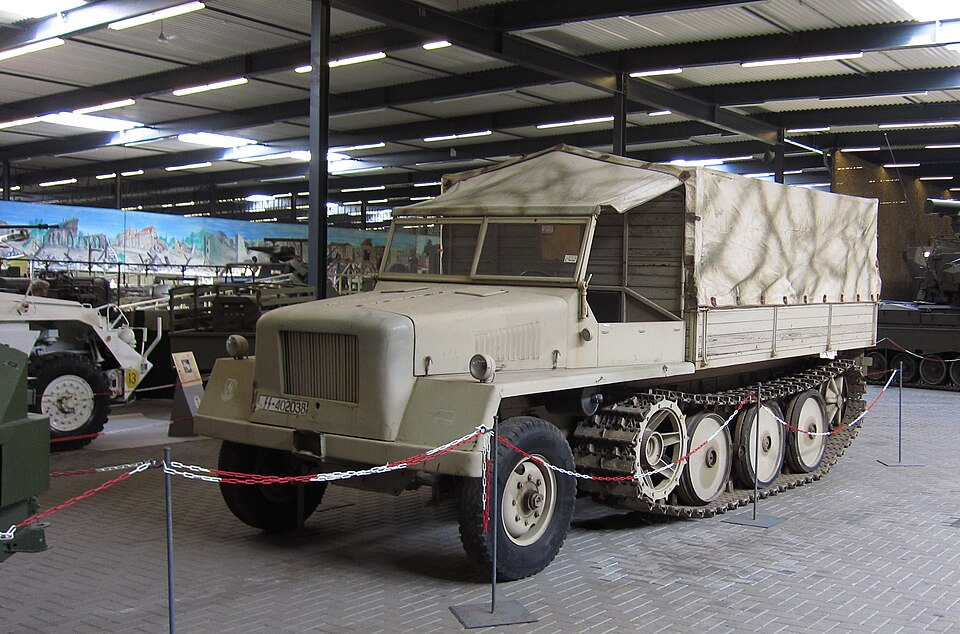
In the Munster Museum


Captured, photo by allied troops, IWM.

Sources about the Bussing sWS

Dr. Nicolaus Hettler: Nuts & Bolts 41 - Büssing's schwerer Wehrmachtschlepper (sWS). Auflage. Nuts & Bolts Eigenverlag, Neumünster 2018. (en/de)
Thomas L. Jentz & Hilary Louis Doyle: Panzer Tracts No. 22-3 - m.Zugkraftwagen 5 t (Sd.Kfz. 6) and Schwerer Wehrmachtsschlepper. 1. Auflage. Panzer Tracts Eigenverlag, Boyds, MD 2010
Jeffrey D. McKaughan: Tech Intell WW2 U.S. Army Technical Intelligence Reports and Summaries Volume 1. 2. Auflage. Darlington Productions Inc., Darlington 1997
Jeffrey D. McKaughan: Tech Intell WW2 U.S. Army Technical Intelligence Reports and Summaries Volume 2. 1. Auflage. Darlington Productions Inc., Darlington 1995
Walter J. Spielberger: Die Halbkettenfahrzeuge des deutschen Heeres 1909-1945. In: Militärfahrzeuge. 3. Auflage. Band 6. Motorbuch Verlag, Stuttgart 1989

kfzderwehrmacht.de
pietvanhees.nl armoured versions
en.wikipedia.org
kingstroopmodels.com
de.wikipedia.org
fahrzeuge-der-wehrmacht.de
wwiivehicles.com
Schwerer Wehrmachtschlepper at Militracks 2018

WW1 Vehicles

British ww2 WWI trucks
British ww2 British WWI Vehicles
LGOC B-type troop Bus
Mack AC
Pierce-Arrow AA truck
BSA 14/18 hp-20/25 hp
BSA 13.9 h.p
Lanchester staff Car
Thornycroft J
Maudslay Lorry
AEC Y Type
Foster-Daimler Tractor
Motorc. Triumph H
Ford Model T Patrol Car
FWD Model B 3-ton Lorry
Leyland 3-ton truck
Vulcan truck
Vauxhall D-type staff car
Crossley 20/25 staff car
French ww2 French WWI Vehicles
Berliet CBA
Berliet Type M
Châtillon-Panhard Tractor
Panhard K11
Latil TAR Tractor
Panhard-Genty 24 HP
Renault EG
Renault AG1 Landaulet
Renault Truck 60CV
Renault FB Artillery Portee
Schneider CD Artillery Tractor
Soviet ww2 Russian WWI Vehicles
(list in research)
US ww2 US WWI Vehicles
Holt tractor
Liberty Trucks, assembled by:
  • Bethlehem
  • Brockway
  • Diamond T
  • Gardford
  • Gramm-Berstein
  • Indiana
  • Kelly-Springfield
  • Packard
  • Pierce-Arrow
  • Republic
  • Selden
  • SMTC
  • Sterling
  • USMTC
  • Velie
  • Dart
  • Lafrance
Cadillac trucks/staff cars
Ricker truck
Ford Model T Mil.
Spruce log truck
Dodge M1918 Light Repair truck
Dart BB, E, L, Liberty CC4, J Tractor
5-ton Artillery Tractor
Ford Model T Ambulance
Mack AC "Bulldog" Truck
Holt 15-ton Tractor
Jeffery Quad Lorry
FWD Model B‎
FWD SU-COE‎‎
Italy ww1 Italian WWI Vehicles
Lancia IZ
Fiat 15ter Ambulance
Fiat 15ter Lorry
Fiat 18BL Lorry
Hersent-Thiriont Flamethrower
(list in research)
Soviet ww2 Japanese WWI Vehicles
(list in research)
Belgian Dutch ww2 Belgian, Dutch and other WWI vehicles
Berna C2 Truck (Swiss)
(list in research)
German Empire ww1 German WWI Vehicles
A7V Überlandwagen
Beobachtungsanhänger
Büssing KZW1800 Artillery Tractor
Daimler Marienfelde Truck
Field Artillery Limbers
Große FeldKüche Hf.13
Mercedes 37/95 Staff Car
(list in research)
Soviet ww2 Austro-Hungarian Vehicles
Austro-Daimler Lorry
Austro-Daimler Artilleriezugwagen
B-Zug Artillery Tractor
Feldküche M.1915

Turkish vehicles Turkish WWI Vehicles
(list in research)

allied ww2 Allied ww2 Vehicles

British ww2 British Vehicles
-AEC Armoured Command Vehicle (415)
-AEC Matador
-Albion CX22S
-Albion FT15N
-Albion WD.CX24
-Austin K2/Y Ambulance
-Austin K3
-Austin K4
-Austin K4 Dropside
-Austin K5
-Austin K6 GS
-Austin K6 Gantry
-Bedford MW
-Bedford OXA Armoured
-Bedford OXC Semi-trailer
-Bedford OXD GS
-Bedford OYC Tanker
-Bedford OYD GS
-Bedford QL series (QLD, QLR/QLC QLT TC)
-CMP FAT
-Commer Q2
-Crossley Q-Type
-Diamond T tank transporter
-Guy Quad-Ant FAT
-Guy Lizard ACV
-Humber FWD
-Karrier KT4
-Karrier K6
-Leyland Hippo Mk I/II
-Leyland Lynx
-Leyland Retriever
-Mack EXBX
-Morris 15cwt
-Morris CDSW
-Morris ML Ambulance
-Morris C8 GS/FAT
-Morris Commercial CD series
-Morris Commercial CS8
-Morris C9
-Morris GS Terrapin
-Morris PU
-Scammell Pioneer
-Scammell Pioneer TRCU
-Scammell Pioneer SV1S/T
-Thornycroft Hathi (1924)
-Thornycroft Nubian
-Thornycroft Tartar
US ww2 Canadian Trucks
-Ford F8 CMP
-CMP C15/F15 (1940)
-CMP CGT/FGT FAT (1942)
-CMP C30/F30 LRGD (1942)
-CMP C30/F30 (1940)
-CMP C60/F60 LWB (1941)
-CMP C60/F60 SWB (1942)
-C-60X 6x6 CMP
-F-60H 6x4 CMP
-Ford F-GT CMP
-Chevy C-GT CMP
-C8A 1C1 HUP
-Chevrolet 3 ton truck
-Chevrolet WB 30cwt LRDG
-Chevrolet C8/C8A 4x2 CMP
French ww2 French Vehicles
-Berliet DGRA
-Berliet GDC
-Berliet GDM
-Berliet VDCA
-Berliet 30
-Bernard fuel carrier
-Citroën Kégresse P14 .
-Citroën Kégresse P17
-Citroën Kégresse P19
-Citroën 23U
-Citroën 32U
-Citroën T45
-Citroën Traction Avant
-ELMAG
-Fiat France 38R
-Ford France
-Hotchkiss PKW Type 680
-Hotchkiss 686
-Hotchkiss 686 PNA
-Isobloc W843M medical bus
-Laffly S15R
-Laffly S15T
-Laffly S15R
-Laffly S35T
--Laffly V15T
-Laffly W15T/R
-Laffly 20TL
-Laffly 25
-Laffly 45
-Latil TAR H2
-Latil M2Tl6
-Matford F917
-Panhard K113 Truck
-Panhard K125 Truck/Bus
-Peugeot 202
-Peugeot 402
-Peugeot DMA
-Peugeot DK
-Peugeot DK5
-Renault AHS
-Renault AHN
-Renault AHR
-Renault AGC
-Renault ADK
-Renault ADH
-Renault AHSs
-Renault YCR (TRC-36R)
-Saurer type 3CT
-Simca 5 staff car
-Simca 8 staff car
-Somua MCL
-Somua MCG
-Talbot staff car
-Unic TU1
-Unic P107
-Trippel SG6
-Willeme DU10
US ww2 Polish Trucks
-C2P -
C4P -
C7P -
Polski-Fiat 508 Lazik -
Polski-Fiat 621 -
PZInż 302 -
Ursus A -
Vickers E staff car -
Sokół 1000 motorcycle
Soviet ww2 Soviet Trucks
-BZ-38
-GAZ AA M1927 M1932 M1941
-GAZ–MM
-GAZ AAA M1937/1940
-GAZ-60
-GAZ-65
-SU-1-12
-SU-4
-SU C-6
-SU-12
-Yag-6
-Yag-10
-Yag-10 SPG
-ZIS-5/V/BZ
-ZIS-6
-ZIS-12
-ZIS-22M HT
-ZIS-33 HT
-ZIS 41 HT
-ZIS 42M HT
-FN-Kégresse T3

Artillery tractors
-Komsomolets (4,041 pre-war)
-T-26-T
-STZ-3 (3,658 pre-war)
-STZ-5 (7,170 pre-war)
-Stalinets (ChTz S-65) (?)
-Komintern (1,017 pre-war)
-Voroshilovets (1228 1942)
-Kommunar (504 pre-war)
-YA-12 (1,666)
-Wheeled Tractor SKhTZ 15-30 (1930) Specialized Vehicles
-BM-13 Katyusha (1940) Soviet staff cars
-GAZ A
-GAZ M1 "Emka"
-GAZ 11-73
-GAZ 61-73
-GAZ 67 Amphibious armoured cars
-PB-4
-PB-7
-BAD-2
Soviet ww2 Czech Trucks
-Praga N (1915)
-Praga TNSPE (1916) AC
-Praga MN, LN (1926)
-Praga RN (1933)
-Praga SND (SNDgs) (1937)
-Praga RND (1935)
-Praga T6 (1937) artillery tractor
-Praga RV (1934)
-Praga AV (1936)
-Tatra 26
-Tatra 57/57K (1932-1940)
-Tatra 72
-Tatra 82
-Tatra 92
-Tatra 81
-Tatra 111
US ww2 US Trucks
-Autocar U8144T 5/6-ton 4x4 truck
-Brockway/LaFrance 6-ton 6x6 truck, G512, 514, 547, 569
-Brockway 6-ton 6×6 truck
-Chevrolet m1931
-Chevrolet m1936
-Chevrolet G506 1.5 ton 4x4 truck
-Chevrolet G-7107 4-1/2 ton 4x4
-Chevrolet 3116 1-1/2 ton 4x2
-Chevrolet AFWX-354
-Corbitt 6-ton 6×6 truck
-Diamond T Model 980/981 12-ton 6x4 trucks (G159)
-Diamond T Model 968 4-ton 6x6 truck (G509)
-Diamond T Model 967
-Diamond T Model 970
-Diamond T Model 972
-Diamond M26 Dragon Wagon
-Diamond M19 Tank Transporter
-Diamond T Model 980
-Diamond T 4-ton 6x6 truck
-Dodge 1⁄2-ton truck
-Dodge WC-51/52 (3⁄4-ton Trucks, Weapons Carrier)
-Dodge WC-53 (3⁄4-ton Carryall)
-Dodge WC-54/64 (3⁄4-ton Ambulance)
-Dodge WC-55 (3⁄4-ton Truck, M6 Gun Motor Carriage)
-Dodge WC-56/57/58 (3⁄4-ton (Radio) Command Reconnaissance)
-Dodge WC-62/43 (G-507, 11⁄2-ton, 6x6 truck)
-Dodge M6 GMC
-Dodge D-15 truck
-Dodge T-234 "China/Burma" truck
-Ford B3000 S
-Ford V3000S
-Ford V3000A
-Ford BB
-Ford V8-51
-Ford m1931
-Ford V8 M1937
-Four Wheel Drive Auto Company (FWD) SU-COE 5-6 ton 4x4
-GMS 353 Bofors
-International B2
-International model 1937
-Inl KR-11 5 ton 4x2 dump truck
-Inl M5-6 318 2-1/2 ton 6x6 swb
-G8T 2-1/2 ton 4x2 Truck
-Mack NR15 10-ton 6x4
-Reo 28 XS 10-ton 6x4
-Studebaker US6x4 U-5
-Studebaker US6x4 U-7
-Studebaker US6x4 U-6
-Pacific M25 Dragon Wagon
-Studebaker US6 U4 bz35S 2-1/2 ton 6x6 truck
-T1E1(M1) half-track
-T5 half-track
-T7 half-track
-T9 half-track
-Ward LaFrance
-White 6 ton 6x6 Prime Mover
-White G-691 444T
-White 6-ton 6×6 truck G512, 514, 526, 547

US ww2 Small truck/car & Misc.
Bantam Reconnaissance Car
Ford GTB
6x6 Willys 'MT-TUG' ("Super-Jeep")
-Willys MB light truck
-Ford GPA ("Seep")
Buick Century Series 60
1941 Plymouth P11 Staff Car
Ford Fordor 1942 Staff Car
Harley-Davidson WLA motorcycle
US ww2 Tractors. M1 Heavy Tractor:
  • Allis-Chalmers Model L
  • G-022 Caterpillar Model 60
  • G-89 Caterpillar RD7
  • G-98, G-107 Allis-Chalmers HD-10DW
  • G-101 International Harvester TD-18
  • G-126 Caterpillar D7
  • G-153 Caterpillar D8
US ww2 Motorcycle

Axis ww2 Axis Trucks


Purchase this pagemarker and support the site !

Sd.Kfz 2, 6, 7, 8, 9, 10 and 11 were half-tracks designed just before the war as prime movers, to carry supplies, ammunition, personal, and tow artillery. Many were also converted during the war as armored versions carrying AA FLAK guns (Flakvierling, 37 mm, or the legendary 88 mm Rheinmetall als used as tank hunters), or were converted as nebelwerfer (rocket launching armored vehicles). They were built by Hanomag, Steyr, Mercedes-Benz, Bussing and many other manufacturers until 1945, over 20,000 half-tracks.

German ww2 German Military trucks
-Opel Blitz
-Mercedes-Benz L3000
-Magirus A3000
-Krupp Protze Kfz.19
-Krupp Protze Kfz.21
-Krupp Protze Kfz.68
-Krupp Protze Kfz.69
-Krupp Protze Kfz.70
-Krupp Protze Kfz.81
-Krupp Protze Kfz.21
-Krupp Protze Kfz.83
-Borgward B 3000
-Skoda Rad Schlepper
-Ost RSO Porsche 175
-Steyr Type 2000A
-Einheits Lkw Kfz.62
-Krupp LKW L3
-Bussing-Nag 4500
-Opel Blitz Omnibus
-Bussing-Nag L
-Mercedes-Benz L1500
-Mercedes-Benz L4500
-Beute Studebaker
-Krupp L3H
-Hanomag SS-100
-Beute Ford B3000 S, V3000S, V3000A
-Beute Ford model BB
-Beute Ford model V8-51
-Beute Tatra 111

German ww2 German Half Tracks

-Sd.Kfz.2 Kettenkrad
-Sd.Kfz.3 Maultier
-Sd.Kfz.4 Panzerwerfer
-Sd.Kfz.6
-Sd.Kfz.7
-Sd.Kfz.8
-Sd.Kfz.9
-Sd.Kfz.10
-Sd.Kfz.11
-Schwere Wehrmachtsschlepper
-Leichte Wehrmachtsschlepper
-Raupenschlepper Ost

German ww2 German Staff Cars

-Horch 81
-Horch 108
-Kfz.15 Horch 901
-VW 182 Kübelwagen
-VW Schwimmwagen
italy ww2 Italian Military trucks
L. Trucks (Autocarro Leggere)
-ОМ Autocarretta da Montagna
-SPA TL.37
-SPA AS.37 Sahariano
-SPA CL39
-SPA ТМ40
-Fiat 618
Med. Trucks (Autocarro Medio)
-Alfa Romeo 430RE
-Alfa Romeo 800RE
-Bianchi Miles
-Ceirano-50СМ
-FIAT-626 NM
-Isotta Fraschini D65
-Isotta Fraschini D80
-SPA Dovunque-35
-SPA Dovunque-41
-SPA-36R
-SPA-38R
-Autocarro Dovunque SPA 41/42 1

H. Trucks (Autocarro Gigante)
-FIAT-633NM
-FIAT-634NM
-FIAT-666
-Fiat 661
-Lancia Ro
-Lancia 3Ro and TE
-Lancia EsaRo
-ОМ Taurus
-ОМ Titano
-Autocarri Unificati Ursus

italy ww2 Artillery tractors
-Breda TP32
-Breda TP 40
-Breda TP 41
-Breda 6x4 51
-90/53 su Breda 52
-Breda 61 (licenced SdKfz-7)
-Fiat-SPA T.L.37
-Pavesi Р4.31 (L140)
-Fiat 727 half-track artillery tractor
-SPA TM40 wheeled artillery tractor

italy ww2 Staff Cars
-Alfa Romeo 6С2500 Coloniale
-Fiat 508M Ballila
-Fiat 508CM Coloniale
-Fiat 1100 (1937) (Balilla-1100 Coloniale)
-Lancia Aprilia Coloniale
-Bianchi VM 6C
-Fiat 2800 CMC

italy ww2 Motorcycles
-Benelli 500 M36/VLM
-Bianchi Supermil 500
-Gilera 500 LTE
-Moto Guzzi Alce/Trialce
-Volugrafo Aermoto 125
Japan ww2 IJA/IJN ww2 vehicles
-Toyota 4x4 Su-Ki (Amphibious truck)
-Isuzu Type 94 truck
-Type 94 6-Wheeled Truck
-Type 95 Mini-truck
-Type 97 4-Wheeled Truck
-Type 1 6-Wheeled Truck
-Type 2 Heavy Truck
-Toyota KB/KC Truck
-Nissan 80 Truck
-Nissan 180 Truck
Japan ww2 Tractors
-Type 92 5 t Prime Mover "I-Ke"
-Type 98 6 t Prime Mover "Ro-Ke"
-Type 92 8 t Prime Mover "Ni-Ku"
-Type 95 13 t Prime Mover "Ho-Fu"
-Type 94 4 t Prime Mover "Yo-Ke"
-Type 98 4 t Prime Mover "Shi-Ke"
-Type 96 AA Gun Prime Mover
-Type 98 20 mm AA Machine Cannon Carrier
-Type 98 Half-tracked Prime Mover "Ko-Hi"
-Type 98 20 mm AA Half-Track Vehicle
-Experimental Heavy Gun Tractor Chi-Ke
-Experimental Crawler Truck
-T G Experimental Crawler Truck
-Fordson Prime Mover
-Pavessi Gun Tractor
-50 hp Gun Tractor
-Komatsu 3 ton Tractor
-Light Prime Mover
-Clarton Prime Mover
-Holt 30

Japan ww2 Staff cars
-Toyota AA/AB/AC
-Type 93 6/4-Wheeled Passenger Car
-Type 95 Passenger Car "Kurogane"
-Type 95C mini truck "yonki"
-Type 98 Passenger Car
-Model 97 Nissan Staff Car, Nissan 70

Japan ww2 Motorcycles
-Rikuo Motorcycle
-Rikuo Type 97 Motorcycle
-Rikuo Type 93 side car

Japan ww2 Misc.
-Type 94 Ambulance
-Type 94 Repair Vehicle

Cold War & Modern Vehicles

Section pending completion.
BAV-485 * MAZ-543 * GAZ 46 * GAZ 67B * GAZ/UAZ-69 * UAZ-469 * GAZ 51 * GAZ 63* ZIL-131 * GAZ 66 * KrAZ-214 * KrAZ-255 * KrAZ-260 * KZKT-7428 * MAZ-535 * MAZ-537 * MAZ-7310 * Ural 375 * BM-21 Grad * MAZ-535 * MAZ-537 * MAZ-7310 * Ural 375 * URAL 4320 * ZIL-135 * ZIL-151 * ZIL-157 * ZIL-157/PR-11M * ZIL-6 * ZIL-6 * 9P140 Uragan * 9K33 Osa * AT-L


* * * * Praga V3S * Tatra 813
Ford G398 * Borgward BE3000 * Henschel HS 115 * Hanomag AL 28 * Mercedes Standard 4.5L * Mercedes LG 315/46 * Magirus-Deutz 170 * Magirus-Deutz 232 * Magirus-Deutz Jupiter 6x6 * Magirus-Deutz A 6500 * MAN KAT-1 * SLT 50 Elefant TT * Liebherr 8x8 GLW * MAN TGM Mil 18 4x4 * Liebherr 4x4 FKL * MAN 630 L2 * Mercedes LA * Unimog 404 2.5 standard * DKW Munga (1956) * Mercedes G-class * Volkswagen Type 181 (1968) * Volkswagen Iltis (1978) * MAN LX Tactical Trucks * M3 Amphibious Rig * Ford Taunus Polizei
Willys Jeep CJ series * Jeep M606 * Jeep M38A1 * Jeep M170 * Dodge M37 * M151 Mutt * M422 Mighty Mite * CJ V-35(/U) * M274 4x4 "Mule" * M37 Series 4x4 "Power Wagon" * M35 Series 6x6 * M54 Series 6x6 * M123/M125 6x6 * M715 series 4x4 * M561 6x6 "Gamma Goat" * M656 Series 8x8 * M880 series 4x4 * M809 series 6x6 * M520 4x4 "Goer" * M915 series 6x4 * M911 C-MET 8x6 * CUCV M1008 4x4 * HMMWV 4x4 * M939 Series 6x6 * HEMTT M977 8x8

Land-Rover * Bedford RL * Bedford TK/MK * Bedford TM * AEC Militant * Austin K9 * AEC Mandator TEL * Land rover LWB SAS

IFA G5

Nissan 2.5 Truck * * Hitachi Type 73 artillery tractor (1974) * Toyota Type 73 * Isuzu HST * Isuzu TSD-45 * Nissan Patrol * Mitsubishi Type 73 * Toyota Land Cruiser *
Jiefang CA10 * Jiefang CA30
Beijing BJ212 * Beijing BJ2020 * Dongfeng EQ240/EQ2081 * Dongfeng EQ245/EQ2100 * Dongfeng EQ2050 * FAW MV3 * Hanyang HY4260 * Hanyang HY4330 * HTF5680A1 * SFQ2040 LieYing * Xiaolong XL2060 * Jiefang CA-30 * NJ2045/2046 * Shaanxi SX2190 * Shaanxi SX2150 * TA580/TAS5380 * TA5450/TAS5450 * TAS5500 * TAS5570 * TAS5690 * Type 82 truck * WS2300 * WS2400 * WS2500 * Wanshan W-2600 * WS21200 * WS51200
Renault TRM 10000 GP | Renault RM 700-100 TT | Renault TRM 2000 lorry | Berliet GBC 8 TK & Renault GBC 180 | Renault Kerax* | Iveco PPT3 | PML VPCM | Scania CCP10 | Scania TRA TOE NG | Renault ESRC | Renault ESRC AVIT | Renault CCPTA | Mercedes CCP3/5 | Renault Carapace | Renault CDLR | Renault PPDL | Renault CDLR CBH 385 | VLTT | Grizzly LUV | VOS-APP LUV | VOS-PAT LUV | Acmat VLRA | Panhard VPS LUV | Aquus AREG VLFS | Renault T4 VLTP NG | Arquus Trapper VT4 | French Mil. Quads | Renault Kangoo | French Bulldozers | Souvim Minesweeper | EFA Bridgelayer | Renault PFM BDL | SPRAT AVLB

Australia:

Land Rover Perentie

Belgium:

F.N. AS 24 "tricar/trike"

Sweden:

Scania T112

Yugoslavia:

M87 Orkan * FAP 13

Modern Trucks

Section pending completion.

India:

Tatra Prithvi | Ashok-Leyland Agni II TEL

Italy:

Iveco ACTL

Romania:

AMT 25, AMT 950, DAC, Roman, Dacia Duster.

Indonesia:

Rantis P6 ATAV

Russia:

UAZ Esaul * Kamaz 6560 * Pantsir S1 * 9K720 Iskander | 2S43 Malva |

Italy:

Iveco Eurocargo | Iveco ACTL 4×4 | Iveco ACM 90 | Iveco ACTL 6×6 | Iveco ACP 90 | Iveco ACTL 8x8 | Iveco ACTL 6x6 | Iveco ACT 81/A | Iveco HD6

France:

Renault Sherpa 5 CAESAR SPH | Renault TRM 10000 GP | Renault RM 700-100 TT | Renault TRM 2000 lorry | Renault Kerax | Iveco PPT3 | PML VPCM | Scania CCP10 | Scanian TRA TOE NG | Renault ESRC | Renault ESRC AVIT | Renault CCPTA | Mercedes CCP3/5 | Renault Carapace | Renault CDLR | Renault PPDL | Renault CDLR CBH 385 | VLTT | Grizzly LUV | VOS-APP LUV | VOS-PAT LUV | Acmat VLRA | Panhard VPS LUV | Aquus AREG VLFS | Renault T4 VLTP NG | | French Mil. Quads | Renault Kangoo | French Bulldozers | Souvim Minesweeper | EFA Bridgelayer | Renault PFM BDL | SPRAT AVLB

Germany:

Mercedes 250GD Wolf | Mercedes Wolf SSA | Mercedes G300 Greenliner | VW T3/T4/T6 van | BWM G650 GS | BMW F850 GS | BMW R1150 RT | BMW R1200 RT | KTM 400LS-E BdW | LIV(SO) Serval | German quads | Faun LST50-3 Elefant | Faun STL56 Franziska | Faun SLT Mammut | RMT HX81 | SAANH 70T | Mercedes Unimog U3/4/5000 | Mercedes Zetros | MAN KAT1 | RMT Multi 2 | RMT WLS 6x6 | RMT UTF WLKS 8x8 | Iveco Trakker/TEP90/AT380T/AT450 | Scania SLT 650/R410/ | Iveco Eurocargo ML100/140/150 | | | MAN SX | MAN TGS 8x4 | MAN TGS 6x4 | MAN RMMV TGA | Mercedes Atego | Mercedes Axor | EWK M3 Amph.Rig | Liebherr FKL | Liebherr FKM | T.Faun FKS ATF 30-2 | T.Faun FKS ATF 70-4 | T.Faun FKS ATF 100-5 | T.Faun FKS ATF 110-5 | T.Faun FKS ATF 120-5 Obelix | Steinbrock 2.5 Y4 | Herbst-Smag Orion V | Konecrane SMV 2216 TC3 | Ahlmann AS1600 | Liebherr 574 | MAN Cobra Radar | Liebherr LTM 1050

Netherlands:

Defenture Mammoth | to come | placeholder | MLC-70 WGMST

Spain:

➹ Santana Anibal

South Africa:

SAMIL 20 | SAMIL 50 | SAMIL 100

Turkey:

United Kingdom:

RWMIK land rover | Toyota Jankel Al-Thalab | Sky Sabre | Alvis Unipower | land Rover Wolf | Land Rover Defender BFA | Alvis Supacat ATMP | Marshall Gasket 3 | MAN SV (Mark I-III)

USA:

Interim Fast Attack Vehicle | M1161 Growler | Boeing Phantom Badger | GD Flyer | Humvee (Generic) | M997A3 Ambulance | M1097A2 Cargo/Troop/AD Carrier | M1083 MTV | | | | | M1114/M1116/M1145/M1151 Up-Armored Armament Carrier | M1152A1 Up-Armored Cargo/Troop Carrier | M1165A1 Up-Armored Command and Control Carrier | M1167A1 Up-Armored TOW Carrier | Ground Mobility Vehicle | Light Combat Tactical Utility Vehicle (L-ATV) | M1297 Army Ground Mobility Vehicle (AGMV) | DAGOR | Desert Patrol Vehicle | Light Strike Vehicle | Advanced Light Strike Vehicle | Ranger Special Operations Vehicle | Interim Fast Attack Vehicle 157 | Guardian Angel Air-Deployable Rescue Vehicle | M1161 Light Strike Vehicle (LSV) | M1163 Expeditionary Fire Support System (EFSS) Prime Mover | M816 Wrecker | MRZR-D (USMC) | M1301 Infantry Squad Vehicle | Oshkosh M1070 | R-11 Refueler | Heavy Expanded Mobility Tactical Truck | Medium Tactical Vehicle | M970 | M939 Truck | M35 2½ ton cargo truck | Medium Tactical Vehicle Replacement | Iron Dome IFPC | MIM-104 Patriot | Terminal High Altitude Area Defense | M1097 Avenger | Kalmar RT240 RTCH | Caterpillar 930K ATFL (10K/13K) | Oshkosh (JLG) EBFL EBF | JLG Atlas II Telehandler | Kalmar RT240 RTCH | Grove GMK4060HC All-Terrain Crane | Terex MAC-50 All-Terrain Crane | Linkbelt HTC-8640 Mobile Crane | Manitowoc 777 Crawler Crane | Linkbelt 108H Crawler Crane | Caterpillar 621 | Caterpillar 140 WTS | Caterpillar 963 CL | Caterpillar 966H WL | Caterpillar 924H WL | John Deere 624J/K R TRAM | USN Caterpillar 924H Wheel Loader | Caterpillar D9 | Caterpillar D7R | John Deere 850J R MCT | Caterpillar M105 DEUCE | Caterpillar D6K | US Army Caterpillar D7R Bulldozer | Backhoe Caterpillar 420D | John Deere 200C/200D/210G | Caterpillar 320