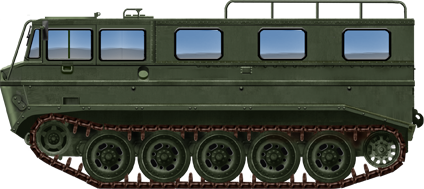
M116 Husky (1961)
 Tracked Amphibious Tractor: 197 Built 1961-1969.

The M116 Husky was a tracked amphibious cargo carrier or marshy terrain vehicle produced for the United States Marine Corps. It was based on the M113 chassis and shared a lot of parts but with a brand new hull. It was an unarmoured, lightweight and low-silhouette, usable for cargo or personnel with a low ground pressure. It was designed by Pacific Car and Foundry as replacement for the WW2
M76 Otter and after 4 prototypes produced by Blaw-Knox for a total of 197. There was a variant, fully armoured (and not belonging there) called the M733 with Pacific Car and Foundry producing 93 from 1966. Both vehicles saw extensive action in Vietnam.
Development
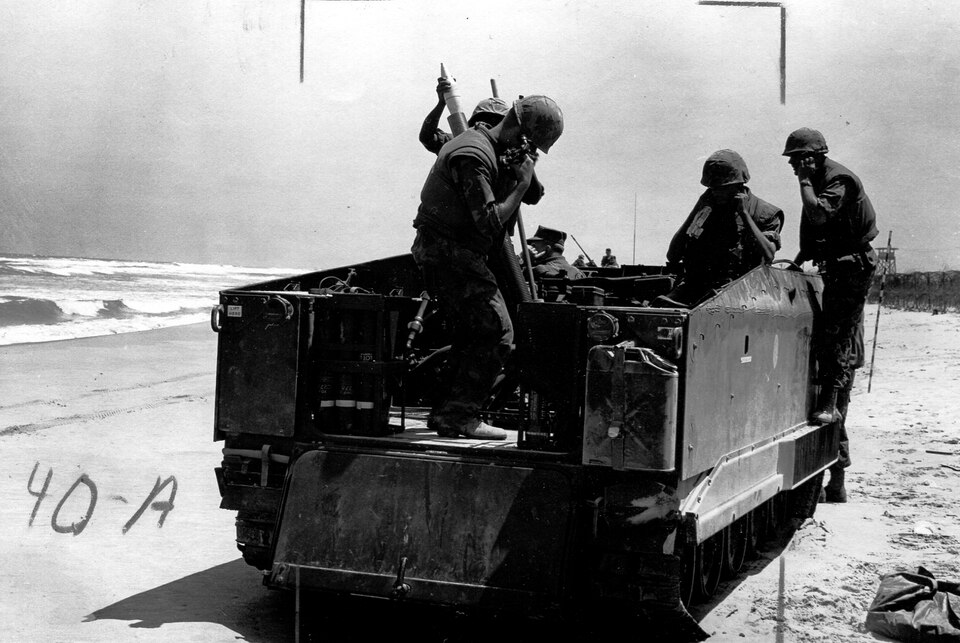 M116 used by the USMC on a beach landing as a mobile mortar platform. This variant had no upper hull here.
The M116 later nicknamed "Husky" originated in 1950s studies. In the 1950s, the U.S. military needed a successor to the M29 Weasel, a lightweight tracked cargo carrier from World War II that was aging out of service. The requirement was for a vehicle that could move supplies and troops across terrain that defeated wheeled vehicles — soft sand, marsh, mud, and inland waterways — while also being amphibious.
The resulting design effort was standardized on 15 December 1960 as the M116, developed specifically to replace the Weasel cargo carrier. Pacific Car and Foundry (PACCAR) served as the designer, creating the M116 as a lightweight, low-silhouette vehicle meant to transport cargo or personnel over unimproved roads, loose sand, soft marshy terrain, and inland waterways.
Development moved through the standard Army R&D prototype process, tracked at the time under the designation T116. Progress on the T116 amphibious cargo carrier was documented in a joint Army/USMC research and development report as early as 1961. Pacific Car and Foundry built four prototypes and followed them with three pre-production pilot models.
A key engineering goal was minimizing ground pressure so the vehicle could cross terrain too soft for trucks or even other tracked vehicles. The finished design achieved a ground pressure of only 1.67 to 2.74 pounds per square inch when fully loaded, which gave it strong mobility over marginal terrain. Despite PACCAR's design work, it didn't win the production contract. On 15 December 1961, Blaw-Knox was instead awarded the production contract, covering 197 vehicles. Blaw-Knox built the vehicles at its Mattoon, Illinois plant, with production running through the early-to-mid 1960s — one surviving example carries a manufacture date of November 1962.
Design
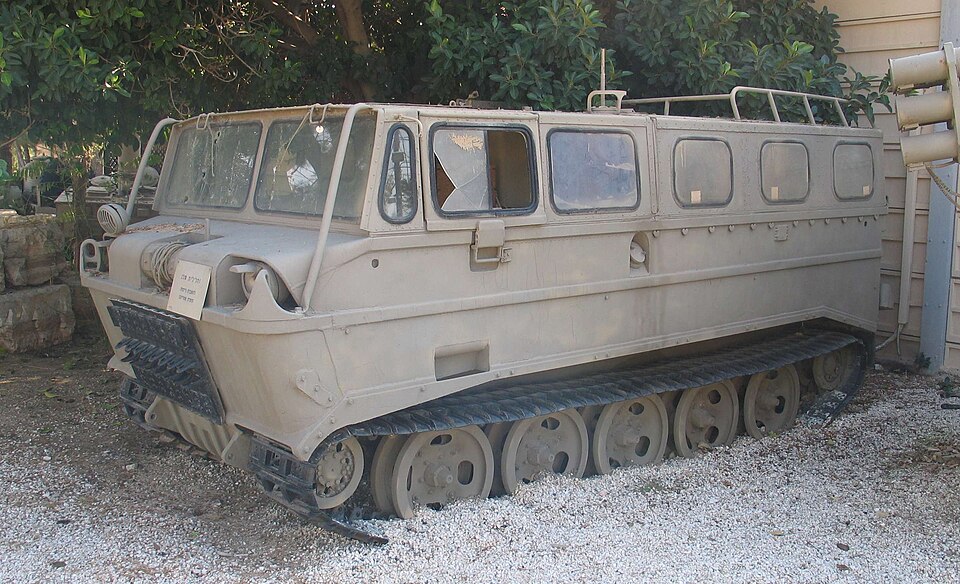
The M116 was a lightweight low-silhouette vehicle designed to transport cargo or personnel over unimproved roads, loose sand, soft marshy terrain and inland waterways. Its low ground pressure of 1.67 to 2.74 psi (11.5 to 18.9 kPa) when fully loaded gave good mobility on marginal terrain. Its empty weight was just of 6,700 lb (3,040 kg) and its curb weight with fuel, equipment, and driver was of 7,880 lb (3,570 kg)
So its average ground pressure at curb weight was 1.9 psi (0.13 kg/cm²)
The M116 had a payload of up to 3,000 lb (1,360 kg), or up to 13 passengers depending on gear. It was powered by a Chevrolet V8 engine paired with a Hydra-Matic transmission for a top speed of 37 mph (60 km/h) on land, roughly 3.7–4.2 mph in water .
The modularity of its hull was enabled by he heavy use of fiberglass for the cab that could be removed from the aluminum hull, reducing overall height, allowing the vehicle to be shortened for easier transport.
M116 Husky (1961) |
| Dimensions (L-w-h) | 15 ft 6 in x 6.8 ft x 6 ft 9 in (4.72 x 2.1 x 2.06 m) |
| Ground clearance | 15.5 in (39 cm) |
| Curb weight, battle ready | 10,600 lb (4,800 kg) |
| Payload | 3,000 lb (1,400 kg) |
| Crew | 1 x 13 |
| Propulsion | Chevrolet V8 |
| Transmission | Hydra-Matic |
| Top speed | 37 mph (60 km/h) land, 3.7 mph (6.0 km/h) water |
| Maximum range | 300 mi (480 km) |
Variants
The M116 Husky
Total production was modest by military vehicle standards: Fewer than 200 Huskys are believed to have been built in total, consistent with the 197 unit production contract awarded to Blaw-Knox. The M116 was in service roughly from 1960 into the 1970s, used exclusively by the United States and only in the Vietnam War. Its niche role — light amphibious cargo hauling over terrain too soft for wheels meant it was never produced in large numbers or widely exported, and it was eventually retired without a direct successor filling exactly the same niche.
M116A1
In December 1966, Pacific Car and Foundry received a new contract for 111 M116A1s for the Navy and Marine Corps, with the first unit delivered to Aberdeen Proving Ground in December 1967. These were essentially unarmored versions of the M733 — in effect, an updated M116 built on the armored hull's improvements. There was an even more marginal variant, the M116E1: This was an engineering variant, a version actually fielded to Marine units in Vietnam.
The M733 APC
The M733 was an armored variant of the M116 with steel armour plates to provide ballistic protection against up to 8 mm rounds and against light small-arms fire and shrapnel at all angles, providing battlefield protection for infantry accompanying marginal terrain vehicles. The primary armament comprised a M60 machine gun, and it had two more pintle mounts for additional M60s machine guns. The M733 had a ring mount that could also accept either the heavy M2 Browning .50 cal. machine gun or a 81mm mortar. It, too, was produced by Pacific Car and Foundry with 93 delivered in 1966-67, also used in Vietnam.
The M116 Pentomic
 With the M28 Davy Crocket
The Davy Crockett (formally the M28/M29 Battle Group Atomic Weapon System) was a very small, man-portable nuclear recoilless rifle developed for the U.S. Army's Pentomic divisions — the reorganized force structure the Army adopted from roughly 1957 to the early-mid 1960s to fight on a nuclear battlefield. Army Chief of Staff General Maxwell D. Taylor treated the weapon's development as a high priority and a key component of the Army's new Pentomic divisions, a reorganization intended to improve the Army's ability to fight on the nuclear battlefield. It was designed to give front-line units access to a compact battlefield nuclear weapon during the era of Pentomic Army doctrine and Cold War NATO–Warsaw Pact tension.
The weapon itself fired the M388 projectile, which contained a W54 nuclear warhead — an implosion device using plutonium-239 as its fissile material, nicknamed the "Atomic Watermelon" for its size and shape. It could be fired from two launcher sizes: the 120mm M28, weighing about 185 lbs with a range of roughly 1.25 miles, and the larger 155mm M29. The Husky was one of several mobility platforms used to move and fire the Davy Crockett system. Beyond the most common mounting on the M38A1D jeep, Davy Crocketts were also mounted on the M116 "Husky" amphibious transporter, as well as on an aluminum ground tripod and later the M151 MUTT (designated M151D when so equipped). The launcher was also deployable via the M113 armored personnel carrier, and the tripod version could be carried and set up by an M113 or M133 as well, though it fired from the ground rather than the vehicle itself.
Practically speaking, this made sense: the Husky's low ground pressure and amphibious capability meant a Davy Crockett crew could get the weapon into marshy, waterlogged, or soft terrain that would bog down a jeep — useful for a "shoot and scoot" nuclear weapon meant to be fired and then relocated quickly before counter-battery fire arrived.
There's an interesting overlap issue here. The M116 wasn't standardized until 15 December 1960, and full production only began after Blaw-Knox won the contract that same month, with deliveries running through the early 1960s. Davy Crockett fielding to Army units began around 1961, primarily to forward-deployed Seventh Army forces in Europe, extending to South Korea by July 1962. So the true "classic" Pentomic period (1957–early 1960s, before the divisions were reorganized again under ROAD in 1962–63) overlaps with only the tail end of the M116's development and initial fielding — meaning the Husky-mounted Davy Crockett setup was really more a late-Pentomic/early-post-Pentomic combination than something present from the doctrine's origin.
Deployment
The M116 Husky served with the United States Marine Corps, seeing use during the Vietnam War. The M116E1 entered service in April 1969 with the 11th Motor Transport Battalion, supporting the 1st Marine Division in the low-lying, frequently flooded terrain south of Danang, and its amphibious, marginal-terrain capability meant it was largely unaffected by weather that grounded other transport, which in turn reduced the unit's reliance on helicopter resupply. The armored M733 entered service around the same time, in August 1969, in the convoy-escort role.
Gallery
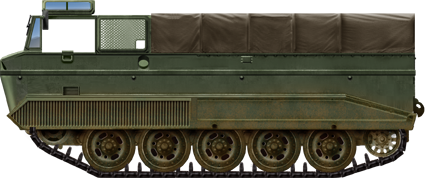
Basic M116 with Tarpaulin in Vietnam
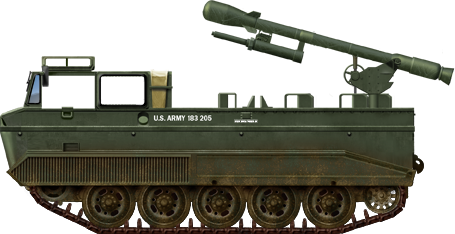 M166 used by the Pentomic Army with a M29 Davy Crocket Rocket
 Fully enclosed variant of the M116 Husky, preserved.
 At Bat El Hosef


Sources
Carrey, Richard (1981). Amphibious Vehicles. United States Marine Corps Development and Education Command.
Doyle, David (2003). Standard Catalog of U.S. Military Vehicles - 2nd Edition. Penhuin.
Gilbert, Ed (2006). The US Marine Corps in the Vietnam War: III Marine Amphibious Force 1965–75. Osprey Publishing.
TM 9-500 C3 Data Sheets for Ordnance Type Materiel. Washington, DC: Headquarters, Department of the Army, 12 October 1966.
Hunnicutt, R.P. Bradley: A History of American Fighting and Support Vehicles. Novato, CA: Presidio Press, 1999.
FMFM 9-2 Amphibious Vehicles. Washington, DC: Department of the Navy, Headquarters US Marine Corps, 7 June 1971.
Smith, Charles (1988). U.S. Marines in Vietnam: High Mobility and Standdown 1969 (PDF). History and Museums Division, Headquarters, U.S. Marine Corps.
en.wikipedia.org
afvdatabase.com
warhistoryonline.com
447bg.org
williammaloney.com/
daviddoylebooks.com
Scalemates model kit
Video