M76 Otter (1956)
 Perhaps 150-200 1951-1954.
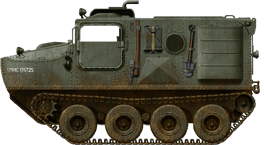
The Amphibious Cargo Carrier M76 Otter was a US Cold War USMC tracked amphibious cargo carrier mostly known for its use in the Vietnam War. Designed by the Pontiac Motor Division in the late 1940s it was adopted in the early 1950s as official replacement for the WWII
M29 Weasel. Built to transport 2 men forward and 8 soldiers at the rear or up to 3,000 lbs (1.5 tons) of cargo it had a lightweight, fully watertight riveted aluminium hull for excellent buoyancy and was powered by a Chrysler 6-cylinder petrol engine. It combined full tracks with unique inflatable rubber-tired road wheels for extra buoyancy, swimming with propeller and rudder. It was also lightly armed (M2 Browning 0.50 cal. on ring mount). It was perfect for the marshy terrain of Vietnam but offered little protection. It was replaced by the
M116 Husky based on the M113 chassis.
Development
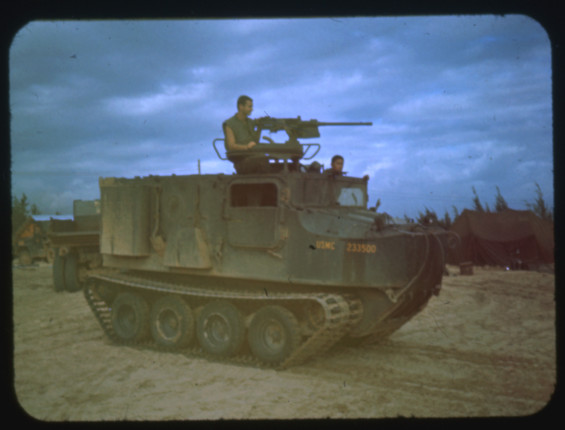
The M76 was designed and built by the Pontiac Motor Division in the late 1940s and intended as a replacement for the M29 Weasel. It was built to haul cargo or troops across shallow rivers, swamps, and other marginal terrain that wheeled trucks couldn't handle. It was built by the Pontiac Motor Division of General Motors — the same company known for muscle cars, oddly enough. Development started already in the late 1940s under the designation T46, with the Army watching development but the US Marine Corps ultimately being the main service to adopt it.
After being approved, production ran from January 1951 to June 1954, though it wasn't formally standardized as the M76 until March 1953.
It entered USMC service in the early 1950s and many saw combat action later in the Vietnam War (see below). It was eventually replaced by the M116 Husky as seen above.
Design
General Layout

Its watertight hull was constructed from riveted sheet aluminum, separated into crew and cargo/engine compartments. Aluminum construction made it very light (helpful for floating) but thin-skinned and vulnerable to enemy fire. It used a cab-over-engine layout, with the engine located under a truck-like nose at the front. The vehicle was small and compact but utilitarian, and still could carry a crew of 10 men including the driver and assistant driver in the cab behind and 8 passengers in the flatbed compartment at the rear, facing inwards on two benches of 4 seats. The vehicle was unarmoured (see below) but still despite its compact size, it weighted around 12,162 lbs (5,516.7 kg) when full loaded and ready for operations, measured 199.4 in (506.5 cm) in lenght for a width of 98 in (250 cm) and an height of 108 in (274 cm), for a ground clearance of 16¾ in (42.55 cm) with a 3,000 lb load.
Powerplant & Performances
The engine was a Continental AIO-268 air-cooled, 4-cylinder opposed engine originally designed as an aircraft engine, rated around 130 hp.
Road wheels were pneumatic (air-filled rubber, like truck tires) mounted on a torsion bar suspension, which both lightened the vehicle and added buoyancy in water or soft ground. Propulsion in water came from a rear-mounted propeller (retractable/foldable for land travel). this Continental AOI-268-3A, 4-cylinder opposed, fuel-injected gasoline, net 110 hp @ 3,200 rpm was seconded by a fuel capacity of 70 gallons (260 L) and a transmission Pontiac CD-150-3, 2 forward ranges, 1 reverse.
Armament & Protection
The M76 Otter was normally unarmed, but a ring mount was installed in the field and standardized, which hold a 0.50 cal M2HB machine gun. The flexible ring mount was located above the assistant driver's hatch. This heavy machine gun had a storage of 630 rounds, and had a 360° manual traverse. As said above, there was no protection, so troops in the fields started to improvize panelling forward and sometimes on the sides or around the ring mount with light aluminum armor around 6 to 16mm on certain variants. This was never standardized.
M76 Otter specifications |
| Dimensions | 4.90 m x 2.50 m x 2.31 m (16′ 0.9″ x 8′ 2.5″ x 7′ 6.9″) |
| Weight | 12,162 lbs (5,516.7 kg) |
| Crew | Driver, co-driver +8 passengers |
| Propulsion | 130hp Continental AIO-268 air cooled, 4-cyl |
| Suspension | Torsion bars |
| Speed | 30 mph (50 km/h) land, 3.7 – 5.3 knots (7-10 km/h) water |
| Range | 70 gallons (260 L), c400 km |
| Armament | Browning M2HB 0.5 cal. HMG, see notes |
| Armor | None, some improvized in the field, partial |
| Total production | |
The M76 Otter in Action
The Otter only was used by the United States Marine Corps (USMC) in Vietnam. A first batch of 33 vehicles was sent to Danang in 1965 assigned to 3rd Motor Transport Batallion, 1st Marine Division, Fleet Logistics Support Command, part of the 1st Marine Brigade. Organically there were three to four M76s per Infantry Battalion. Their role was to supply frontline units in alternative to helicopters which lacked landing areas in some partilarly marshe and swampy grounds. They saw action in the 1968 Battle of Dai Do, Dong Ha.
However reports ave an idea the vehicle was not always propular. It postwar memory books the M76 Otter was said "always broke" but also that it "did more than it was ever designed to do", negotiating water obstacles, but also it had ha high profile on land and its HMG "invited RPGs", it was also "slow and ungainly" but found a sweet spot forbidden to LVTs. So they were invaluable. It was also used as light vehicle recovery and field ambulance.
With time appreared the "gun tub" when the Marines started plundering Navy workshop to wel armour plating and named it after the Navy "port side 20mm gun tub". The M76 Other soldiered on until the end of the Vietnam war, 1973, but some were also sent for arctic environments. It was replaced in service by the M116 Husky. Like the Weasel it replaved, many were preserved and are privately owned or displayed at shows, including a rare T46E1 prototype. The last retired was a HQ Transportation vehicle used in the North Pole Alaska to combat wildfires.
Others are in Museums, Pacific War Museum on Guam, Isle of Wight UK, Marine Corps Mechanized Museum in Camp Pendleton.