Isuzu Type 94 Truck
 IJA (1934) Military Lorry - circa 5000 built
The Type 94 truck is the great standard of the Imperial Japanese Army (IJA) in WW2. It was first designed from 1934 in order to compensate for the lack of motorization of the Army, which was a limited and improvized effort from civilian models in military use. Until 1939, the JA laked proper military trucks, with reinforced suspension, greater ground clearance, and proper off-road tyres. Jidosha Kogyo (later Isuzu) of the three major truck manufacturers, improsed its model as the best, mostly used in its 6x6 chassis and declined into multiple variants. Around 5,000 were manufactured until 1945.
WW2 Japanese Army Trucks
Like other industrial nations, and interested by UK's own tests in the 1920s, Japan began motorizing its army and create motorized infantry regiments to go with its newly formed armoured regiments. Gradually, and especially until the end of the 1930s for operations in China, the Army purchased a variety of trucks to carry troops and supplies. This increased in WW2 with a variety of lorries and trucks built by mostly by Toyota, Nissan and Isuzu. These were the Type 94 6-Wheeled Truck, Type 95 Mini-truck, Type 97 4-Wheeled Truck, Type 1 6-Wheeled Truck and Type 2 Heavy Truck for the latter, and Toyota KB/KC Truck, Nissan 80 and 180 Trucks, plus the Amphibious Truck
Toyota "Su-Ki".

About Isuzu
Isuzu Motors started in 1916, when Tokyo Ishikawajima Shipbuilding and Engineering Co. Ltd. planned a cooperation with the Tokyo Gas and Electric Industrial Co., to build automobiles. In 1918 a technical cooperation with Wolseley Motors Limited started, with exclusive rights to produce and sell Wolseley vehicles in East Asia. In fact some were later declined as armoured car for service in China. In 1922 the first ever Japan-produced passenger car was indeed a Wolseley A9. A CP truck followed in 1924, with 550 built until 1927. In 1933, Ishikawajima Automotive Works merged with DAT Automobile Manufacturing Inc. (predecessor of Nissan) and became "Automobile Industries Co. Ltd.".
The vehicles were marketed as Sumiya and Chiyoda but branded "Isuzu" after the Isuzu River. In 1934, its direction met the Government’s Ministry of Trade and Industry to produce a mixed military and civilian truck with good caracteristics. The Type 94 was born. In 1937 a reorganisation led to formed the Tokyo Automobile Industries Co Ltd. The Chiyoda Type 94 truck was mass-produced and when in 1942, Hino Heavy Industries was split off from Isuzu it became independent again. Production of the TX40 variant was relaunched in 1946 as part of the US Marshall Plan and in 1949 the company name was definitively simplified as "Isuzu".
Development of the Type 94
Before the War, standard Japanese commercial trucks were used by the military. However it was soon realized those trucks performed poorly in field conditions, and Japan could not rely on them for military service. It was therefore decided to commission a purpose-built military truck, while supporting private motorcar companies to develop a military 6-wheeled truck. At the time, Isuzu of all brands had the best reputation for its rugged trucks capable of off-road work, and the company created a prototype of a 6x4 truck under in-house name of "Isuzu TU10". It was first shown to the army in July 1933. It married excellent off-road capabilities with high ground clearance, with reliability in being easy to maintain.
Army trials of the TU10 started this summer, and the vehicle went through six different tests, in diverse terrains and weather conditions, spread out between July 1933 and July 1934. Eventually the Type 94 was accepted for service, and further developed into a final production model by 1934 — hence the Imperial year 2694 in its the designation. So, if the Type 94 was initially developed in 1933 as part of the Imperial Japanese Army's program to sponsor independent motor companies, this company in particular, achieved this goal of providing the army a a standard, reliable military truck.

The Type 94 had no issue countering the already tested existing civilian lorries which all showed poor performance in the field in comparison. Isuzu's design when accepted in 1934, gave the impetus to other companies to do better. This 6x6 chassis configuration gave all satisfaction in terms of range, reliability, and most important, off-road capabilities. Production started in 1934 and went on all the way to 1945, apart from industrial bombing distruptions, it was everywhere the IJA needed off-road trucks, but the production remained ellusive. Mire so, by 1944 standard it was considered completely underpowered and obsolete.
Design of the Type 94
General Layout

The Type 94 was a 6x6 army truck designTotal weight was around 4,800 kilograms, total length 5.3 metres.
"The Type 94 was a 6×6 truck fitted with an Otsu diesel engine capable of propelling it at speeds of up to 60 km/h. The vehicle was unarmed and unarmored but carried two spare tires on the side for maintenance. The only crew required was a single driver, but up to 1,300 kilograms of cargo or passengers could also be carried. The total weight of the vehicle was around 4,800 kilograms, while its total length was 5.3 metres.
Full dimensions were 5.4 × 1.9 × 2.7 m, with a payload of 1.5 tons. Both gasoline (Ko model) and diesel (Otsu model) engines were offered, producing 43 hp at 1,500 rpm or 68 hp at 2,800 rpm, giving a top speed of 45–60 km/h. The original Ko variant was fitted with an upright 6-cylinder water-cooled engine almost identical to that used on the Isuzu Type 93 six-wheeled civilian passenger car, adapted for military use. Later in 1939, the DA40 — a 6-cylinder diesel engine — was developed for the truck with similar power output but lower fuel consumption; this version became the Type 94 Otsu. The standard Type 94 truck was designed to be operated by a single driver and could carry either up to 12 passengers — two in the cab, ten in the cargo bay — or up to 1,300 kg of cargo.
Engine & Performances
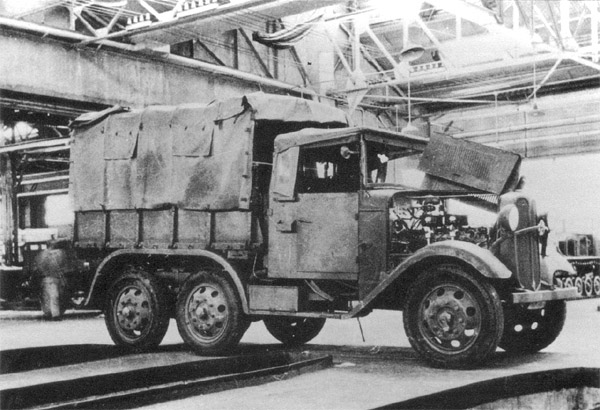
The Type 94 was produced in two variants, one a gasoline powered version with a 6-cylinder L head water cooled engine producing 43 hp, with a maximum speed of 37 miles per hour and a fuel consumption of 7.8 miles per gallon. The other had a 4-cylinder diesel engine producing roughly the same hp, with a maximum speed of 43 mph and 16 mpg. The hard top and soft top cabs were available with both engines.
According to US Army bulletins, both vehicles could operate on US fuel, but the diesel had to be mixed with oil to work efficiently in the engine. The four rear wheels were powered. Capacity was 5500 lbs. It was fitted with an Otsu diesel engine that capable of powering the vehicle at speeds of up to 60 km/h on flat, while preserving range. Off road it was down to 30 kph or less if heavily loaded. The truck itself neither unarmed and unarmored, but carried two spare tires on the side for maintenance. The crew comprised single driver and the practical payload was 1,300 kgs of cargo, or an infantry platoon.
Its army requirements design made it, unlike its civilian-based predecessors, highly reliable in the field and very capable of traveling cross country, helped also by a high clearance, to traverse the rough jungle terrain where it mostly served. Variants built during the war included an optional gasoline engine, a soft top and hard top conversions for the driver cabin roof.
Variants of the Type 94
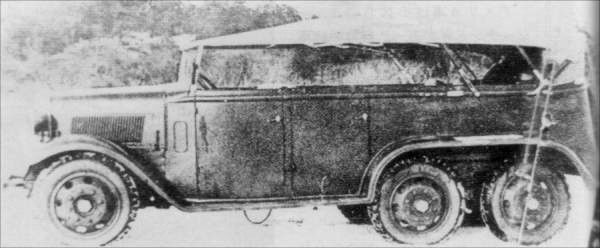 Type 94 6x4 Bus
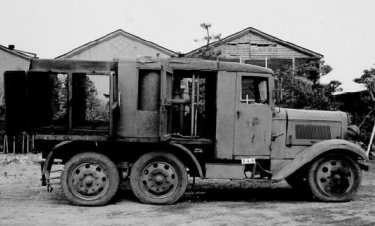 Type 99 Decontamination truck
 Radio Truck
Over the course of its production, numerous variants were designed, such as:
-TX40 gasoline-powered civilian 4×4 truck, a Type 97 military variant.
-TX50 diesel-powered version of the TX40
-TX80/TU80 with improved axle strength to increase payload (and various other specialized variants).
Variants included thus an optional gasoline engine, soft top and hard top conversions and a bus. But the most notable specialized variant was the Type 98 AA Machine Cannon Carrier. There was a ralway adaptation model, when locomotives were not available, and a fuel truck version, two decontamination variants, a radio, workshop variants sharing closely related rear cab.
20 mm AA machine cannon carrier truck
This consisted of the Type 98 20 mm AA machine cannon mounted on the back of a Type 94 six-wheeled truck. The Type 98 20 mm AA autocannon was the most common light anti-aircraft gun of the Imperial Japanese Army, with a range of 5,500 meters, an altitude ceiling of 3,500 meters, and a rate of fire of up to 300 rounds per minute. The gun could be fired from the rear platform of the truck or unloaded and fired from the ground. These carrier trucks were deployed in the air defense units of the four Japanese tank divisions.
The Type 94 in action
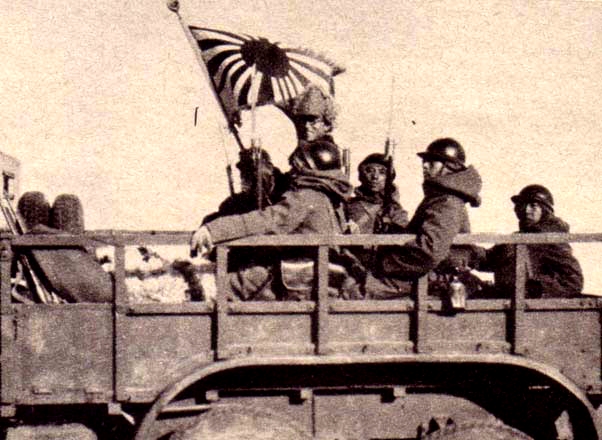 Type 94 carrying IJA troops in Mandchuria, 1935.
The Type 94 was the most widely produced Japanese truck of WWII, albeit precise manufacturing numbers are ellusive, we are back to speculation. The truck was indeed used not only for military but also encouraged for civilian use. The Japanese government went so far as offering subsidies to the companies that purchased and used the truck to make its overall price lower for the military by scaling up production. Many were captured and entered service with Allied forces or local civilians, after the Japanese army left their occupation areas. Thus, it was used as a prime mover and as cargo and transport vehicle, often overloaded and used on difficult dirt tracks.
The Type 94 was most abundant in China. But it was also used widely across the Pacific Theater, with performances praised already in the late 1930s. It was quickly adopted as the standard truck of the Imperial Japanese army and served throughout the war, until 1945. "Thousands" had been produced and in fact it was produced in the largest numbers among Japanese trucks. Total production is unknown, though estimates suggest possibly 5,000 or more vehicles were built between 1934 and 1945. Some sources suggests production was even relaunched in 1946 under a modernized form and went on in some sources until 1979.
The Type 94 truck was used to transport infantry and supplies, and also as an artillery tractor for light guns like the 47 mm Type 1 anti-tank gun and the Type 88 75 mm AA gun. This made it the only truck that can tow artillery and not an half-track design. It saw plenty of service in the war in China and across the Pacific and South East Asia.
Unlike its predecessors, it proved reliable in the field, very capable of traveling cross country as well, a rara quality. Fuel consumption was good, with a range between 200 and 300 km depending on the load and use. Easy to maintain, it was well-liked in the field, marrying a high ground clearance with rinforced leaf spring suspensions and heavy duty military tyres. This was the only model allowed to traverse most of rough jungle tracks, where it mostly served. Civilian types were reserved for the good roads of China and Indochina. The variants produced mostly introduced minor improvements over the course of its service life.
In popular culture
Scale Models & Collectibles: The Type 94 has been the subject of numerous scale model kits, including:
A 1:35 scale metal kit by Pit-Road (GF-050), a 1:35 photo-etched parts kit by Fine Molds (MG71), a 1:35 canvas-top kit by Fine Molds, a 1:35 kit by Wespe Models (ISUZU 6×4), and a 1:144 multi-topic kit by Beaver Corporation. It has also appeared in 1:700 scale naval diorama sets.
In Video Games: The Type 94 is a playable vehicle in the game War Thunder, represented as an anti-air truck (SPAA):
It was introduced in Update 1.65 "Way of the Samurai" along with the initial Japanese Ground Forces tree. As with any truck AA, this vehicle is fragile and should not be taken near the frontline, even though it is potent as a frontline automatic anti-tank gun. With 20 bullets, 45 mm of max penetration, a good traverse speed and reload rate, this gun can shred planes and light targets alike. War Thunder Wiki
It also appears in Forgotten Hope Secret Weapon (FHSW), a Battlefield 2 mod: In FHSW, it is the only truck that can tow artillery without being a half-track design. The combination of the Type 94 truck and the 20 mm Type 98 AA gun enabled mobile air defence, with walls around the gun that can be turned up or down.
Isuzu Type 94 specifications |
| Dimensions | 5.4 x 1.9 x 2.7m |
| Total weight | 3.5-4.8 tons (1.5 tons payload) |
| Crew | 1 (Plus infantry platoon) |
| Propulsion | Gasoline Engine (Ko Model) or Otsu Diesel Engine:
43hp/1,500rpm or 68hp/2,800rpm |
| Top speed | 45-60 km/h |
| Range (maximal at cruise speed) | Unknown |
| Total production | Unknown - possibly 5000+ 1934-45 |
DesignationType 94 Six-Wheeled TruckManufacturerIsuzuDeveloped1933 (prototype), accepted 1934Configuration6×6 (military), 6×4 (prototype)EngineKo: 6-cyl gasoline / Otsu: DA40 6-cyl dieselPower43–68 hpTop Speed45–60 km/hWeight~3.5–4.8 tonnesDimensions5.4 × 1.9 × 2.7 mPayload1,300 kg / up to 12 passengersCrew1 driverProduction~1934–1945 (est. 5,000+)TheatresChina, Pacific, South East Asia