German WW1 Vehicle
 c5,000 trucks, cars, tractors built
For this first portal page on the great war, here is one that is a bit better deocumented thanks to the German Army administrative precision.
The German Imperial Army was the largest user and manufacturer of military trucks among the central Empires, thanks to its larger industrialization, world's second after Britain. Most brands were born even before Kaiser Wilhelm II came to power: Mercedes, Krupp and Daimler, Bussing, Opel. Others disappeared like Podeus. They provided all the trucks necessary to the German war effort, from road-only models to off-road models, but also staff cars, and artillery tractors. It's always surprising to consider than the Sturmanzerwagen A7V, the one and only German tank, had more unarmoured versions made with the same chassis, like the Flakpanzer and überlandwagen, the latter an utility tractor for the no-man's land.
Foreword
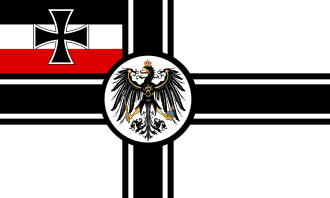
Motorisation in the Imperial German Army started as far back as 1899, when the first truck and first passenger car with internal combustion engine were tested for military use. The development really took off from 1908 with comparative trial runs held to find a vehicle in the role of Armeelastzug (truck-trailer combination). In 1914, a single truck model was given the role of supplier for all troops and on all frontlines.
However the state soon forced civilian manufacturers to join the effort and soon, Lastkraftwagen (cargo truck) diversity was ramped up, as more models came out, to become the backbone of German military supply operations in World War One. Soon also there was an administrative and organisational aspects with the creation of the Kraftfahrtruppe (Army Motor Transport Corps). During th ewar, if well-known Benz, Daimler and Opel took the limlight, other truck manufacturers joined the fray such as Büssing, Horch, Mannesmann-Mulag and Stoewer, or even more confidential such as Ageka, Komnick and Windhoff among others.
First List
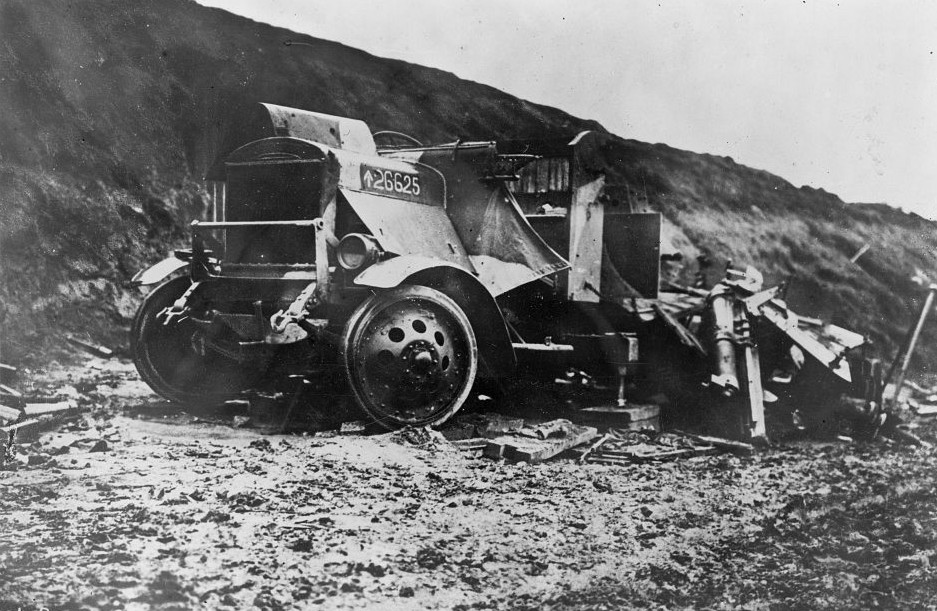
A7V Überlandwagen & Flakpanzer
Beobachtungsanhänger
Büssing KZW1800 Artillery Tractor
Daimler Marienfelde Truck
Field Artillery Limbers (all types)
Große FeldKüche Hf.13
Mercedes 37/95 Staff Car
German Army Logistics in 1914-18
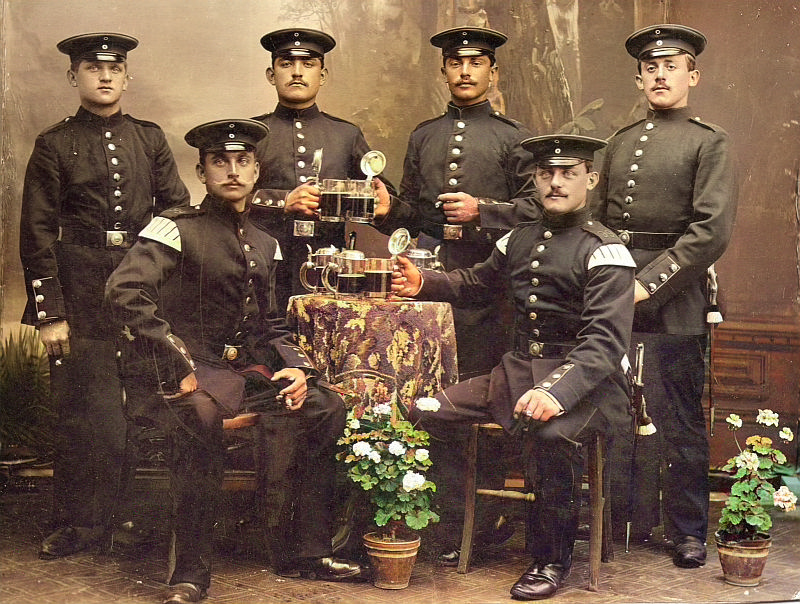
The logistics of the German Empire army in 1914 were among the most advanced in the world, but they were also rigid and ultimately struggled to adapt to the realities of industrialized total war. Understanding both the initial system and its evolution helps explain Germany’s early successes—and later difficulties—in World War I.
German Army Logistics in 1914
Rail-Centered Mobilization: Germany’s logistics system was built around an exceptionally dense railway network, coordinated by the Prussian General Staff.
Mobilization plans were pre-calculated down to the minute. Troops, horses, artillery, and supplies were moved via rail to the frontiers. The system enabled Germany to mobilize faster than rivals like France or Russia
This efficiency was critical to the Schlieffen Plan, which depended on rapid concentration of forces in the west.
Supply Structure
Once troops reached the front: Supplies moved from railheads, then horse-drawn wagons then front-line units. Each army had a line of communications (Etappen system) managing depots and transport
Heavy reliance on horses (Germany used ~700,000 at the start of the war). This system worked well in short, fast campaigns, but it assumed continuous forward movement.
Strengths in 1914
- Highly organized and centralized planning
- Excellent railway integration
- Efficient initial deployment and concentration of forces
- Weaknesses in 1914
- Over-reliance on fixed timetables
- Limited flexibility once operations deviated from plan
- Heavy dependence on horses, slowing supply beyond railheads
- Assumption of a short war
These weaknesses became clear during the First Battle of the Marne, when advancing German armies outran their supply lines.
Evolution of German Logistics (1914–1918)

Transition to Trench Warfare. After 1914, the war became static:
Railways extended closer to the front, construction of light railways (Feldbahnen) for last-mile delivery and massive growth in ammunition consumption, especially artillery shells.
Logistics shifted from mobility to sustained supply under fire. Industrial and Resource Challenges: Germany faced increasing strain due to the Allied Blockade of Germany restricting imports, shortages of food, fuel, and raw materials and need for centralized economic control under figures like Walther Rathenau. This led to the creation of the War Raw Materials Department (KRA) to manage resources.
Increasing Mechanization (Limited) existed when Germany introduced new trucks (though fewer than France or United Kingdom), motorized artillery tractors and improved road networks near the front.
However, fuel shortages and industrial limits restricted full motorization.
Logistical Adaptation in 1916–1918: During battles like the Battle of Verdun, supply systems became defensive and depth-based, emphasis on stockpiling ammunition and supplies before offensives, use of rotating troop systems to maintain effectiveness. By 1918, Germany could still organize large offensives (e.g., the Spring Offensive), but supply lines struggled to keep up with rapid advances, troops often lived off captured Allied supplies, logistics collapsed as momentum stalled.
Key Patterns in the Evolution
From Precision to Strain, 1914 Precision-planned, rail-driven mobility. By 1915–1916: Adaptation to static warfare. By 1917–1918: Resource crisis and logistical overstretch.
But there were Core Structural Limitations: Germany’s system was brilliant for short wars of movement, but it lacked strategic endurance, it depended heavily on external resources that became unavailable, it struggled with long-distance sustainment under attrition. Bottom Line, German logistics in 1914 were arguably the most efficient in Europe—but they were designed for a different kind of war. As World War I turned into a prolonged industrial struggle, Germany adapted tactically (light railways, better organization), yet strategically fell behind due to resource shortages, limited motorization, and the cumulative effects of blockade and attrition.
WW1 German Trucks
Operations

Motor transport columns in 1914 (Etappen-Kraftwagenkolonnen) comprised on average of 17 standard army trucks (Armee-Lastzüge) with trailers. Load capacity was already four metric plus the trailers (two tons) so that each column carried a total of 102 tons, which was almost twice the capacity of heavy horse-drawn columns (62 wagons).
Nine trucks represented 54 tons, but they moved at an average of 30 kilometers per hour for a range, loaded, of just 100 kilometers before reefill with gasoline. So these were done the closest to a railway as possible. But this was a heavy system, lacking flexibility and predictibl by entente powers that could plan and artillery bombardment on the approaching columns to the frontline. "Etappen-Inspektionen" were created as light motor transport columns (leichte Etappen-Kraftwagenkolonnen) for more flexibility. They comprised 15 trucks, each of three metric tons capacity and without trailers for better speed and mobility, carrying 45 tons total, and also modelled after those of the cavalry divisions. They were designed for speed first and foremost and could be used in a les predictible way as emergency commands, at divisional or corps level.
During the Belgian campaigns, these became paramounts to compensate the destruction of the railway system. It was also true for northern France and all had been already setup in prewar logistic planning for a westrn offensive. needless to say, these columns were even more vital in the east. By 1914, only 9,639 trucks were registered in Germany, almost all in civilan service. There were few standards, even less army trucks. The government subsidized private owners to purchase military-grade vehicle on exact specifications and have them ready for mobilization in 1912-13.
Civilian trucks were also requisitioned with the mobilization and a balance was chosen between transportation shortages of the army and the needs of the civilian society, not to disrupt trade supply. Percentages of available trucks were sized depdending on local avalability and use not to create much troubles. Later a plan was estabish to calculate further requisitions and constructions, based upon the number of all mobilized motor transport formations, estimations reached 2,000 trucks. They were all requisitioned for a grand total of 4,000 motor vehicles (inc. cars, tractors and light lorries) together with 8,000 drivers and mechanics to operate and maintain them. Many passenger cars were mobilized for the general staff and for laison along the front.
The German Volunteer Automobile Corps (Deutsches Freiwilliges Automobil-Corps) founded in 1904 under Prinz Heinrich v. Preußen, brother of the Kaiser also was activated and fully supported the mobilization and enabled a quantity far larger than planned prewar. So, in the end, just like a very efficient use of trained and railways, the road-bound logistic train of the Imperial German Army was really efficient, especially when compared to the French.
Staff Cars
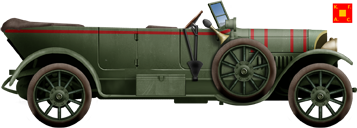
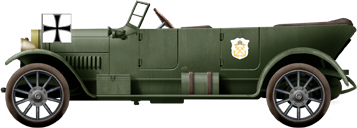
Mercedes (1915), belonging to the Imperial Volunteer Automobile Corps (Kaiserlichen-Freiwilligen-Automobil-Corps), operating within the Empire's territory, were authorized to display registration plates with numbers painted in red. They were further identified by a special sign affixed adjacent to the rear registration plate. This sign took the form of a red square plate measuring 12 x 12 cm, with a yellow square placed in the center bearing the letters "K.F.A.C." in each of the four corners. K.F.A.C. vehicles operating in the rear sectors of the frontline were painted green-grey (Feldgrau) and marked with two broad crimson stripes on the body and hood/bonnet.
In 1916, this corps was renamed the Imperial Automobile Corps (K.Kf.K, Kaiserliches Kraftfahr-Korps), which may have influenced the marking system, although the specifics of such changes remain unknown. The Staff car of Admiral Ludwig von Schroder, Marine Korps, Flanders 1917, marked with its distinctive emblem featuring two crossed anchors topped with a crown and flanked by two flowing sashes. This symbol, originally embroidered on the shoulder straps of naval infantry soldiers since the early 20th century, became widely used after the outbreak of war. Painted on a white shield, it was displayed on both sides of the vehicle, on the doors of staff cars, and on the loading platforms of lorries.
Trucks
Note: The vehicles are represented at 1:72 scale, except if specs are unknown.
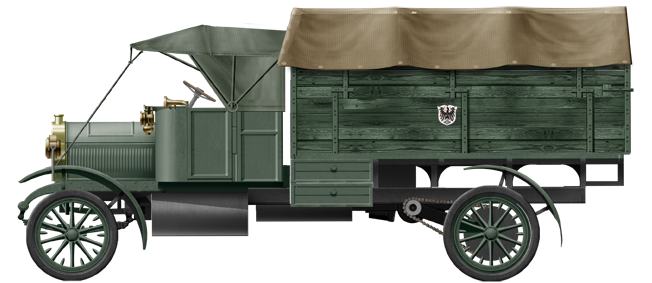
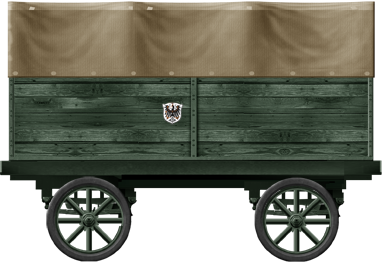
An early heavy lorry Podeus LIII with trailer (road train), produced for the Imperial Army under the Ministry of War’s subsidy program. During 1914–1915, these vehicles delivered supplies to positions no closer than 10 kilometers from the front lines, making the application of disruptive camouflage unnecessary.
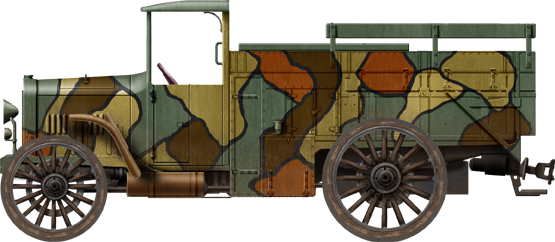
The late-war (1918) Krupp-Daimler K.D.I heavy vehicle served both as a heavy artillery tractor and an ammunition transporter operating near the front lines. Although not typically exposed to direct enemy fire, these vehicles required camouflage to reduce the risk of aerial attack.
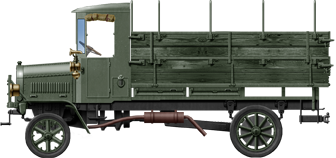
A Daimler-Marienfelde truck from an unidentified Prussian Motor Vehicle Column (Preußische Kraftwagen-Kolonne) at the Western Front, 1917.
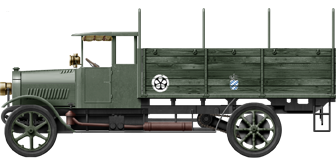
An Opel 3-ton truck from an unidentified Bavarian Motor Vehicle Column (Bayerische Kraftwagen-Kolonne) at the Western Front in 1918, marked with the Bavarian coat of arms and unidentified unit tactical symbols.
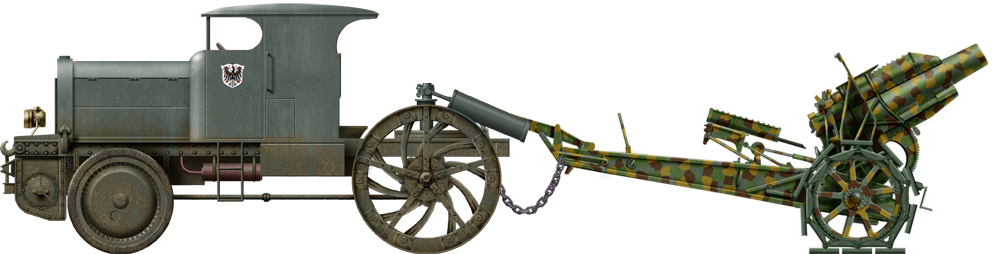
Büssing K.W.Z. 1800 heavy artillery tractor towing a Krupp 21cm Mörser, belonging to an unidentified Fußartillerie (Heavy Artillery) Regiment on the Western Front, 1918.
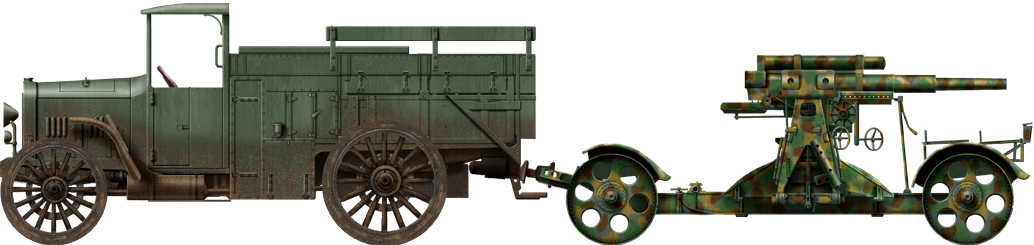
A Krupp-Daimler K.D.I towing an aircraft cannon 8,8cm belonging to an unidentified Kraftwagen-Schwere Flak Batterie (Motorized AA Battary) on the Western Front, 1918.
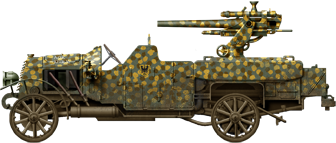
A 77 mm Leichte Kraftwagengeschütze M.1914 of A.O.K. 2 / K. Flak 36 (2nd Army Command, 36th Motorized Anti-Aircraft Detachment) in France, 1917. The vehicle is painted in a patchwork camouflage scheme of yellow ochre, brown, green-grey, and field grey. Note the unit designator (Formationszeichen) painted on the bonnet used by the Imperial Army between February 1915 and August 1917.
A7V Überlandwagen
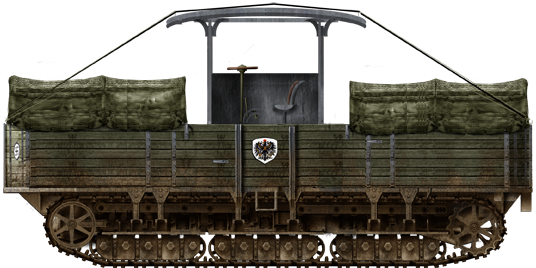
The situation in 1915 – 1916 was dire, as Germany, Britain and France had settled into a stalemate. In order to solve the ‘bloody equation’ formed by the artillery-barbed wire-machine gun combination, both Britain and France began development on a vehicle that had the ability to cross trenches with ease and be able to withstand enemy machine gun fire. This tracked vehicle would eventually revolutionise the battlefield. Thus the tank was born.
Although the tanks suffered from mechanical failures and inadequate crew training they had a major physiological impact on the German soldiers. German intelligence subsequently submitted reports to the Oberste Heeresleitung (German supreme command or OHL for short), which then lobbied the war ministry for an equivalent. However, some of the senior officers of the time were more focused on artillery and infantry tactics rather than the development of the tank or similar armored vehicles.
More on tank encyclopedia
A7V Flakpanzer
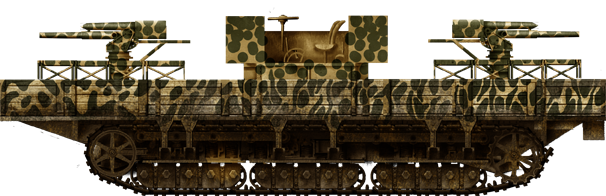
In WW1, the Germans used the A7V chassis as a starting point to develop several other variations. Although most would be used for the A7V Überlandwagen rough terrain tracked supply vehicle, others were used to create unique vehicles, such as a trench digging machine and the anti-aircraft version known as the A7V Flakpanzer.
Plans were also made to produce an A7V Funkpanzer wireless communication tank fitted with a Graben-Funkstation 16 radio transmitter and large circling antenna on the roof.
In order to combat the ever more numerous amounts of aircraft in the skies, German Army needed something that could fend off the enemy aviators, but also be able to relocate to a more defensible position if necessary. Little is known about this mysterious A7V Flakpanzer save for a few photographs. Three prototypes were being trialed in the closing stages of World War One.
More on tank encyclopedia
Armoured Cars

If Germany lacked tanks, it had more armoured cars, from the same truck manufacturers. The Ehrhardt E-V/4 (Straßenpanzerwagen) was the Most important German armored car of WWI arguably, built in 1915, Typically armed with 2–3 machine guns and protected by 6–9 mm armour for a crew of 8–9 men and top speed of 40 km/h on roads. It had a fully enclosed armored body, unusual for the time, multiple firing ports and a rotating turret and were designed mainly for road use, not rough terrain.
Thy were deployed primarily on the Eastern Front, where open terrain and roads made them more useful and also used for internal security and anti-partisan duties.
The other important model was the Büssing A5P, much larger and heavier than the Ehrhardt with up to eight Machine guns and 10+ crew, this was a behemoth with versions in all-wheel drive, quite advanced for the time. It was however used on roads whenever possible and produced in smaller numbers. In general these models were unable to cope with the Western Front conditions (trenches, mud, shell craters) making wheeled vehicles ineffective and better suited to mobile warfare, which was more common in the East. Were technically solid, sometimes even ahead in design but saw limited but useful service, especially outside trench-heavy areas and didn’t influence the war as much as tanks did for the Allies.
Sources/Read More
Note: The subject is pretty scarce compared to WW2, but here is the list of books and online resources i could find:
Books:
German Army Handbook, April 1918, introduction by David Nash. Arms and Armour Press, London, 1977
Stormtroop Tactics, Innovation in the German Army, 1914-1918, by Bruce I. Gudmundsson. Praeger Publishers, 1989
Imperial German Army 1914-1918, Organization, Structure, Orders of Battle, by Herman Crom, Helion & Co. 2002
Das Koniglich Bayerische Infanterie Liebregiment im Weltkrieg 1914/18, by Max Schick, Bayerishcen Kriegsarchiv, 1931
The World War 1 Databook, by John Ellis & Michael Cox, MPG Books Ltd, 2001
Videos:
More general on WWI trucks
Sites & online discussions:
landships.activeboard.com
2
3
4
greatwarforum.org
german1914.com/
www.worldwar1.com
prussianmachine.com
www.worldwar1.com
prussia.online
encyclopedia.1914-1918-online.net
Imperial_German_Army_in_World_War_I
Imperial_German_Army
uberlandwagen-gelandewagen-a7v
landships.activeboard.com artillery-tractor/
landships.info/ Bussing_KZW1800
landships.info Daimler-Marienfelde
passionmilitaria.com
bulgarianartillery.it
Model kits:
scalemates general query
cult3d Daimler B lorry 1915
Tamiya FWD truck
The topic is very poor. 3D artists needed to fill the gap.