9A82 TELAR
 Soviet Union
Tracked Erector Launcher (1983) - c400 built
This post is about one element of the large S-300 SAM family: The 2A82 is related to the 2A85, as a tracked variant of the system (S-300V complex). This particular TELAR had its own illumination radar and fires the largest missile in inventory, the 9M82 (SA-12B Giant) with a 100 km range and 30 km altitude, chiefly to intercept ballistic missiles (SLBM). The system S300V was developed from 1983 to 1988 by Antey. It was upgraded over the years as the S-300V-1, 2, 3 and now S-300V-4 in 1994.
The 2A82 inside the S-300 system
About the S-300 system

The S-300 (NATO SA-10 Grumble) comprises a wide array of long-range surface-to-air missile systems developed in USSR fro the late 1970s to the mid-1980s. NPO Almaz developed the programme for the Soviet Air Defence Forces tasked of defending the army and sensible sites against NATO air raids and cruise missiles. Now the sustem is used by Russia, Ukraine, and other former Eastern Bloc countries plus, Bulgaria, Greece and famously Turkey. China and Iran were early adopters and worked on this base to develop their own systems.
The S-300 system is fully automated, compatible with manual observation and remote operation with radars, which is the default mode. Each targeting radar provides target designation for the central command post, so the S-300 is a full system, mobile, all mounted on trucks, some trucks used as TELAR (missile launchers), another for the survellance radar, and one for the command post. The latter compares data received from the targeting radars, filtering out false targets, through both active and passive target detection modes. The Missiles, depending of the type, have a maximum range of 40 kilometres (25 mi) from the command post. The successor S-400 (NATO SA-21 Growler) was develed by the Federation of Russian and entered service on 28 April 2007.
2A82 TELAR
 Rear view of the 2A82, missiles deployed.
Development
The 2A82 TELAR (Transport Erector Launcher, And Radar) is a fully integrated system that cannot see target from far away as per the S-300 system, a task filled by dedicated radar trucks (to be covered as well), but which can use its radar to guide the missile onto the target at medium range. The base vehicle is fully tracks for good off-road performances, but unarmoured, only protecting the crew from the elements.
The first system in 1985 was the S-300PS/S-300PM that combined, the TEL, mobile radar and command-post vehicles all based on the MAZ-7910 8×8 truck for commonality. The S-300 PMU in 1987 used the same vehicle with upgrades, followed by the S-300PMU-1 introduced in 1993, using the smaller 5V55R and 48N6E missiles as well as the 9M96E1 and 9M96E2. But they used the 5P85SE vehicle and 5P85TE towed launchers, support vehicles included such as the 40V6M tow vehicle. But the tracked equivalent was the first in service, in 1983, fully operational in 1988: The S-300V (SA-12).
Specifications of the S-300V (SA-12)
The S-300V fired the 9M83 missile, with the complete system called 9K81 S-300V Antey-300 (SA-12 Gladiator/Giant) which varies from other designs in the series as it was built by Antey rather than Almaz, and thus based on tracked vehicles instead of trucks. It fires either the 9M82 and 9M83 missiles (NPO Novator) with the V suffix standing for Voyska (ground forces). This top-tier army air defence system replaced the 2K11 Krug, with long range missiles capable of intercepting ballistic missiles, cruise missiles, and aircraft at very high altitude. The 9M83 (Gladiator) missiles have a maximum engagement range of around 75 km (47 mi) and the 9M82 (SA-12B Giant) are capable of 100 km (62 mi) range and altitudes of around 32 km (20 mi) with a warhead around 150 kg (330 lb), optionally with a tactical nuke.
It's the size of the missile, much larger, that dictated the use of a tracked TELAR instead of the usual 8x8 truck to better spread the load. The S-300V thus was designed from the start to be carried on tracked MT-T transporters for better cross-country mobility than the S-300Ps and its search, tracking, and command systems are better distributed than the S-300P. There is a mechanically scanning radar for target acquisition (9S15 BILL BOARD A) and at battery level the 9S32 GRILL PAN has an autonomous search ability, SARH delegated to illumination radar on the TELAR vehicles themselves. The 9S15 can simultaneously carry out active, with 3 coordinates, and passive, with 2 positions searches for targets as the high altitude SAM system, putting a greater emphasis on the anti-ballistic missile defence with the large 9M82 (SA-12B Giant) anti-ballistic missile.
That heavy and large missile meant only two can be carried by each TELAR. Thus a usual battery of four vehicle (six possible) made form "only" eight missiles. Each vehicle had their own dedicated ABM radar, the 9S19 HIGH SCREEN phased-array radar at battalion level. A typical S-300V battalion has its own target-detection-and-designation unit, a guidance radar, up to six TELARs, a 9S457-1 command post, 9S15MV or 9S15MT BILL BOARD all-round surveillance radar, 9S19M2 HIGH SCREEN sector surveillance radar, 9S32-1 GRILL PAN multi-channel guidance radar. Four types of missiles are compatible with the TELAR:
Vehicles
Each TELAR transport the missiles, but also fire and guide them with ther own telescopic radar illumination and targeting sytsem. It is normally stored between the two large missile canisters, partly buried into the chassis. There are two models:
9A83-1 TELAR: four 9M83 Gladiator missiles
9A82 TELAR: holding two 9M82 Giant missiles (see here).
Launcher/loader vehicles (LLV): Transport extra missiles to reload the TELARs and also could fire missiles under the control of a TELAR:
-The 9A84 LLV with two 9M83 Gladiator missiles
-The 9A85 LLV with two 9M82 Giant missiles.
A chassis derived from the T-64MBT
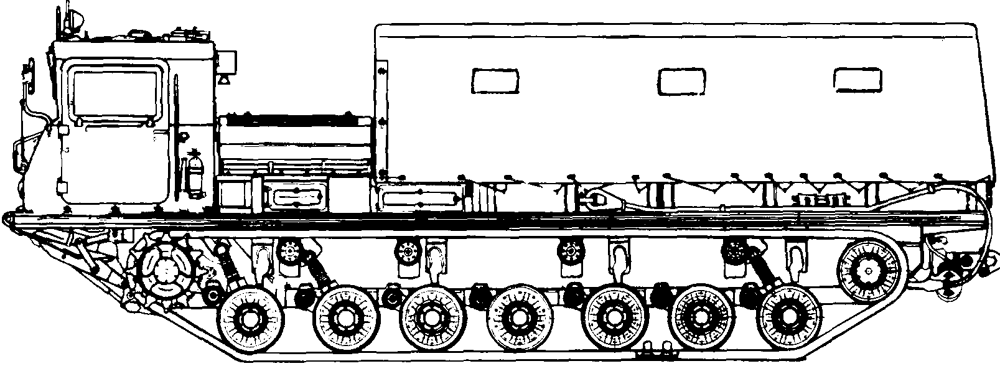 MT-T Tractor used as a base.
The base used for the 9A82 and 9A85 is the same KhZTM MT-T "Eney". MT-T stands in Russian for "Multipurpose Tractor - Heavy", also called Object 429AM ("Izdelie 429AM" GABTU), designed as a soviet general purpose cargo carrier and artillery tractor based on the T-64 and T-64A main battle tanks, renown in its time by a very modern suspension system. The MT-T was produced from 1979 to 1992 and was used as a base to transport various cargo.
General Layout
 9A82 and 9A85 TELAR side by side at Oboronexpo 2014
The 2A82 TELAR is based on the MT-T chassis onto which is located a cab large enough for three operators in addition to the driver, seated side by side behind a 3-windows face. The roof is rigid. NBC protection is optional, a well as air conditioning, but there is a heater drawing from the engine. Due to the size of the missile canisters, the cab is located further forward compared to the standard MT-T. The cab comprises also a small operating room to deploy and fire the missiles, with displays for the vehicle's own illumination radar.
In the chassis aft is located the cradle holding two large canisters for the two 9M82 Giant missiles. They could not be lifted independently, but on a common frame, raised and set in a vertical position by a giant hydraulic arm powered by an electric engine fed in turn by a battery, loaded by the engines when underway. There is an emergency backup APU as well. When the vehicle stops in position to fire, the cradle both pushes back the missile launching frame and erect it until both canisters are raised to 90° elevation.

Meanwhile, the radar arm located when underway between the two cylinders is also raised by its own hydraulic arm, forming a "H" configuration. The operator received data from the command post, and fed data into the illumination radar that guides the missile to target. The two missile can be fired with a delay of 10 seconds between them to avoid heat interference issues. The whole deployment of the 2A82 from underway to launch and back underway is claimed about 8 minutes. There are no grounding telecopic feet unlike trucks as the chassis is far better able to spread the load. The whole vehicle is unarmoured, and unarmed, except for the crew's personal service weapons.
Engine and Performances
It is powered by the same engine, with some adaptations, as the T-64, the V-shaped 12-cylinder four-stroke 710 hp V-46-4 multi-fuel high-speed liquid-cooled diesel engine with direct fuel injection. This output was passed onto a wheel Arrangement comprising 7-roadwheel with single pin tracks and four return rollers, rear drive sprocket and transmission, and front idler. Suspensions are based on torsion bars on all axles, albeit there are completed by hyadrualic dampers on the 1st, second and last axles.
With the fully loaded vehicles around 35 tonnes, versus 25 tonnes for the base MT-T, it is capable of 60 kph on road with an average speed on dry dirt roads of 34 kph, and can reserve at 4.5 kph. Fuel range is around 500 km, for a fuel consumption per 100 km of up to 330 litres. Sme vehicles has a winch that can pull loads up to 25t with a 100 mm steel cable. The vehicle is not amphibious, too heavy for tactical transport by air, but it could ford 1.3m and climb a 32° slope and work under temperature ranging from −45 to +40°.
Detection Types

Target detection ranges varies based on the radar cross-section of the target:
9S15M: 330 km (210 mi). 10sq.m (110 sq ft) cross section or
240 km (150 mi) with a 3 sq. metre (32 sq ft) cross section.
9S19M2: 175 km (109 mi) unknown cross-section, but with two passive electronically scanned arrays, with a very high resistance to interference.
9S32M (TELAR 9A82/9A83): Range 200 kilometres (120 mi) but can work independently or receive target designation, notably from AWACS aircraft and ground-based radar. Radar cross-section targets of 0.1-square-metre (1.1 sq ft) are detected at up to 140 kilometres (87 mi), locked on at 120 kilometres (75 mi). Against MGM-52 Lance missiles, this is 60 km (37 mi).
Againt aircraft launched missiles it is 80 kilometres (50 mi). Against fighter or ballistic missile (like the MGM-31 Pershing) it is 140 kilometres (87 mi). The system ca detect a target with a cross section of 0.05 square metres (0.54 sq ft) at 30 kilometres (19 mi) as well.
At the upper level the S300V uses the command post system 9S52 Polyana-D4, same as the Buk missile system, working in a brigade. Chinese version of this system is the HQ-18.
2A82 Missile
The 9M82 is by far the largest missile in the S300 family, NATO codename "SA-12B Giant". Its range could be as low as 13 km(8.miles) and as long as 100 km (62.1 mi), for a max 30 km (98,000 ft) altitude, which is max also for aircraft, and for ballsistic missiles doing their athmosphere re-entry. The missile 's top speed of 2,600 m/s (5,800 mph). The are 9.9 m (32 ft) long for 1,215 m in diameter inside the canister, for a full weight of 4,685 kg (10,329 lb) filly loaded, each having a 150 kg (330 lb) warhead, optionally nuclear. It is assisted by its own semi-active radar for an on-board homing/Command system taking succession of the illumination radar of the main 2A82 tracked vehicle.
Operators

Egypt ordered S-300VM "Antey-2500" missile systems in 2014, all delivered by 2017.

Russia kept all variations of the family. including the S-300V/S-300V1 with 2000 total launchers. Production stopped in 1994, upgrades commenced and by 2015, all S-300V4 systems had been delivered. Modernization of all S-300Vs to S-300V4s was shedued to end in 2012.

Ukraine still operates the S-300V1 ang other systems. Only six were kept in working order between 2004 and 2014. 4 more were overhauled in 2014–15. The country had around 100 batteries of all types in 2022.
| Specs 2A82 TELAR |
| Dimensions: | 8,711 mm x 3,420 mm x 2,720 mm |
| Weight: | MT-T: 25t, 9A82 35+ tonnes (5 ton per canister) +radar arm |
| Load: | Load capacity 12t: 2x Missiles |
| Crew: | 1 driver + 2-3 operators |
| Propulsion: | V12 710 hp |
| Speed: | 65 km/h |
| Range: | 500 km |
| Production: | Unknown, c400 systems. |
Sources
S-300VM_missile_system
APA-S-300V-TELAR-TL
deagel.com
army-guide.com
S-300_missile_system
commons.wikimedia.org
trumpeter-china.com
9A82 TELAR on armorama