Brossel TAL
 Belgium (1935-1940) 74 built
The Brossel TAL (officially Brossel 780B Tracteur d'Artillerie Lourde) was a heavy 4×4 artillery tractor manufactured by Brossel Frères for the Belgian Army prior to World War II. Designed primarily to tow heavy artillery pieces and trailers across rough or soggy terrain. Only 74 were built between 1938 and 1940. It was noted for outperforming comparable French Latil tractors in testing and that was conformed ny its adoption by the German Wehrmacht after the 1940 invasion.
Development of the Brossel
Given its small production ans relative confidentiality, the Brossel TAL is relatively unknown outside Belgium. It's a shame because it is one of the best wheeled artillery tractors of WW2. The
Société Anonyme Brossel Frères was founded by the three brothers (Paul, Louis and Henri) in 1928, from an already existing car workshop of 1912, one of the first in Belgium, which adapted and distributed Swiss Lorries from Arbenz starting in 1919. After Arbenz stopped production, the facility was purchased and from 1924, newly developed lorries locally started to be marketed. In 1931, Brossel took over and added to this in 1932 the company "Pipe". The plant as located near the capital, Brussels.
New lorries were distributed under the brand name Brossel going from 3 to 15 tons whereas. Lighter vehicles were sold as "Bovy-Pipe". In 1937, Brossel made larger lorries with 4 to 10 tons payload, as well as wheeled tractors and omnibuses and they came in with optional diesel or petrol engines on a list the customer received but the coppany soon developed its own engines. The gearbox was at first manufactured elsewhere, and then by the company itself. Brossel also proposed naked chassis to be completed in partner workshops. The company came under interest from the Belgian army in 1935 that started a timid move towards motorization.
For a new requirement regarding a wheeled artillery tractors, Brossel managed to be selected for a production of a 4x4 wheeled artilley tractor derived from its previous utility tractors, notably used for salvage. Brossel started developing the TAL in 1935 and it was accepted in 1937, with a production starting right away and going on until 1939. A total of 74 were produced for the Belgian Army due to the lack of production capacity. The plant was a glorified workshop with pre-taylor organization, hand-made with a slow delivery.
But for the high price paid and few in numbers, what the Balgian Army paid was still a powerful heavy artillery tractor, featuring four-wheel drive and four-wheel steering, powered by a 125 hp Brossel home made diesel engine with a lot of torque. Itself was coupled to a transmission with four forward gears and one reverse. It was an open vehicle with a two-seat front driving compartment, rear ammunition compartment covered by a continuous metal roof but no doors, sides covered by canvas. It was spartan but well thought.
The reputation of the Brossel TAL (the acronym meant "Tracteur (d') Artillerie, Lourd(e)" or "heavy artillery tractor") went soon beyond Belgian borders. The Belgian Army indeed pitted it against Latil artillery tractors from France, the most reputed, and the latter appeared underpowered, finnicky and not as good on the same terrains. So by early 1940, the Brossel TAL was also tested by the French Army, short of modern heavy artillery tractors. Trials were conducted at Vincennes, and they yielded positive results.
It was indeed proved superior in every respect to the contemporary French Latil M2 TL6. Derspite the reviews, no orders followed in a context of rapidly deteriorating situation. The invasion took place not long after. Even if the French ordered the Brossel, that would have been in the hundreds, and the facility was not able to deliver that many vehicles without a complete overhaul of the production and radical extension, meaning delays. In this what-if situation, French Brossels would have not been delivered before the end of 1940.
Design of the Brossel TAL
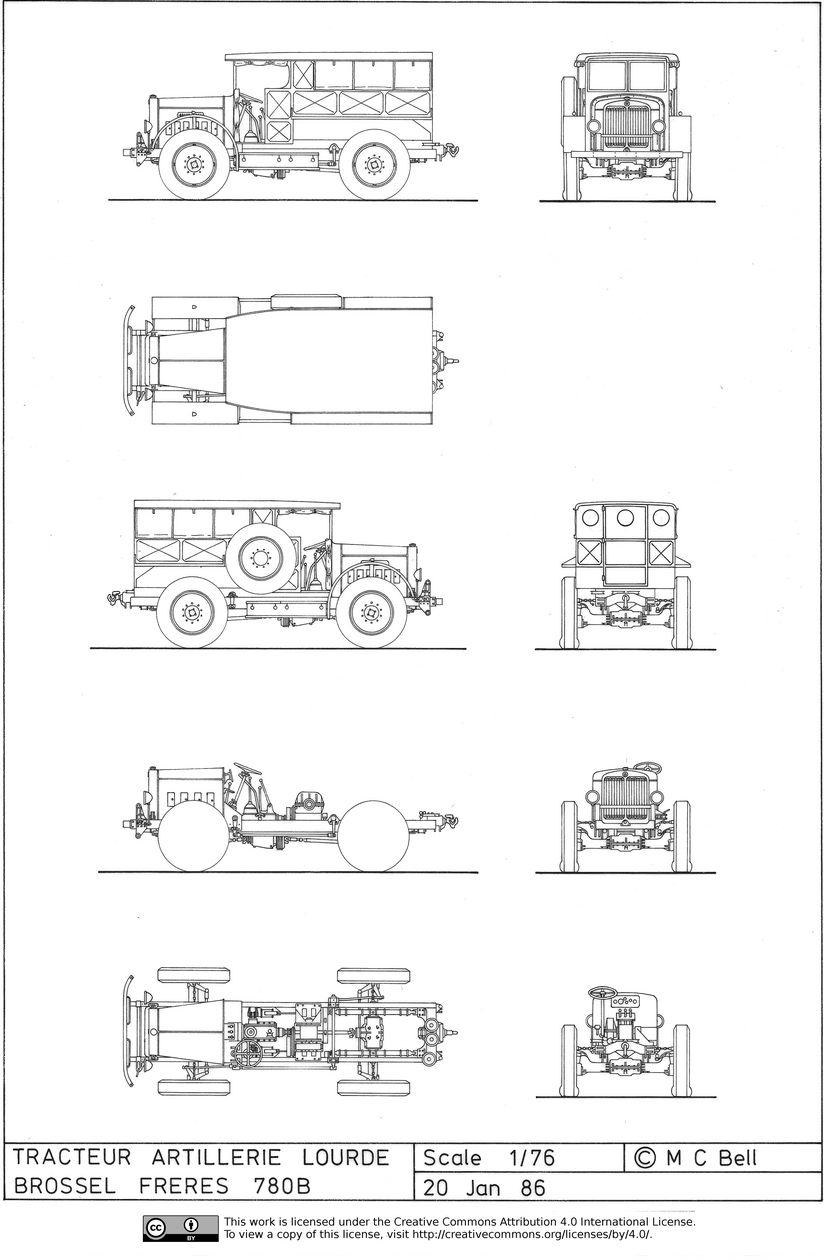
The Brossel 780B Tracteur d'Artillerie Lourde was truck-like, with large wheels for a better traction on muddy terrains, but not excessively large like for some contemporary Italian wheeled artillery tractors. The vehicle weighted 6,390 kg in full order (filled and ready), measuring 5,47 meters (18 ft) for 2,81 meters wide (9.2 ft) and 2,33 meters tall (7.6 ft). This full 4×4 vehicle (true all-wheel drive) was powered with a 6-cylinder engine in-line, diesel (in-house Brossel type) which was liquid-cooled, with a capacity of 9,350 cm3 or 9.3 metric liters capacity. It was rated for with an output of 125 HP (93 KW) at 1,800 rpm. However the same was available in petrol or diesel versions respectively of 70 or 95 hp, both with the same Brossel four-speed transmission. This traduced on a top speed of 60 km/h on road, unladen, not towing anything, which was not bad for that category.
Off-road, when fully loaded and towing a 155 mm this fell rapidly on a difficult terrain to a crawl, but the engine was not short of torque. The range, on road was an appreciable 380 km (236 miles) also reduced with a full towing load on bad terrain outside roads. The Brossel 780B could also tow utility trailers. The Belgian asked Brossel to come with a split trail for the artillery that would allow a "train" with an ammunition trailer followed by the howitzer. The vehicle served as the prototype for the Fabrique Nationale d’Armes de Guerre company in Herstal in the development of the FN 63-4RM wheeled tractor.
The Brossel 780B had a classic arrangement with a forward bonnet and longitudinal engine behind a large radiator, side louvres, tall, simple mudguards over the forward axle, and two direcitonal lights on top, then two road lights mounted over the bunper and protective frame. Pas the mudguards and the steps below the cabin supported two large utility storage bins for tooling. There were fuel tanks just behind, and straight mudguards over the rear axle. Above in the flatbed was the utility storage space for ammunition crates, and benches for the artillery crew, seating either side outwards. The upper part was covered with tarpaulin panels.
The forward cab was open, with canvas doors, a bench large enough for three. The metal roof could be removed and the split windshield integrating the rear mirrors and top wipers could be folded down forward. In winter, the vehicle could be covered entirely by tarpaulin panels. The vehicle had large military roadwheels on leaf spring suspensions. The vehicle was unarmed, except the small arms carried by the gun crew. The vehicle as unique by its cross-shaped panels.
specifications Brossel 780B |
| Dimensions | 5,47 x 2,81 x 2,33m |
| Payload | 10 tons towed, 3t in flatbed |
| Crew | Max 3+ 6 (driver, co-driver +, 6 gun crew) |
| Propulsion (Chevy) | 6-cyl. liquid C. 9.3L, 125 hp/1800 rpm |
| Transmission | 4x4, Brossel 4+1 gearbox |
| Top speed | 30 to 60 km/h off-road/road |
| Fuel consumption | Unknown |
| Suspension | Leaf spring, 4x4 |
| Maximum range | 80+ liters tank, 380 km road |
| Armament | None |
| Production | 74 |
In Belgian Service
The 74 TALs were delivered on time before and during the war in 1939 used by Belgian support artillery units organic to divisions or above. They were used for towing French Schneider 155 mm heavy guns lookalike. That caliber became standard for the US and ultimately a NATO and international standard to this day. The CANON DE 155 L MODELE 1924 was a rear beast under command of the whole Army as only 24 were made by Cockerill. They had a crew of 10, could elevate to +26° with a 4° traverse either side, using a horizontal Sliding Wedge breech, with hydropneumatic recoil, Box Trail carriage, 4.721mm (L/30.48) barrel lenght for 8.900 kg in traction, 7.840 kg in action.
The model 1924 fired 43 kg (HE) rounds at 665 m/s (1 r.p.m.) to max 17.000m (). They were were mounted on carriages taken from obsolete Krupp M.1909 guns and had to be separated into two parts for traction, onli issued to heavy regiments at army level.
In German Service
They were few, but aparts those destroyed, most Brossel TAL would be captured and integrated in the Wehrmacht after the fall of Belgium. They were used both in petrol and diesel versions, and painted in standard dunkelgrau with standard markings. They were not the only Brossel vehicles used, as thr Germans also requisitioned ands operated the Brossel BCS AU6S, AB 6, A40D, AB 6D, 6D 115 and an Omnibus type. Some of the Captured vehicles were reused by the Wehrmacht as specialist vehicles, like a crane-equipped recovery vehicle. Their excellent off-road caracteristics meant some were sent to the eastern front.