Bedford OX (1939)
 Medium 4x2 1.5 ton lorry, 24,429 produced 1940-45.
The Bedford OX was a short-wheelbase 1.5 ton payload short wheelbase 4x2 lorry manufactured for the British Armed Forces. It was presented in 1939 and ubiquitous in World War II with ver 24,000 delivered, including civilian configurations. The main variant was of course the general purpose OXD standard General Service (GS) for cargo and personnel. The OXC was a specialized tractor made for semi-trailers by Scammell. The OXA was an improvised armored vehicle conversion only used for home defense. It was named also from its 30 cwt (1.5 ton) payload, half the original Bedford OY but it shared most components, including its semi-forward cab idetical to the 15-cwt Bedford MW and the rest with the OYD. It was also powered by the same engine, ensuring the creation of the heavier OXA or "Lorry 30cwt Anti-Tank" developed in 1940.
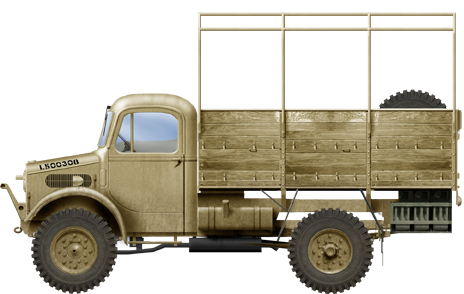
Development
The British army needed a fast and agile infantry lorry and specified it withing the trucks procurement order of 1939 submitted to the government when the war broke out in 1939. All British manufacturers were sollicited for lorries and medium to heavy trucks. This resulted in a four-wheeled, 2-wheel-drive Bedford OY to haul 8,500 lb (3,800 kg) albeit being officially rated under the three-ton (3,000 kg) category. Bedford began manufacturing GM trucks from 1925 after Vauxhall Motors was purchased. The latter started assembling trucks from 1931 for the civilian market and they proved popular and respected. In all, Vauxhall delivered 30,000 Bedford trucks by 1937.
In September 1939, the War Department still counted 85,000 vehicles, 26,000 of these being ex-civilian of all brabds. Vauxhall already started work on a 4x4 military truck before the war. Its development process was completed by September in order to get this juicy "off the shelff" contract in order to start mass production. This resulted in many 4x2s OY and OX trucks, both derived from the civilan O series.
The Bedford OY was slighlty modified compared to the commercial ready design (COTS) but it was given a simplified bodywork, and single rear tires of the new standardized military off-road type. The OX was cut from the same cloth, but with a shorter wheelbase and chassis, and both in production came up with wooden or metal rear bodies to spare strategic materials. As war progressed, metal panels became the norm. The two platforms, OY and OX diverged by size and payload.
The OY was a three-ton truck (72,000 manufactured, to compare to 250,000 global), made at Luton by early 1940 as soon as the contracts were signed. The OX was the 1.5 ton variant, so half that. But in practice they routinely can hanlded 2 tons. The base was the same apart their smaller size, making them a bit more lively and agile. They had (especially the OXD) the same mission, but were preferred on degaded terrain over the OYD as having more torque and being easier to manoeuver around. Overall "only" 24,000 or a tenth of the globa Brtish truck production in wartime, were made, so a third of the OY production.
Design
Chassis and general design

The OX Delivered to British forces were essentially identical to the OY, derived from the 1939 Bedford O-series, apart their much smaller wheelbase, and thus, overall lenght. The flatbed was the same, just shorter and with less arches. The Bedford OX measured 4.95 m (245 inches) in lenght for a wheelbase of 111 inches (2.82 meters). It was 2.18 m (86 inches) wide like the OYD and in height c3.20 m (126 inches) but this varied with or without tarpaulin, and some completed as specialized cab trucks. Weight was empty (kerb/mass) approximately 2,629 kg (2.59 long tons) for a total gross weight of 4,129 kg (4.06 long tons) and was rated 30 cwt (1.5 long ton or 1,524 kg) for its military payload.
There were difference in final design, with some completed (early type) with wooden panels to spare materials, and later in the war, with metal panels. Some versions used to carry artillery pieces saw the the sides of the body taller, and with the tilt raised to provide headroom. This outfit had two functions, to act as a "slave" or help starting other vehicles, including tanks in the field and to act as a spare battery carrier and charging plant and as a minor repair facility for wiring and electrical equipment.
Indeed it could carry two CAV 12-volt dynamos mounted below the floor which together with the 30-volt slave battery charging dynamo, could be belt-driven by a gearbox as power take-off, all supplied by Spurling Motor Bodies Ltd. The OX-version as a 30cwt truck was sliggtly different if it was a GS version or
tractor. The latter or OXC was a pure tractor, with an even shorter wheelbase and the chassis hosting an attachment bollard gear for a semi-trailer by Scammell. The armoured OXA was an antirely different animal but was the only armoured version in the Bedford "O" series as the larger OY series were alreadly too long to support the weight of an armour. The compact chassis was far better suited (see below). Civilian variants of the OX was available also from 1941. All this made a grand total as said of something like 24,429 OX lorries.
Mobility
The OX was powered by a Bedford in-house 6-cylinder, type WD, 3.519 cm3 (214 cubic inches) displacement, and liquid cooled. It was rated at 72 hp at 3.000 rpm. It was liquid cooled, running on petrol. Despite of this there was a radiator forward, air cooled. It was rated for 72 horespower at 3,000 rpm. Transmission was 4-speed, without transfer case. To compare the OY series had the same, despite being much larger. For the starter, de-icing, lights and dashboard, there was an electrical system rated for 12 volt.
The Brakes were Hydraulic, with vacuum servo assistance. The Tyres were of the standard military 10.50 - 16 type, with broad serrations for off-road use. However 34x7 dual rear tires were later chaged for 10.50-16 oversize single tires to improve off-road performance. For more details and niceties seens the Beford OY.

specifications OX |
| Lenght | | 8 ft 8 in (2.64 m)
| Width | 6 ft 6 in (1.98 m) |
| Height | 2 ft 3 in (0.69 m) |
| Wheelbase | 111 inches (2.82 meters). |
| Kerb Weight | 2,629 kg (2.59 long tons) |
| Payload | 30-cwt (1.5-ton) |
| Crew | 1 driver +10 passenger |
| Propulsion | Bedford 3.5 L 72 bhp I6 petrol |
| Transission | Manual, 4-speed: 3 fwd, 1 rev. |
| Suspension | Leaf Spring |
| Speed (road) | 65 kph |
| Range | c450 km |
| Armament | None |
| Production | 24,429 |
Variants
 OXC with the "Queen Mary" trailer and a damaged Mosquito fuselage. Note the horns and spare tyres for the Scamell Trailer.
OXD:
OXC with the "Queen Mary" trailer and a damaged Mosquito fuselage. Note the horns and spare tyres for the Scamell Trailer.
OXD: The standard General Service (GS) cargo and personnel truck.
OXC: A specialized tractor variant modified by Scammell to tow semi-trailers, including large aircraft-recovery "Queen Mary" trailers.
OXA: An improvised armored vehicle conversion fitted with an armored body and a Boys anti-tank rifle, used for home defense.
The Bedford OX in action
 Bundesarchiv, Bild 101I-715-0212A-26A / Kreutzer, Wilhelm / CC-BY-SA 3.0 [CC BY-SA 3.0 de (http://creativecommons.org/licenses/by-sa/3.0/de/deed.en)], via Wikimedia Commons
Like the Bedford OY, by far the most affluent of all British trucks in WW2, the smaller OX, and in particular the OXD, making the immense majority of the production, became also ubiquitous. They were used in the same general purpose (GS) roles, either as troop carriers, capable of carrying ten infantry on bunks in the rear flatbed, with the officer seated forward, or payloads of all types up to two tons in emergency. The 1.5 tons formal capacity was an official classification and manufacturer's recommendations, but the needs of the battlefield means those deployed close to the depots at the rear of the line often carried two tons or more.
This of course shortened their life, taking their toll on the axles and suspensions, as well as the engine, especially over difficult terrain. Vehicles used in rear depots or back at home were not that overtaxed and were eagrly looked well after the war by collectioners as they were in general in better shape overall. They were on paved, good roads most of the time, and carried their prescribed load.
Now the Bedford OX were seen on all theaters where the British Army was present. The very first with wooden body were ready on tim to be deployed as part of the BEF in France in May 1940 for example, but they started service in North Africa, where their greatest torque and better power to weight ratio was appreciated on bad roads and sand. Still, they never had been developed as off-road military trucs and thus, their capabilities off road were limited.
They also soldiered on in Sicily, Italy, then France, the Netherlands and Germany in 1945. They were still around in Korea as well but started to be replaced already from 1950 by better, more modern models. Plus the small 4x2 trucks fell in disregard post-WW2. They were considered as a waste of resources compared to their payload. The Bedford OX was also sent to Russia via lend lease. Of the 1100 Bedford trucks delivered to Russia in 1942, some were OXD 1½-ton (30-cwt) 4x2 truck, the others Bedford OYD 3ton 4x2 or QL 3-ton 4x4.
Thus, between north africa and Russia, many were also captured by the Germans and integrated into the Wehrmacht. They were used for example by the 1. Kavallerie Division from 1942, later reorganised to 24. Panzer Division, no longer under Panzergruppe Guderian but Panzergruppe Kleist. The main issue with this type like other captured allied trucks was the lack of spares. It seems the Bedford OX was never deployed in the far east. Being a COTS vehicle tailored for European Conditions, it would probably not last long under tropical conditions. On this threater, the British preferred to use more rugged US made trucks.
 RAF Bedford OXC with the "queen Mary" trailer.
And there was the case of variants. The Bedford OXC tractor made by Scamell, was trailored to haul several types of semi-trailers. They were used thus by the RAF with the blue-grey livery, or camouflaged when used in the field, to carry spare parts or knocked-down aircraft from depots to airfields, or back to depots and workshops for repairs. The trailers were large enough for any fighter. However at 73 hp, these OYC were not powerful enough to carry tanks, apart smaller ones like the M3 Stuart. It seems no OX variant was tailored as specialized truck with dedicated cab. The OXD was also used by the Navy in bases, in that case showing the dark grey livery.

As for the OXA it was a case of emergency conversion in the style of the "Beaverettes" using existing chassis for armoured vehicles, destined to the home guard after June 1940 and used until all invasion danger was ended. The Home guard, aside what left of the small professional core of the BEF landed in France in 1940 and mostly rescued at Dunkirk and other ports until June, needed desperately new armoured vehicles. The British tank industry was still in its transition with peacetime level schedules, and in case of a German invasion, armoured vehicles were needed fast. All the available chassis that could be converted were. Small trucks and lorries were appreciated because of their higher torque to weight ratio and small size ideal to fit armour.
 Before the OXA there were also improvized conversion for the Home Guard, like this one.
Thus was created the Bedford OXA, the only armoured car derived from the famous O series. Improvized on the 30cwt (1.5 ton) truck chassis, it had an armoured casemate replacing its rear flatbed, armed with a Boys anti-tank rifle. Thus its official designation was "Lorry 30cwt Anti-Tank". A total of 948 units were built in 1940–1941, and they were als used by regular British Army units in 1940 but most went to the British Home Guard units until 1942 as better, specialized models came about in between. Between its limited off-road capabilities and relatively weak engine for an overall weight of 6.5 t (6.4 long tons) for 11.1 hp/tonne it was not quite fast at 40 mph (64 km/h).
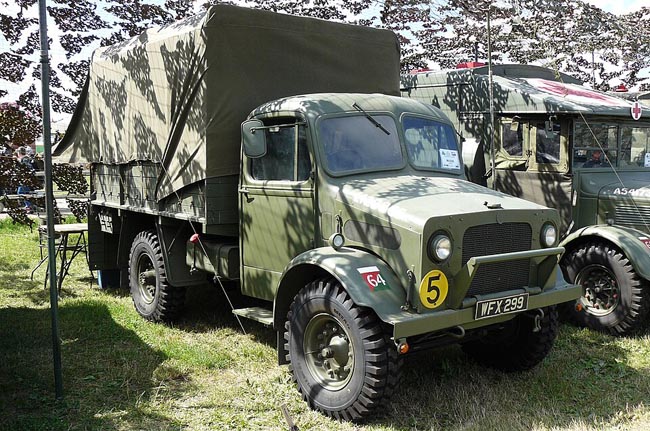 Bedford OXD
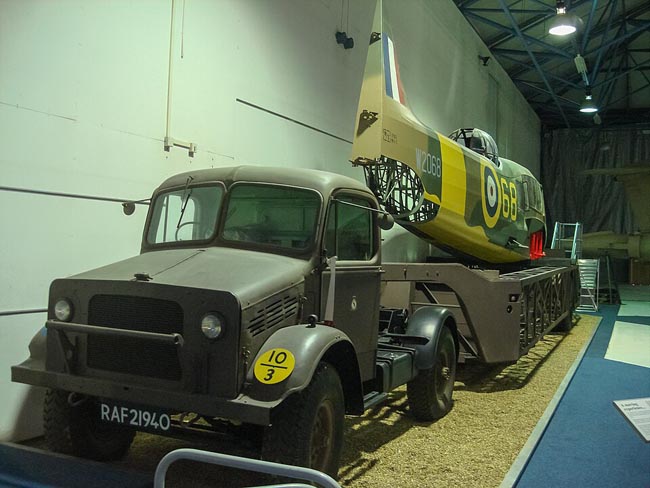 RAF Museum London OXA tractor