Kamaz-341v Leer (2015)
 Russian Kamaz-341v Leer truck (2015-2026)
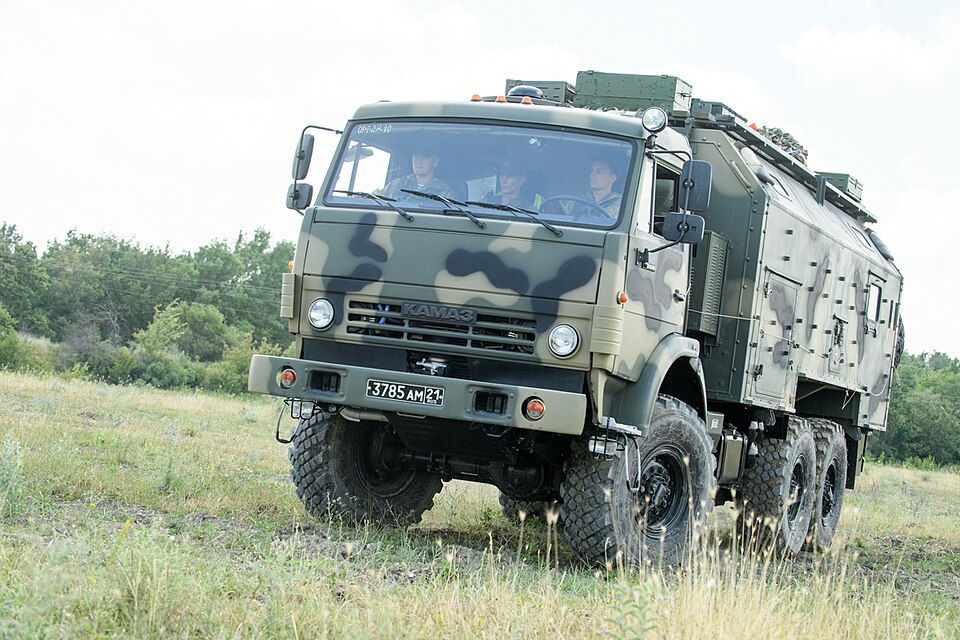
The RB-341V Leer-3 is a Russian mobile electronic warfare system mounted on a KamAZ-5350 6x6 truck chassis. It is deployed generally in 30 minutes after arrival, comprising a command and control Post housed inside the truck's rear cab, with workstations for operators. It is capable of operating three Orlan-10 unmanned aerial vehicles (UAVs) launched for a portable catapult and of Cellular Jamming within a 3.5 to 6 km radius or imitating a mobile phone tower to intercept signals and hijack local communications. It could be used to sends fake text messages, audio files, or notifications to mobile subscribers in the target zone after locating enemy transmitters and tracking high concentrations of mobile devices. Used in Ukraine and effective in 2020 until countermeasures taken from 2022 onwards. It is no longer used today and likely reset for new missions and to command or jam a new generation of drones.
Development
The RB-341V "Leer-3" is a modern Russian electronic warfare (EW) and signals intelligence (SIGINT) system specializing in GSM cellular networks. A distinctive feature of the system is the delivery of its EW and SIGINT assets to the target area using unmanned aerial vehicles (UAVs). It was developed and is manufactured by the Russian company Special Technological Center LLC (St. Petersburg) and produced since 2015. Exact number delivered is classified. It was first unveiled to the general public in early October 2015 at the "Southern Military District Innovation Day" exhibition with Western Military District specialists starting operational drills until the end of the year.
By 2016, specialists from the Penza-based Radiozavod JSC, Ruselectronics holding workong with the "Special Technological Center" developed a new mobile ground-based remote control station (MNPDU) on this vehicles, powerful enough to guide Orlan-10 UAVs. This station could maintain control over up to three UAVs simultaneously, for 24 hours and up to 100 km. The same system could simultaneously receive photo and video data from three drones at onces, identify targets and monitor wind speed/strength, ambient temperature, transmitting this data to the MP32M1 command-and-staff vehicle, acting command post vehicle for rocket trucks, correcting for fire calculation and adjustment.
Design
The carrier: KamAZ-5350

The KamAZ-5350 "Mustang" is a rugged, 6x6 all-wheel-drive tactical military truck manufactured by the Russian automaker KamAZ in Naberezhnye Chelny. Introduced in 2003, it serves as a core transport and logistics asset for military operations. It succeeded older truck families like the KamAZ-43118 and forms the backbone of the Mustang family alongside its 4x4 (KamAZ-4350) and 8x8 (KamAZ-6350) counterparts.
It feaures an 6x6 all-wheel drive, optimized for severe cross-country terrain.
The Engine is a KamAZ-740.622-280 V8 diesel engine. Its power output is 280 horsepower (cv) at 1,900 RPM with 1,177 Nm of torque.
The Payload Capacity is 6-tonne (13,227 lbs) while towing artillery or trailers. It is 7,690 mm in length, 2,500 mm in width, and 3,080 mm in height woth a ground Clearance: 390 mm, allowing high off-road mobility.
Designed primarily for troop and cargo transport, the basic chassis was adapted for multiple specialized roles like integrated armored command modules, or as base for the "Patrul-A" armored vehicle, or as carriers of electronic warfare systems or mobile rocket launchers. The closely related KamAZ-53501, features a slightly altered payload structure.
The Payload: RB-341 cab
The RB-341V Leer-3 capabilities had been thus expanded thanks to modularity inside the rear cab, and interchangeable payloads. It was tactically designed for a set of capabilities, since 2016 expanded to:
- Suppression of mobile communications.
- Simulation of cellular base station operations in the GSM 900 and GSM 1800 bands, and spoofing
- Reeconnaissance by locating signals within GSM networks. Detection of terminals such as mobile phones, tablets...
- Plotting the location of terminals on a digital map.
- Transmitting terminal location data to artillery crews for fire strikes.
- Aerial surveillance of the battlefield situation and troop movements
- Assessing the status of army and naval facilities
- Terrain analysis
The Leer-3 system is capable of performing these missions in any area for 10 hours, using a single UAV. It was setup for high resilience against enemy electronic warfare countermeasures. The operating crew comprises five personnel. There is on the roof an UAV control vehicle featuring automated operator workstations and a command-and-telemetry radio antenna-feeder system, all based on the KamAZ-5350 chassis.
There are racks also to hold one or two Orlan-10 UAVs and an inclined launcher (catapult) for UAV takeoff, plus interchangeable payloads.
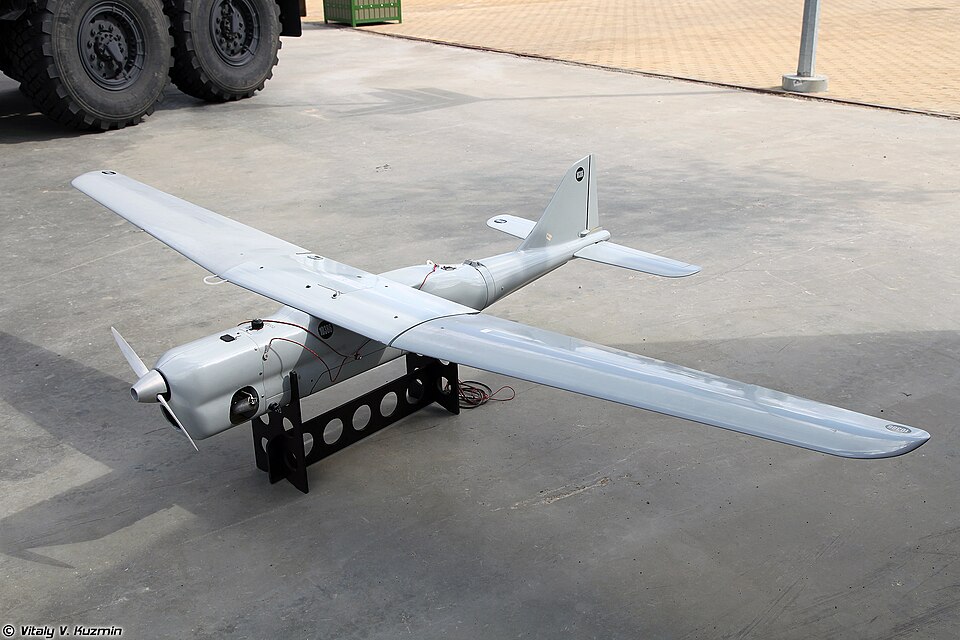 Orlan-10 UAV at TB2015 Exhibition
⚙ Kamaz-341v Leer specs. |
| Weight | 6-7.3 ton curb weight |
| Dimensions | 7,69 x 2,5 x 3,08 m (4.5 m antenna deployed) |
| Propulsion | KamAZ-740.622-280 V8 diesel 280 hp (191 - 206 kW) |
| Suspensions | 6x6 all-wheel drive |
| Speed | c90 kph road |
| Range | c600 km |
| Armament | None, 3 recce drones |
| Crew | 1 driver, co-driver + 5-6 operators |
Kamaz-341v Leer in action
Syrian Civil War
Reports of the system's use in the Syrian conflict have emerged since 2016.
Nagorno-Karabakh
On November 15, 2020, a number of vehicles were spotted en route to the city of Stepanakert (Khankendi) as part of the peacekeeping mission in Nagorno-Karabakh.
2014 Crimean invasion and 2022 Russian Invasion of Ukraine
The Leer-3 was first spotted in Donetsk in the summer of 2015, shortl after entering service and subsequently appeared in a video filmed in the Donetsk region in the spring of 2016. On August 10, 2018, the OSCE Special Monitoring Mission reported that with a mini-UAV on July 28, 2018, it had observed an RB-341V alongside other Russian EW systems near Chernukhino, 64 km southwest of Luhansk, an area not controlled by the Ukrainian government.
On March 10, 2020, an SMM short-range UAV detected three electronic warfare systems, including one RB-341V "Leer-3," an R-934B "Sinitsa" and one RB-636 "Svet-KU") in the southern outskirts of Luhansk, among separatist forces. This was viewed by journalists and experts as evidence of Russia's involvement in the war in Donbass. It was widely used during the 2022 invasion of Ukraine. but according to RUSI, demonstrated low effectiveness; due to its prolonged use in the Donbas, so that Ukrainian forces became familiar with it and were able to develop effective countermeasures.