Krasukha
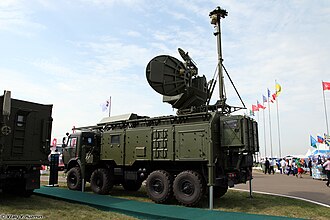
 Russian EW truck (2010)
The Krasukha (Russian: Красуха) which can be transated as "Belladonna" (Deadly Nightshade) is a Russian mobile, truck-mounted electronic warfare (EW) system produced by the KRET corp. on two platforms hence the -2 and -4 variants. The Krasukha is organically used to jam airborne radio-electronics notably those of UAVs as well as all classic airborne systems guided by radar. Thus with the same platform, little changes in hardware, but most changes on software, the vehicle has grown to a large pannel of applications in the Russian Armed Forces. Deployed close to the borders of Russia with Bielorussia and Poland on in the Kaliningrad enclave it was well used for the present conflict in Ukraine since 2022 and recently deployed by Iran.
Development
Development of the "Krasukha" systems started in the mid-1990s. The 1L269 "Krasukha-2" was developed concurrently with the 1RL257 "Krasukha-4" and they differ in their equipment with the Krasukha-2 using analog equipment, and the Krasukha-4 using digital equipment as well as diverging performance characteristics from the chassis used: The Krasukha-2 is mounted on a four-axle BAZ-6910-022 chassis, the Krasukha-4 on a four-axle KamAZ chassis. Most detailed data is classified.
State acceptance trials were completed in 2009 and the first Krasukha-2 stations were delivered to the Russian Armed Forces in 2012. KRET Corps. managed to complete the 2014 state defense orderfor the Krasukha-2 in October 2014. Delivery of two additional systems was planned for 2015 but unsure as of 2025. The initial for the Krasukha-4 was signed on May 26, 2011. A second contract was awarded to the Radio-Electronic Technologies Concern (KRET) on April 23, 2012. A third contract was concluded with KRET on March 27, 2013 for eighteen Krasukha-4 systems and a total of ten were delivered between 2012 and 2013.
Design of the Krasukha
The Krasukha-2 is an S-band system jamming Airborne Early Warning and Control (AWACS) aircraft, notably the Boeing E-3 Sentry at ranges of up to 250 kilometres (160 mi). It could also jam other airborne radars such as those used by radar-guided missiles. The jamming consiting in sending a false target to draw the missile away. The Krasukha-2 is organically used to guard mobile high-priority targets such as the 9K720 Iskander SRBM. It is mounted on the tactical truck 1L269.
In contrast, the Krasukha-4 is a broadband multifunctional jamming station mounted on a BAZ-6910-022 four-axle-chassis, complementing the Krasukha-2 .The model 4 operates in the X-band and Ku-band, counteing airborne radar aircraft such as the Joint Surveillance Target Attack Radar System (JSTAR) from the Northrop Grumman E-8. The Krasukha-4 even has enough range to disrupt low Earth orbit (LEO) satellites. At closer range it was taunted as capable of causing damage to any targeted radio-electronic devices. Ground based radars could be also targeted.
The Krasukha-4S is an improved variant, highly enhanced, unveiled by KRET Corp.in March 2024. This EW system was deployed to protect industrial facilities, military units and command pots from Ukrainian drone attacks. It is also evaluated by the Russian Armed Forces of the Northern Military District.
About the 1L269
The 1L269 system could be aither the Kamaz-based Krasukha 4 or Baz based Krasukha 2. The former was chosen for its lower platform cost. The seacond is a high-en heavy military chassis used usually to carr SAMs and ballistic ordnance, there modified as a mobile electronic warfare (EW) system. The Krasukha 2 is based on a cheaper, rugged Kamaz 8x8 all-terrain truck chassis, also designed to jam airborne radars, low-earth orbit spy satellites, and unmanned aerial vehicles.
The BAZ-6910 is today unarmed and unarmoured, designed for Electronic counter-measures and broadband radar jamming with a effective Range of up to 250–400 kilometers against airborne targets and specific radar bands. It is deployed with the Iskander tactical ballistic missile batteries.
The cheaper Kamaz-based Krazukha-4 is based on the same base chassis xxx, and uses the same hard cab aft as she Shipovnik-AERO TV signa jamming truck. The same chassis is aso used by the
Pantsir S1 truck. The all-wheel-drive tactical truck KAMAZ-4310 and modern "Mustang" family (KAMAZ-4350, 5350, and 6350) are the backbone of Russian military logistics, troop transport, and missile system mobility. So this lowers costs considerably.
The 8x8 variant KAMAZ-6560 is a heavy 38-ton class multi-purpose truck used for specialized transport and military systems and the KAMAZ-63501 is a 26-ton class variant for logistics wh a payload of 14-ton plus 11-ton trailer. The KAMAZ-65951: A modern heavy industrial and off-road variant with enanced off-rod options. The 8x8 wheel drive (eight wheels, all driven) of the model 6560 is powered by a KamAZ-740.35-400 turbocharged diesel.
Power Output is 400 horsepower and as a maximum Torque of 1,570 Nm. It is coupled with a ZF 16S mechanical gearbox, 16-speed manual with remote control (Automatic with torque converter optionally featured on specialized weapon platforms). the transfer Case is a 2-speed mechanical control (1.536 low gears/0.890 high gears). All for a top Speed of 90 km/h (56 mph) on paved roads and a cruising Range of approximately 800 km (497 miles). The Cab Type: Forward-control, two-man crew. Unarmed and unprotected. It Can cross water obstacles up to 1.8 metres deep without preparation. It is also able to clear gaps up to 1.4 metres wide and climb vertical steps up to 0.55 metres and vertical gradients up to 60%.
The drivetrain comprises for the front Suspension: 12 leaf springs with two hydraulic double-acting shock absorbers and an anti-roll bar. For the rear Suspension 13 leaf springs, balanced system with an anti-roll bar to prevent rollover during high-speed turns. The Tyres are 16.00 R20 tube tyres (designed for extreme off-road pressure). The Brakes are Pneumatic with ABS. There is also a Central Tyre Inflation System (CTIS).
The Krasukha-4 mobile electronic warfare system jams spy satellites, ground-based radars, and AWACS (Airborne Warning and Control System) aircraft. The Krasukha-4 system provides complete protection against radar detection within a range of 150–300 km and can also disable enemy electronic warfare and communications equipment via radar-frequency interference. The system operates by generating powerful jamming signals across the primary frequencies used by radars and other radio-emitting sources. For the manufacturer it is mounted on a BAZ-6910-022 four-axle chassis by Bryansk Electromechanical Plant (BEMZ) OJSC.
The electronic composition of the truck is unknown, classifed, and onlt deduced from analyst's work from photos. Its internal architecture comprises digital computing, high-frequency signal generation, and highly directional beam-forming hardware distributed across two KAMAZ-6350 8x8 trucks (or occasionally BAZ-6910 chassis). One vehicle serves as the command/operational post, while the other houses the main emitter array.
Frequency Coverage and Waveband Composition:
Unlike its sibling system, the Krasukha-2 (which targets lower-frequency S-band search radars), the Krasukha-4's electronic suite is tuned specifically for super-high-frequency (SHF) spectrum bands. It covers a core operating waveband of 1 GHz to 18 GHz, with extended capability up to 40 GHz:
X-band (7.9 GHz to 8.4 GHz): Targets tactical fire-control radars and satellite imagery arrays.Ku-band (10.9 GHz to 14 GHz): Suppresses airborne synthetic aperture radars (SAR) and high-resolution imaging used by platforms like the U.S. E-8 Joint STARS.
Ka-band (18 GHz to 40 GHz): Disrupts ultra-high frequency satellite communications (SATCOM) and millimeter-wave radar seekers.
Antenna and Transmitter Ensemble:
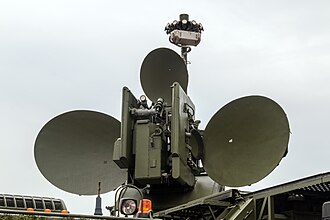
The physical hardware tasked with intercepting and overwhelming signals includes:Triple Parabolic Emitter Array: Mounted on the roof of the primary jamming vehicle. These dishes rotate 360 degrees and tilt rapidly on automated gimbals, allowing for highly responsive beam steering and multi-target engagement.
Telescopic Signal Intelligence (SIGINT) Mast: Housed on the second vehicle to elevate passive interception antennas. This mast sniffs out enemy emissions to calculate exact coordinates before active jamming begins.Travelling Wave Tubes (TWTs) / Solid-State Power Amplifiers: The core internal energy drivers. They generate a highly focused, dense radiofrequency (RF) beam intended to overpower the weak return signals of target radars.
Signal Processing and Internal ComputingAccording to technical documentation and manufacturing insights from the Bryansk Electromechanical Plant:Digital Radio Frequency Memory (DRFM): The system utilizes DRFM technology to capture an incoming hostile radar signal, instantly digitize it, alter the data (adding deceptive range or velocity details), and retransmit it back. This creates a "smart" blend of deceptive and noise jamming rather than just raw, blunt interference.
Automated Threat Assessment Processors: The system can function in a fully automated tracking loop. Internal computers scan the local RF environment, detect an active signal, match its signature against a pre-loaded digital threat library, prioritize it based on threat level, and select the optimal jamming waveform.Primary and Back-up Mode Synthesizers: These generate waveforms that target the fundamental operating frequencies of enemy sensors, as well as their reserve and frequency-hopping channels, effectively blinding the target asset.
Support and Power ElectronicsInternal Multi-Kilowatt Generators: Generating focused RF streams across hundreds of kilometers requires immense power. The chassis features auxiliary power units (APUs) capable of driving the high-voltage power supplies needed for the amplifiers.Liquid Cooling Manifests: High-power microwave and RF generation creates extensive thermal build-up. The electronics shelter includes a dedicated heavy-duty climate control and liquid cooling unit to keep the processors and transmitters from overheating during prolonged active cycles.
⚙ Krazukha 4 specs. |
| Weights | curb 17,025 kg, Gross 38t |
| Dimensions | 10,325 × 2,550 × 3,390 mm |
| Payload | 20,000 kg (20 tonnes) |
| Propulsion | KAMAZ-740.63-400 (Euro-3/4 standard) V8 turbocharged diesel 11.76l 400 hp (294 kW) |
| Speed | 90 kph road |
| Range | Dual tanks 700 litres, c900 km. |
| Armament | None |
| Crew | 1 driver +4 operators |
Krasukha in action
Krasukha vehicles of the -2 variants were reported first seen action in Syria, blocking small U.S. surveillance drones from receiving GPS signals. As the Turkish intervened in the Syrian civil war, it was claimed jamming ad causng the crash of a Bayraktar drone, loosing control. The Israeli Defense Force (IDF) in 2021 met the vehicles (-4 variant) GPS denial system in action. This forced the subsequent development of non-GPS weapons targeting, anti-GPS-jamming technology in the same conflict and facing the Hamas.
In July 2018, an OSCE monitoring mission drone detected a 1L269 Krasukha-2 near Chornukhyne in Ukraine. In October 2015, the Russian Aerospace Forces deployed the "Krasukha-4" at the Khmeimim Air Base in Syria and claimed they were used to down "some American Tomahawk cruise missiles" launched at the Syrian government on April 17, 2018.
Later a Krasukha-4 claimed to have grounded an American AH-64 Apache attack helicopter in Syria. It went so far as damaging its electronics. In 2020, Russian claimed a Krasukha operated off the base at Gyumri in Armenia, countering Azerbaijani Bayraktar TB2 drones and the Israel Harop loitering munitions. The model 4 was successfuly exported to Azeri forces later in August 2021. So far the system had been exported to Algeria, Ethiopia, and Libya.
Krasukha-4 had been famously used in the Russian invasion of Ukraine since 2022. Ukrainian forces captured near Kyiv. The truck showed some damage and was sent to the US for examination. It was captured on the outskirts of Makariv and at first sent to the US Air Force base at Ramstein for initial analysi before the United States for more detailed study. It was used to jamm Starlink signals as well as for targeting, drones, and artillery. However more recently the density of the satellite architecture and software updates rendered jamming neffective.
On 9 August 2023, TASS stated that the system was about to be purchased by "several Southeast Asian nations", but so far only Vietnam had been confirmed and in Europe, Serbia in addition to the Sapphire EW systems. By August 2025, it was confirmed exported to Iran and very likely took part in jamming operations since the ongoing 2026 atack on Iran following the closing of the Hormuz strait.