Vityaz DT-30 (2003)
 Articulated Tracked Vehicle (2003): 150+ manufactured
The Vityaz DT-30 is a heavy, two-unit articulated tracked all-terrain carrier with a 30-tonne payload capacity designed to haul cargo and equipment across extreme off-road environments like swamps, deep snow, deserts, and Arctic or Antarctic terrain. Developed in the Soviet Union starting in 1971 by the Ishimbai Transport Machine-Building Plant (Ishimbaitransmash) and entering service in the 1980s, was declined into multiple version. The DT-30PM is the lastest in the lineage, entering service in 2003 and declined since into the DT-30E, PE1, DT-30MNE, DT-30PMNE1, DT-30PK8-1, DT-30PMN, 2S39 Magnolia, Pantsir SA and Tor-M2DT. It used both by the Military and Civilian sectors and soe were lost in Ukraine.
Development of the DT family
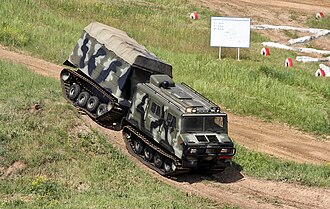
By the early 1960s, the Soviet Union looked at the Swedish own articulated tracked vehicles for badly served areas, lacking road, tracks and mixing swamp and mud. The "ATV" was to be unlike the already capable LT-LB, armoured, but wcheaper, lighter, and with more payload as a swamp-going vehicle. The initial requirement was for 5 tonnes (4.9 long tons; 5.5 short tons) payload. As there was no specialist in USSR, a specialized design bureau was established for development, notably to provide services on the USSR northern borders.
In February 1971 the first two ATVs such vehicles designated DT-LP and DT-L, saw their State trials and by playing with the track and axles, a family was created, the DT-10P, DT-20P and DT-30 ATVs. The first two entered service in the 1980s. Mass Production was approved and started in 1982 at the Ishimbai Transport Machine-Building Plant (Ishimbaitransmash) which started with the DT-10.
The larger DT-30 started its trials by late 1981, both of the DT-30P and DT-30, in the most severe weather and terrain conditions and several military districts. They were best adapted to transport all sorts of loads in the most severe climatic conditions of the northern part of Russia, Siberia, and Far East, or even the desert, towards the Kazakhstan and other southern territories near Iran. They outperformed all Russian-made and even foreign vehicles of the same type (The Swedish articulated vehicles were also compared).
Research and development would go on in 1985, but for what we are concerned, the DT-30 had a load-carrying capacity 30 tonnes and own weight of 29.5 long tons, 33.1 short tons, the DT-30P having similar specifications. Vityaz was privatized after 1991 and contnue production of the three vehicles, albeit the DT-30 is the most popular given its general characteristics. They are useful in remote areas, especially the Arctic and Antarctica. In civilian service, the DT-30 is used notably by Gazprom JSC, Rosneftegazstroi, Rosneftegaz JSC and others.

They carry personnel active on oil and gas pipelines, carry geologists and scientists in the most isolated regions. The DT-30K crane, DT-30E excavator and also existing alongside refuelling vehicles, mobile workshops, even mobile oil refineries and fire-fighting vehicles. Many were sold to the Middle East and Asia, North and South America for the same needs. The vehicle is indeed lighter than a MT-LB, and has really a much lower ground pressure, while still being able to carry heavy loads in one go.
Design of the DT-30
The three vehicles features a similar layout as well sealed, all-welded structures and the power plant located in the forward tractor followed by the driver's cabin large enough for three. The 12-cylinder multi-fuel engine has a torque converter to an hydro-mechanical transmission via a cardan shaft and bevel gearing, final drive units, drive sprockets forward (same for the trailer). For simplification here we will speak of "tractor" for the motorized half and "trailer" for the rear tracked unit.
The track assembly comprised four wide rubberised-fabric band tracks, reinforced with welded steel cross-pieces. There are four track guide engagement drive sprockets and nine pairs of polyurethane rollers. All road wheels has rubber bands, and there are four idler wheels provided with polyurethane rims. The vehicle has independent suspension as well as torsion-bar with spring supports, on all rollers. The tracks are especially large in order to lower the ground pressure even further. The vehicle is articulated and features the "kinematic method" for turning with a "forced folding". The vehicle had an autonomous heating and air ventilation systems.
It uses a positive tracking force for all tracks underway and while turning. The two vehicle units can oscillate in relation to each other, which is remarkable by their capacity of representing a full weight (vehicle and payload) of 60 tonnes (59 long tons; 66 short tons) total at ease on sand/loose soil/snow. The company Vityaz market i as the world's most capable in the category of articulaed tracked vehicles.
The two units could turn relative to each other thanks to a connection calling for hydraulic cylinders, and they had been tested over ditches and walls, fording water unprepared down to 1.20m fully laden, but is amphibious when unloaded or lighty loaded. It could also be on ice or peat. The forward unit could be uncoupled and even continue to move with a track disabled, was tested over ditches 4 m (13.12 ft) wide. It remains stable on side slope of 15%, and a without preparation. It was also tested mountains up to an altitude of 4,000 m (13,123 ft).
Variants
- DT-30: Base variant, non-articulated, replaced by the DT-30P Articulated and amphibious in production
- DT-30PM - Upgraded variant of the DT-30P.
- DT-30E - Articulated carrier fitted with excavator, PE1 Upgraded version
- DT-30MNE: Better hydraulic excavator, extended front section carrying 12 tons of equipment, PMNE1 Upgraded.
- DT-30PK8-1: Universal drilling variant for permafrost and quicksand soils.
- DT-30PMN Vehicle fitted woth the KS-5771 telescopic boom crane system.
- 2S39 Magnolia: DT-30PM with a 2S9 Nona turret at the rear
- Pantsir SA: DT30PM with radar and missile systems from the Pantsir-S1 at the rear.
- Tor-M2DT: DT-30PM with the Tor anti-aircraft missile system.
Exports
The DT-30 is used by Russia, both the Military, and civilian agencies such as Gazprom JSC, Rosneftegazstroi and Rosneftegaz JSC.
Slovakia's Fire and Rescue Service uses the DT-30PM.
The DT-30 In action

The DT-30P ised by by Russian infantry in challenging areas and islands, also tasked of carrying ammunition, equipment and base camp gear, or elements of radar and weapons systems. The low ground pressure also akes it immune from AT mines. This made the military version of the recovery vehicles with their high pull ratio of 500 kN fquite useful to approach a stuck or damaged vehicle from any direction in the worst conditions.
The DT-30P is also used by search and rescue teams in extreme condition, notably after snow slides and large-scale destruction environment, after for example a natural catastophy to evacuate or supply isolated populations. Its 30 ton could be very useful for medical personnel, and to carry specialized team with equipment and food to affected area. However this is not a frontline vehicle, it is unarmoured and unarmed.
Ukrainian forces claimed two DT-30s destroyed near Kharkiv in the 2022 Russian invasion and by December 2024, Oryx lists one DT-30 destroyers, three more DT-30 captured. The Pantsir and Tor variants had been shown only in the reaharsal of the Russian Victory Day Parade in April 2017, their production and operation remains ellusive.