KN-13
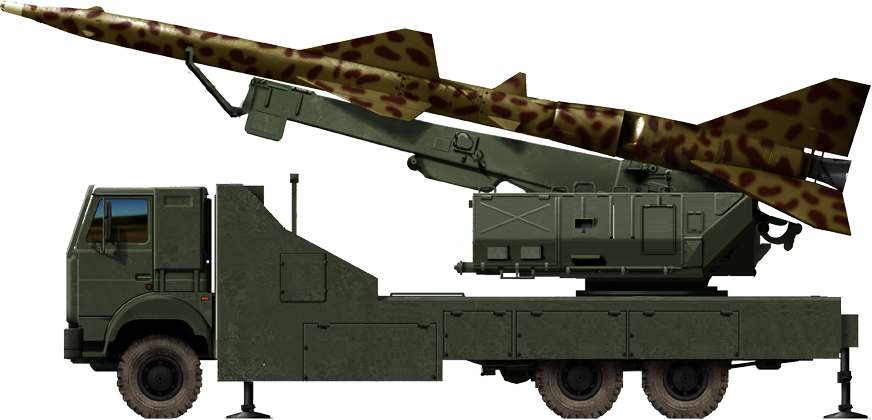
 Launcher Truck, c1990, min. 38 vehicles.
North Korea has two primary categories of trucks for the S-75 (SA-2 Guideline) system: Either a standard logistics prime mover to transport towed components, and a specific heavy commercial truck modified into a mobile launcher platform, which is the object of the current post. Needless to say after "stolen" photos of dubious quality we know practically nothing on the Belarusian MAZ-630308-224 referenced here to launch directly the Pongae-1 (local name) refurbished and modernized over the years.
What we Know
North Korea retains over 40 batteries of aging Soviet-era S-75 (SA-2 Guideline) surface-to-air missile systems. While traditionally deployed on fixed or semi-mobile sites using towed SM-90 single-rail launchers, North Korea has explored and displayed mobile variants and occasionally repurposed the high-energy V-750 missiles for ground-attack or test roles.S-75 System and Launcher OverviewRole: Strategic mid- to high-altitude air defense, though increasingly viewed as obsolete against modern air forces.
Launcher Configuration: Standard batteries use six fixed or semi-mobile single-rail launchers (SM-90) paired with PR-11 transport-loader vehicles.
Mobility: Primarily static or relocatable via heavy-duty trucks rather than integrated self-propelled transporter-erector-launchers (TELs), though select modified or parade variants have demonstrated mobile concepts.
Repurposing: Military analysts note that old S-75 air-defense stockpiles can be converted or expended as low-cost surface-to-surface assets or target decoys to strain regional missile defenses.
The Mobile Launcher Truck MAZ-630308-224 is locally named "KN-13" (as stated on its plaque at the exhibit). This is a rare, upgraded mobile S-75 configuration, based on a heavy-duty commercial cargo trucks imported or adapted for military roles. In that case, the Truck Model used has been identified by analysts (after crossing this with import references) as the
MAZ-630308-224 often designated with the local and analytical tag "KN-13".
Configuration: This heavy-duty, 6x4 three-axle chassis originally designed by the Belarusian manufacturer MAZ. It is given a specific flatbed, heavily modified by the Korean People's Army (KPA) to carry an integrated, elevating single-rail missile launcher directly on the rear bed, shifting the traditionally static S-75 into a semi-mobile system. The MAZ-630308-224 is a heavy-duty, commercial-derived, 6x4 three-axle chassis produced by the Minsk Automobile Plant (MAZ) in Belarus. This 6x4 (three-axle chassis) is powered by a YaMZ-238 V8 Diesel.
Belarussian MAZ-630308-224
In the context of North Korea's armed forces, this specific civilian truck was acquired—sometimes via international intermediaries and sanctioned supply lines—and heavily modified by the Korean People's Army (KPA). By mounting an elevating, single-rail missile launcher directly onto the flatbed, North Korea converts this otherwise standard transport truck into a semi-mobile platform for launching aging yet repurposed S-75 surface-to-air missiles. Converting this truck into a launcher allowed North Korea to give an otherwise stationary, Cold War-era air defense system (the S-75) a level of shoot-and-scoot mobility, complicating target acquisition for regional adversaries.
Powerplant
This vehicle is powered by a YaMZ-7511.10 (produced by the Yaroslavl Motor Plant) turbocharged V8 diesel rated for 14.86 litres (14,860 cc) giving 400 horsepower (294 kW) at 1,900 RPM. Torque is 1,715 to 1,766 Nm available at 1,100–1,300 RPM. It has a 12-speed mechanical gearbox transmission, typically the Fast Gear 12JS200TA model. The drivetrain is a 6x4 drive configuration (three axles, dual rear axles driven). It had both inter-wheel and inter-axle differential locks. Fuel Tank Capacity: 350 litres.
General Layout
Length: 10,230 mm. Width: 2,500 mm. Height: 4,000 mm (standard configuration). Wheelbase: 4,590 mm + 1,400 mm. Platform Internal Length: 7,750 mm (provides the physical space required for long payloads like S-75 or solid-fuel tactical missiles). Weights and Load Rating: Curb Weight: 11,900 kg. Payload Capacity: 12,600 kg (standard commercial configuration). Gross Vehicle Weight (GVW): 24,500 kg. Maximum Axle Load: 6,500 kg on the front axle; 18,000 kg split across the rear tandem bogie. Because of its broad 7.7-metre rear platform, heavy payload limits, and a robust 400 hp V8 engine, this commercial truck served as a highly stable, low-cost platform for North Korea to adapt into an improvised mobile system for its military.
About the Pongae-1 (North Korean S-75)
Offensive part of the KN-13 weapon system in North Korean nomenclature, the S-75 Dvina (NATO SA-2 Guideline) is a Soviet-designed, high-altitude air defence system which became the backbone of North Korea's surface-to-air missile (SAM) network. Unchanged, it was known locally as the Pongae-1 (Thunderbolt-1), with the first delivered by late 1962 already. Despite its age, it is either maintained or modernised as other legacy systems rather than retired.
Propulsion & Range: The standard S-75 missile uses a solid-fuel booster, mated to a storable liquid-fueled upper stage. It has an effective anti-aircraft range of approximately 30–45 km. It could engage targets at altitudes up its ceiling limit near 25,000 metres. The original Soviet system relied entirely on radio command guidance tracked via a ground-based "Fan Song" engagement radar. To counter Western electronic countermeasures (ECM) and jamming, military analysts note that North Korea has fitted an infrared (terminal thermal) seeker to at least some of its S-75 inventory.
This allows the missile to home in silently during its final flight phase, letting the ground radar switch off to maximize survivability. North Korea historically acquired 38 SA-75M "Dvina" complexes, three S-75M3 "Volga" complexes, and over 1,300 missiles from the USSR. It later supplemented these with Chinese-produced HQ-2 variants.
Because the S-75 struggle against highly maneuverable modern fighter jets, Pyongyang treats the Pongae-1 as a multi-role layer in its current inventory: Strategic Air Space Denial: They remain deployed in fixed, hexagonally arranged historical batteries around high such as nuclear sites, the Yongnim Ballistic Missile Base, and the submarine shipyards at Sinpo—forcing adversarial aircraft to map out and jam them.Repurposed Short-Range Ballistic Missiles (SRBMs). Like similar adaptations observed globally, North Korea's massive stockpiles of high-energy S-75 missiles can be converted into surface-to-surface ballistic strike weapons. When fired in a ballistic trajectory, a converted S-75 can carry its 200 kg fragmenting warhead against ground coordinates over an estimated distance of up to 300–350 km
Additional Support Trucks with the S-75
As a combat unit, the KN-13 is complementary to other vehicles used as standard Towed Logistics Trucks, cold war ZIL-157 & ZiS-151. They are used in fact for the vast majority of North Korea's conventional, static S-75 batteries. Trucks are used strictly as prime movers, to haul the PR-11 transport-loader trailers. These legacy Soviet ZIL-157 and ZiS-151 exists alongside localized variants built by North Korea's
Sungri Motor Plant (such as the Sungri-61 series). In that case these are 6x6 all-wheel-drive vintage tactical utility trucks.Role: These pull the single-missile semi-trailers from storage bunkers out to the fixed SM-90 launching pads during deployment drills.
⚙ specifications MAZ-630308-224 |
| Weight | 12t light, c22 tons with launcher and missile |
| Dimensions | 10,23 x 2,5 x 4m |
| Propulsion | YaMZ-7511.10 V8 diesel 14.86L: 400 hp (294 kW) |
| Transmission | 12 speed mech. 12JS200TA |
| Speed | 90 kph road |
| Range | 350L diesel fuel, c900 km |
| Protection | None but from the fire of the launcher. |
| Suspension | 6x4 civ. tyres, no run-flat or CIS |
| Crew | 1 driver +2 missiles operators |