LARC-LX (1952)
 Amphibious Landing Truck (1952-2001): c60-100 made
Called the Lighter, Amphibious Resupply, Cargo, 60 ton, this is the world's largest military vehicle ever built. The LARC orginated in the BARC (Barge, Amphibious Resupply, Cargo) as a very high payload, welded steel-hulled amphibious cargo vehicle, replacing notably the WW2 legacy GMC DUKW. Capable of carrying either 100 tons cargo or 200 troops, but more generally 120 men and 60t cargo including tanks and trucks itself, the vehicle powered by four diesels was basically a wheeled landing craft. It was designed and introduced a bit late for the Korea War but saw plenty of action in the Vietnam war, albeit quantities remained low and production stopped after between 60 and 100 manufactured by Letourneau, usually specialized in giant work specialized vehicles.
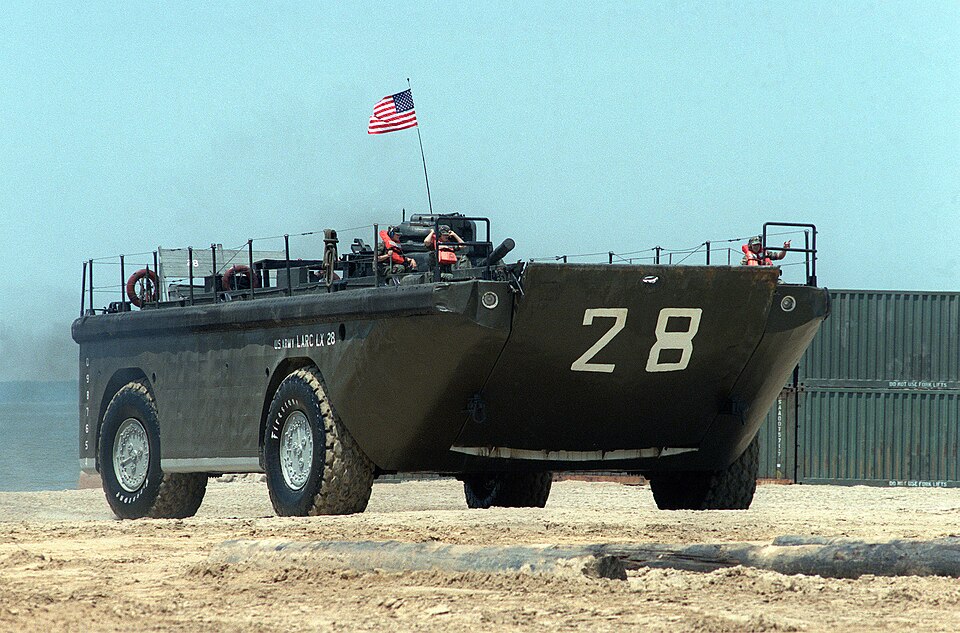 LARC LX 28 carrying a M48 starship, Army logistics exposition PROLOG '85, 13 May 1985
About the manufacturer, Letourneau
Letourneau, like Caterpillar and others is a name instantly recoignizable on all sites involving heavy duty working specialized vehicles in the US and abroad, especially familiar to construction and mining sites. LeTourneau was founded by inventor Robert G. (R.G.) LeTourneau, one of the most influential pioneers in heavy earthmoving equipment. He is often called the "Dean of Earthmoving" because many modern construction and mining machines trace their design roots to his innovations. He started as a land-leveling contractor in California in the early 1920s. Frustrated by inefficient equipment, he started designing his own scrapers and earthmoving machines. One of his earliest breakthroughs was the "Mountain Mover" scraper (1922), which allowed a single operator to control the machine from the tractor seat, greatly improving productivity.
Key innovations included:
The first practical one-man operated scraper systems.
Extensive use of welded construction instead of rivets.
Development of high-speed rubber-tired earthmoving equipment.
Improved scraper designs that could load, haul, dump, and spread earth efficiently.
LeTourneau became famous for building some of the largest land vehicles ever made: The Tournapull Scrapers in the late 1930s, self-propelled vehicles that became the model for modern motor scrapers used worldwide. He pioneered diesel-electric wheel drives, where a diesel engine powered generators feeding electric motors in the wheels. This concept is still widely used in giant mining trucks today. He also created Overland Trains by the 1950s and 1960s for the U.S. military, stretching nearly 600 feet (183 m) long, able to travel across deserts, tundra, and other terrain without roads. They were initially even planned to be nuclear-powered.
They remain among the longest off-road vehicles ever built. He also designed the G175 Tree Crusher, 175-ton vehicle designed to flatten forests for land clearing. But during World War II, his factories produced a most of the Allied earthmoving equipment, up to 70–75%, helping building military bases in the Pacific, as well roads, and major infrastructure projects such as the Alaska Highway. He was contacted in 1945 also, in prevision to the upcoming invasion of Japan, to create a successor, with greater capacity, to the GMC DUKW (see later).
In 1953, LeTourneau sold much of his earthmoving equipment business to Westinghouse Air Brake Company (WABCO). He continued developing giant electric-wheel machinery and offshore drilling technology. LeTourneau equipment manufacturing continued under various owners, eventually becoming LeTourneau Technologies. In 2011, LeTourneau Technologies was acquired by Joy Global, which was later acquired by Komatsu. Some LeTourneau mining-equipment technology remains in use today.
Development of the LARC
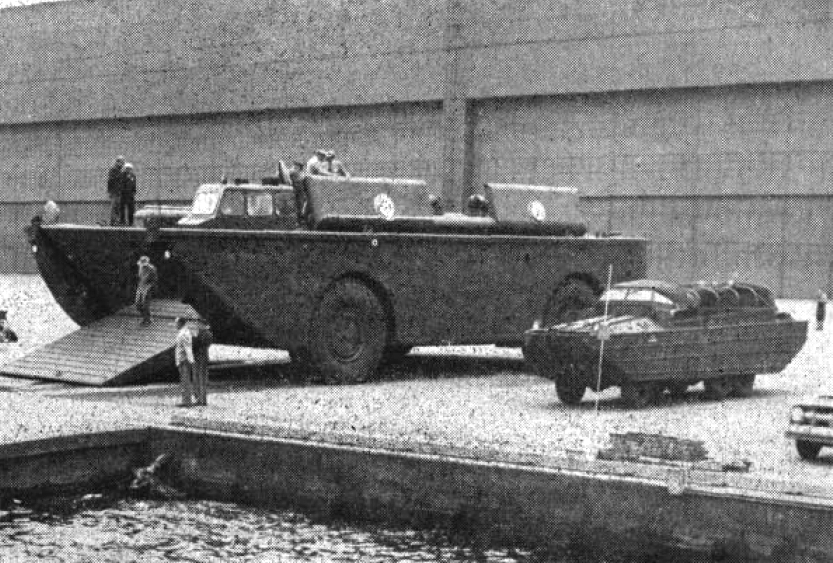 BARC and DUKW side to side in 1952 trials
As seen above, the links between the US Army and Bob Letourneau were quite strong. His company was already busy providing mass-produced working vehicle for the Seabees and their Army equivalents, but in mid-1945 the Island-Hopping campaign was about to be concluded with an invasion of the southern most Japaese home islands in the mother of all landings, called Operation Olympic, part of Operation Downfall. Plenty of experience had been gained by the USMC and US Army on the use of amphibious vehicles, the wheeled GMC DUKW and a family of LVTS, all tracked, able to move on rocks and reefs unlike the DUKW.
By then, the limitations of the DUKW became apparent. Even it was amphibious, it could not be loaded to a certain extent in order to preserve buoyancy and stability, and it became dangerous in formed seas, even at low coeficient. More so, it was found slow and underpowered, even sluggish while on land, difficult to maintain due to its hull and placement of its powerplant, unwieldy, and lacking a quick way to disembark its payload: This was unlike the LTVs which had a proper ramp, a bucket vehicle. Payload needed to be lifted in and off sometimes with some difficulty. All this led the US Army (and USMC) to investigate for a replacement, ideally with greater capacity. The only advantage until then of the DUKW was its low cost, based on the
GMC 353 "Jimmy" the most common medium truck in US and allied service.
However if the army wanted a "wheeled landing craft" to be able to disembark much havier loads further inland, including trucks and other vehicles, to bypass Japanese beach defenses to be encountered, the main problem was its expected side and weight, that no truck chassis could match. As it was investigated as a concept, with the final operation planned for the winter, the atomic bombs of Hiroshima and Nagasaki and Soviet invasion of Mandchuria put an end to Japan's ambitions and a reddition. The successor of the DUKW remained in the Army's "bucket list".
This was not the end of the story though. In 1950 the war in Korea broke out. In addition there was a fear the Soviets, while invading Europe, would deny access to relief US forces across the Atlantic by nuking ports. There was the need for a family of ship-to-shore vehicles that could land assets anywhere outside ports. LCUs and LSTs would take the best beaches, but anwhere else, this was the job for these wheeled "landing crafts". And if there were still thousands of GMC DUKW available for a possible beach landing or river crossing in storage, the initial need for a proper "wheeled landing craft" remains. This led to the design of three competing programs:
-The Lighter Amphibian Resupply Cargo V (LARC V) carrying items such as CONEXES and other palletized cargo.
-The Amphibian Resupply Cargo (LARC XV), larger but still used for the same purpose.
-The BARC capable of carrying 100 tonnes, or two 20-foot containers or one 40-foot container. The name "BARC" was still used after 1964 to mark the difference with the LARC-V and LARC-XV.
Brigadier Gen Frank Schaffer Besson from 1948 after being at the head nearly five years as Deputy Chief of Army Transportation became Major General in 1950, assumed command of the US Army Transportation Center and School, at Fort Eustis in 1953. He thus pioneered many concepts to project power at greater speed and efficiency at the tipping point of the whole transportation system. He was the first to apply tehe novel concept of containerization, and roll-on/roll-off vessels, and worked at improving amphibious vessels, such as the 5-ton and 15-ton LARCs and 60-ton BARC (larter LARC-LX).
The BARC (barge, amphibious, resupply, cargo) was tested at Fort Lawton, Washington in 1952 and purchased by Maj. Gen. Besson, Chief of Army Transportation from 1958 to 1962. It was quickly nicknamed "Besson's Ark." For the whole family, some 968 units were originally built of whoch over 600 sank, due to accidents or merely as means of disposal at the end of the Vietnam campaign and withdrawal in 1973. The most impressive by far, the BARC, later designated as the LARC LX (Lighter, Amphibious, Resupply, Cargo) was designed to carry troops and 60 tons of cargo but also to carry wheeled and tracked vehicles from ship to shore or on inland transfer points (like river crossings). It was also designed to be capable of landing on a beach through breaking surf. The specifications of the Army drawn in 1950 was that it had to operate on lowstrength soils at a gross weight of 319,000 pounds (120,000-pound pay-load), or carrying 40-foot containers discharged by crane, or rollers like from a cargo aircraft.
So in early 1950 Letourneau had received news about this program and started R&D on a much larger vehicle, leading to the construction of four experimental BARCs for the Army but also for off-shore oil drilling platforms. For the army, it was reinfirced enough to carry if needed a 60-ton main battle tank, or a fully equipped infantry company in the absence of any port. The empty weight was 97.5 tons and Letouneau based on its previous experience, created a vehicle defined by its larhge entral loading deck, with enough spaces in the wings to install arches for its four giant wheels and associated engines, one for each. He managed to fit four 265 hp GMC marine diesel engines. Each drove a single wheel on land but they could be coupled together to drive one of the twin, large propellers in the water. Top speed was 20 miles per hour on land and 7.5 miles per hour when swimming.
Design of the LARC
General Layout
The LARC-LX reflected many LeTourneau engineering themes: Huge low-speed off-road wheels, Diesel-electric and heavy-duty drivetrain concepts, Operation in places with little or no infrastructure and Massive payload capacity relative to vehicle size. It was smaller than LeTourneau's famous TC-497 Overland Train, but arguably more practical and successful, serving for decades around the world.
Te vehicle is essentially a wheeled landing craft, fully amphibious, defined like a landing craft by its massive central utility flatbed or deck, whereas all utilities amd mechanics are at the rear or sides. There was a driving cab at the rear left corner, glassed, and the diesels and drives were located close to the wheels arches, the transmission and drive for the propellers on the "deck" aft, below the cab. It had a crewof 5, with a driver, co-driver posted forward for guidance, and three mechanics or aides for landing (manning the ramp for example).
The 100 tons vehicles when fully loaded or 194,000 pounds empty, was powered by four GM 6-71, marine diesels, it was 62.5 feet (19.1 m) long overall for a width of 26.5 feet (8.1 m) and an height of 19 ft, 6in, a wheelbase of 28 ft, 6 in, a draft of 7’6″ empty and 8’8″ loaded.
Powerplants and performances
 1952 trials of the initial BARC, 3rd prototype (note the cab forward), landing a full company of 120.
Capable of transporting 60 tons from ocean to inland, across heavy seas and up inclines as steep as 60 degrees. It remains the only amphibian in the current inventory able to enter and exit the shore through breaking surf.
Drivetrain Configuration: 4 separate engines driving each wheel, accessible through top panels.
Engine: 4 Detroit Diesel NA6-71, 165 hp each, selectabe 2x4 or 4x4
Propulsion: 2x 48 inches or 1.22m propellers in water, 49 inches (48 ply) or 1.24 m tires on land
Transmission: 3 speed automatic, located at the rear with switchable propeller/wheel drive, one per side.
Top Speed: 16 mph (land) and 7 knots (water)
Fuel Capacity: 600 Gallons
Fuel Consumption was 25 gallons per hour empty; 35 GPH loaded.
Range (land): 150 miles (240 km)
Range (sea): 75 miles (121 km)
Battery: 24 volt
Speed (water) - Large Propellers in tunnels aft.
Forward (empty): 7.5 mph (12.1 km/h)
Forward (60 ton): 7 mph (11 km/h)
Forward (100 ton): 6.5 mph (10.5 km/h)
Speed (land)
Forward (empty): 15.2 mph (24.5 km/h)
Forward (60 ton): 14 mph (23 km/h)
Forward (100 ton): 12.75 mph (20.52 km/h)
Reverse (60 ton): 2.85 mph (4.59 km/h)
Turning circle: 75 ft (23 m)
Gradient: 60%
Temperature range: 125 F to -25 F (-30 to +50 °C)
Capacity
Load capacity/Displacement: 60 tons (rated); 100+ tons in calm seas/level ground. 2,800 Cubic feet to deck level. It was tested carrying every soft skinned or armoured vehicles in US Army inventory. It was cable of landing one M60 man battle tank, the largest in service for example.
Operations
 LARC-LX surf-landing a M60A2 tank at Army exposition PROLOG 1985.
The LARC-LX was famously used in Vietnam. In 1964, the BARC was already phased out and the LARC-LX was introduced with few modifications. First prototype tests were performed in 1952. It srved as a LARC-LX from 1967. It saw combat support service during the Vietnam War beginning in early 1967. Remained in Army service until 2001, giving it nearly 50 years of operational life. Outside the US Army, they had been used by the Taiwan ROC Marine Corps from 1958 to 1997. However by the 1970s the Army started to believe speed wa smore important than capacity and developed the LACV-30, a air cushion landing craft and cold war ancestor of the Navy's LCAC. However even when the LACV-30 was decommissioned in 1994, the LARC-LX remained.
The Army still had 36 of them in 1979. In its technical report number 225, the Army Materiel Systems Analysis Activity sated that albeit the LARC-LX lacked speed, it had no major deficiencies and probably was the most versatile heavy vehicle in inventory. Comparisons made with the smaller LARC-60 were damning: The LARC-LX was comparatively cheaper, more reliable, consumption was lower, and it carried far more for the same evel of consumption. Gradually the numbers went down, but there were still a dozen in inventory in the 1980s and the Army kept preciously this small park maintained and ready to go well beyond the end of the cold war. It was definitively considered "limited standard" in 2001 and officially retired when then 309th Transportation (LARC LX) Company, 11th Transportation Battalion, was inactivated on 15 October. But many were preserved and can be seen today across America, coast to coast.