PZInz-222 (1939)
 Half-Track Tractor, 13 produced 1939
The Half-Track Supply Truck wz.39, better known as the PZInz(PZInż) 222 was intended to replace older half-track vehicles of French origin or licenced. These ranged from artillery tractors to specialized vehicles to infantry carriers for a 12 man infantry squad. 12 were being tested at the time of the invasion in the 10th Cavalry Brigade and they took part in defense of Poland. Their fate is unknown.
Development

PzInz-202
The PZInż 202 was a Polish half-tracked heavy artillery tractor from before World War II, designed to tow a trailer or ordnannce up to 5 tonnes while also carrying the assicated ammunition payload and crew, up to 1,9 tonne. It was also intended to act as a self-propelled anti-aircraft gun when converted. It was powered by a PZInż. 135 (Saurer CR1D) diesel rated for 65 hp (47.8 kW). There was in the plans also a carbureted PZInż. 705 engine rated for 75 hp (55.2 kW). The suspensions comprised torsion bars, the front axle wheels had wishbones and transverse leaf springs.

Work started on the PZInż 202 in 1937 or early 1938, with a single prototype tested from June 1938. It successfully passed trials and tests, but was not authorized for production before WW2 broke out. Historian J. Korbal found the reason this model was delayed: It would have cost over 40,000 złoty in addition of being a parallel development of the simpler PZInż 342 wheeled tractor much cheaper also to maintain and operate. After trials new trials in the winter 1938-39, it waited renovation and modifications, but disappareared in the war.
About aństwowe Zakłady Inżynierii
 The "Polish Jeep", the PF 508 1azik, was based on the 1932 Fiat Balilla.
In 1938, the PZInż. Research Office's chief engineer Edward Habich developed a design for a light, half-track armored personnel carrier as requested b the Army. Państwowe Zakłady Inżynierii was founded in 1928. This state-owned enterprise established from the Minister of Industry and Trade Eugeniusz Kwiatkowski, was based on the existing Central Automotive Workshops (CWS), tasked of modernizing nd augmenting the manufacturing of cars and motorcycles for the civilian market, but also for the Polish Army. In 1930, Ursus declared bankruptcy and was nationalized and incorporated into PZInż, becomng its military branch.
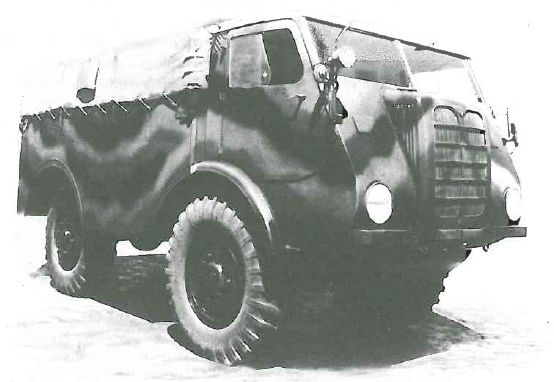 The PZInz-342 CO 4x4 tactical truck, chosen for production instead of the costly PZInz 202, but too late in 1939.
PZInż. retained the CWS brand for cars, Sokół for motorcycles and under a license agreement from 1932 with FIAT, a Polish version of the 508 Balilla was started, with 10,000 produced in 1939, including a jeep-like open version for the military. In 1933–1934, a new faciliy was opened at the Polish Automobile and Truck Association (PZLNŻ) and there ws a full reorgnizaiton and rationalisation of production in 1933. By
September 1939, the PZInż plant was bombed and in 1944, its machinery and equipment looted, removed, and the factory obliterated by the Germans...
PzInz-222
The PZInż 222 was a prototype half-track and infantry carrier from the interwar, and followed pre-war plan to become the primary vehicle of Polish motorized cavalry units. To be more affordable than the roughly similar, but larger PzInz-202 it was based on components from the Polski Fiat 618. The prototype PZInż 222 started its factory trials by late 1938, later field tests, official ones, and it passed them all successfully. Production was thus greenlighted and planned to start by mid-1939. Until then indeed, the Polish Army used licenced or purchased Citroen Kégresse models. But they were found ill-adapted to the Harsh Polish winter conditions and underpowered. So a serie of Polish-designed half tracks were started from 1937.
The basic version of the PZInż 222 was a half-track infantry carrier, unlike the PZInż 202 which was a heavy artillery tractor. So it was overall smaller and lighter, also fster. Plans were underway to create many specialized vehicles based on the ame platform: A reconnaissance vehicle, a telephone vehicle, an antitank and AA artillery tractor, or the Goertz listening devices complementing the AA batteries.
It is estimated that, in addition to the single prototype, 12 initial batch field test verhicles were manufactured, and they were in use at the beginning of the war, by the summer of 1939, all undergoing final testing by the 10th Cavalry Brigade, and then used by the latter unit actively in combat in the September Campaign. Their fate is still disputed to this day.
Full development History
Origin and Genesis

Throughout the 1930s, the dominant transport vehicles in the Polish Army's motorized units remained the PF 618 and PF 621, although their civilian and military versions differed significantly. The constant increase in the number of tanks in Poland created a need for a vehicle capable of driving through Polish off-road terrain at a pace similar to that of a tank, but over the same difficult terrain. The infantry had to keep up with the tanks. Another crucial assumption was that the vehicle be inexpensive and simple in design, allowing for the commencement of mass production.
This doctrine was supported by a half-track transporter designated PZInż. 222. It was designed by Eng. Edward Habich (not the first, by the way) from the State Engineering Works' Office of Studies, intended to provide an alternative to the similar PZInż 202, which proved too modern, and therefore complex to produce, and too expensive for Poland's capabilities and needs. Work on it lasted less than a year, ending in 1938. Such a rapid design was only possible thanks to extensive unification of components with the mass-produced Polski Fiat 618 pickup truck.
Variants Planned
The PZInż.222 transporter was intended to be a multi-purpose vehicle. According to the Polish Army's motorization program of 1937, it was to be used:
- Infantry tractor for 37 mm wz.36 anti-tank guns & Heavy AA HMG SP carrier
- Cavalry tractor for 37 mm wz.36 ATG, Cav HMG carrier, cav motorized units carrier
- Artillery tractor, 75 mm field guns, HMG carrier, Telephone patrol vehicle, Reconnaissance vehicle
- Air force frontline airfields supply vehicle & off-road ambulance
- Armored units repair vehicle and ambulance
- Medical service, all-terrain field ambulance
- Communications service: All terrain telephone vehicle
- Commissary service, off-road transport vehicle
Other Variants and Derivatives
-In addition, the same PZInż 222 body was developed as a carrier for the 81 mm mortar and ammunition.
-Engineer S. Pankiewicz also developed a special platform for a small-caliber anti-aircraft gun.
-At the request of PZInż direction, chief engineer Habich also developed a tractor specialized for towing trailers up to 2 tons, named PZInż 232, all remained on paper.
Design

Chassis and general design
The PzInz-222 is basically a similar vehicle than the PzInz-202, sharing the same chassis and most accessories, but it was also shorter, with one less axle whereas the PzInz-202 had four main roadwheels on its tracks, the PzInz-222 had only three axles in addition to the forward drive sprockets. The aftermost axle was indeed mounted higher up and used as track tensioner (see below). About this ladder frame, there was a simple open cab with a forward folding windshield over the bonnet, split, fitted with top wipers.
The vehicle had a forward directional wheeled axle, two spare wheels on both sides, just before the cut access for the cabin. The latter had two seats. Behind was an utility compartment close by tall, flat metal panels. There was a set of five arches that could be mounted on brackets to cover it, with plastic windows. In winter, there were also folded canvas and plastic side doors that would be mounted to completely enclose the vehicle. There were banks inside the rear compartment, large enough for 10 infantry with their equipments. The back panel could fold down to access the flatbed for loading more easily, also to facilitate access and exit of the infantry. It had also a towing hook, but no winch. It was unarmoured but the tall sides of the rear compartment offered some limited protection.
Mobility
The PzInz-222 was a small and compact vehicle, measuring 4,815 mm overall for a width of 1,800 mm and Height of 2,150 mm (without tarpaulin), a wheelbase of 3,050 mm and a ground Clearance of 280 mm. It weighted 2,850 kg empty, 4,000 kg Fully loaded for a payload close to 1,200 kgs. It could two a 2.5 ton trailer or ordnance as well. To power it was a Carbureted, 4-stroke, 4-cylinder PZInż. 357 (Polski FIAT 118A) engine with a capacity of 1,944 cm³ and power of 45 HP (33.8 kW) at 3,600 rpm. It could reach a modest 42 km/h on-road and 22 km/h off-road, but its tracks excelled in snow and mud. Fuel consumption on road was 24 l/100 km, off-road 34 l/100 km for a respective range of 290 km and 200 km.
The Polski Fiat 618 pickup truck provided a lot of part for this model, with the Army imposing in 1937 extensive standardization of components. The main difference wit the truck was of coourse its rear tracked wheeltrain resulting in the rear axle being moved forward. The engine was served by a gearbox with four forward gears (3 and 4 synchronized) and one reverse, and a reduction gear for off-road driving. The clutch was a dry, single-disc clutch.
The PZInż. 222 had an automatic axle locking mechanism engaged when the rotational speeds of the right and left wheels differed too much. Properly selected reduction and final drive ratios allowed the carrier to climb 49-degree gradients with a full load. Power was transmitted to single-crest, pin-type tracks with rubber pads. This type of track was designed specifically for this model and proved to be a very successful design; during testing after covering 13,000 km, the tracks showed only minimal wear. PZInż. It used Polish Stomil 7.50 x 20" tires.
The PZInż. 222 had suspension on semi-elliptical leaf springs arranged longitudinally and hydraulic arm shock absorbers. Drum brakes were used on the front wheels and the tracks. The mechanical handbrake operated on the drive shaft. The PZInż. 222 transporter had a load capacity of 1150 kg in off-road conditions and could tow a trailer weighing up to 1000 kg. The vehicle had a complete 12V electrical system, powered by a 100W generator, and a 60Ah battery.
specifications |
| Lenght | 4,815 mm |
| Width | 1,800 mm |
| Height | 1,800 mm |
| Weight | 2,850 kg |
| Crew | 2+10 |
| Propulsion | 4-cyl. PZInż. 357 1.9L, 45 hp |
| Suspension | Leaf spring fwd, torsion bars aft |
| Speed | 42 km/h (on-road) 22 km/h (off-road) |
| Range | circa 300 km |
| Armament | None, personal weapon or towed ordnance |
| Production | 12 preseries + 1 prototype |
Fate of the Vehicle
At the end of 1938, field trials were conducted. These proved favorable for the vehicle, which, in accordance with the relevant decision of the military authorities, was to be put into series production. In early 1939, 12 examples of the transporter were produced as part of a so-called trial batch. In 1939, according to some sources, the first series of these vehicles, consisting of 30 units, was ordered from PZInż, with a completion date of September 15, 1939. The progress of work at PZInż is unknown, but it must have been significant. It is known that for the 1939/40 fiscal year, funds were allocated for the construction of 200 vehicles. A sufficient number of components were even gathered.
The Polish Army received only a trial batch of 12 vehicles. In the summer of 1939, they were transferred (though probably not all) to the 10th Cavalry Brigade for final field trials. They were also caught in the war there, and as part of the 10th Cavalry Brigade, they took part in combat. Virtually nothing is known about their wartime usefulness or combat experience. They were likely used to tow anti-tank guns or transport heavier equipment. Their fate is unknown. It is believed they may also have been tested by unspecified engineer units.
There are documents that provide information on the amount of equipment that fell into Hungarian hands after Polish troops crossed the border in 1939. Among other things, According to a September 20th inventory, the Railway Bridge Engineers' Reserve Center No. 1 in Kraków was supposed to have handed over one Fiat 618 wheeled-track vehicle to Hungary. This most likely refers to PZInż. 222.
The archival document "Automotive Department. Summary of automotive material handed over to the Hungarian military authorities," prepared by the Military Attaché of the Polish Legation in Budapest at the end of 1939, states that a total of "25 (!!!) Polish Fiat 618 wheeled-track vehicles" were handed over to Hungary. However, due to numerous errors in this document and inconsistent research, it is difficult to determine its accuracy.