GAZ-53
 Soviet Union
Truck (1961-93) 4,000,000 built
The GAZ-53 is a 3.5 tonne 4×2 truck manufactured between 1961 and 1993 to four millions making it the most common Soviet Truck ever. It was introduced as the GAZ-53F, and completed soon by the smaller 2.5-ton GAZ-52 in 1962, produced until 1989. Both had different lighting systems, wheel rims and payload. From 1961 and until 1975 they were manufactured alongside the GAZ-51. The GAZ-53A with its 4 tonnes and relatively good off-road performances also interested the Army as the GAZ-53N also known as the GAZ-53A-016. They were also widely exported in Eastern Europe and often mixed up with the ZIL-130. A sure way to pull them apart is their GAZ grille, fluted vertically, and indicators above the headlamps. These trucks were in their immense majority absorbed by the civilian sector.
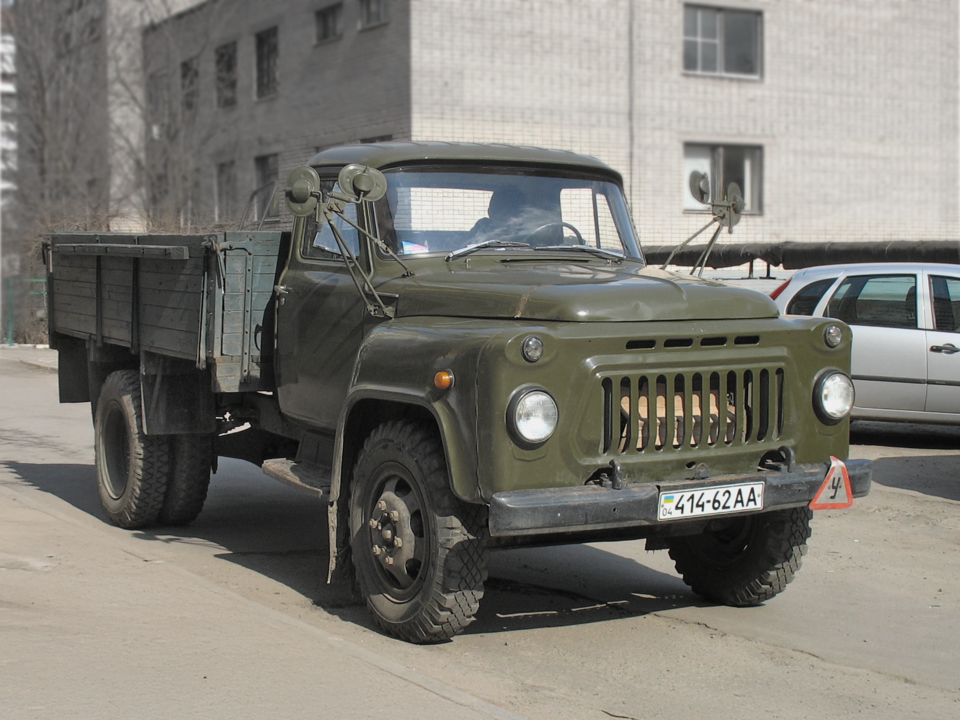
The GAZ-53 in brief
The GAZ-52 and GAZ-53 range was designed in the 1950s with the first prototype GAZ-52 tested in 1956 as essentally a modernized GAZ-51 with a new front end but sharing the same chassis, engine and payload (2.5 tons). In 1958 a new and more modern cab was developed looking (again) at US trucks and so further prototypes were built with a new wheelbase, going from 3300 mm to 3700 mm for a length reaching 6,395 mm. It was tested and accepted as the GAZ-52F at first and 300 of these were manufactured in 1958-1959. Then from there to 1964, other prototypes were tested, none produced.
So in 1960, the GAZ-53 was developed as a heavier of the GAZ-52F with a 3.5 ton payload. Importantly, it was matched by a more powerful 4,2 L light-alloy V8 ZMZ-53 engine derived from the GAZ-13 Chaika, rated for 120 hp SAE at 3200 rpm. This ensure a top speed of 90 km/h (56 mph) light, which was unheard of for a truck of that capacity back then. Early versions retained the name GAZ-53F ans bottnecks with the new engines force the adoption of the older 75-hp six-cylinder engine from the GAZ-51. The new ZMZ-53 arrived with the vehicles produced from 1964. The 4.3L ZMZ-53 V8 engine, inspire by WW2 US engines, had a lot or torque and in practice, the payload of 3.5 tonnes gross was often pushed further.
Production of the GAZ-53 started in 1961, so well before the GAZ-52 and from the GAZ-53A in 1965, revisions led to a 4 tons payload, and its production went on amazingly until January 1983. By then the new GAZ-53-12 took over and was manufactured until the fall of USSR. Since it was also for export, it was maintained until 1993. All had the same four-speed gearbox, only synchronized on the third and fourth. Among the sub-versions the only one of interest here is the military version
GAZ-53A-016.
The GAZ-53 was replaced by the GAZ-3307 produced at the Gorky Automobile Plant (GAZon) from 1989 to this day, assembled both at Nizhny Novgorod and BelAvtoGAZ Kolyadichi from 2012. It looks very old fashioned but is extremely rustic and easy to maintain and repair, just like the GAZ-53. 1.5 millions were made, and it is also used for military purposes. Its chassis is the same as the GAZ-53-12, but the cab, dahsboard, bonnet and features are new, inspired by Magirus trucks. Also produced under licence at KTA Madara, Shumen, Bulgaria, from 1967, the GAZ-53 was distributed locally as the Madara 400 series but with Western 4-cyl. 3.9 L Perkins diesel and turbodiesel in the 1980s engines at the Vasil Kolarov engine plant in Varna for up to 100 PS (74 kW), with 3,000 made per year until the 1980s.
GAZ-53A-016/GAZ-53N
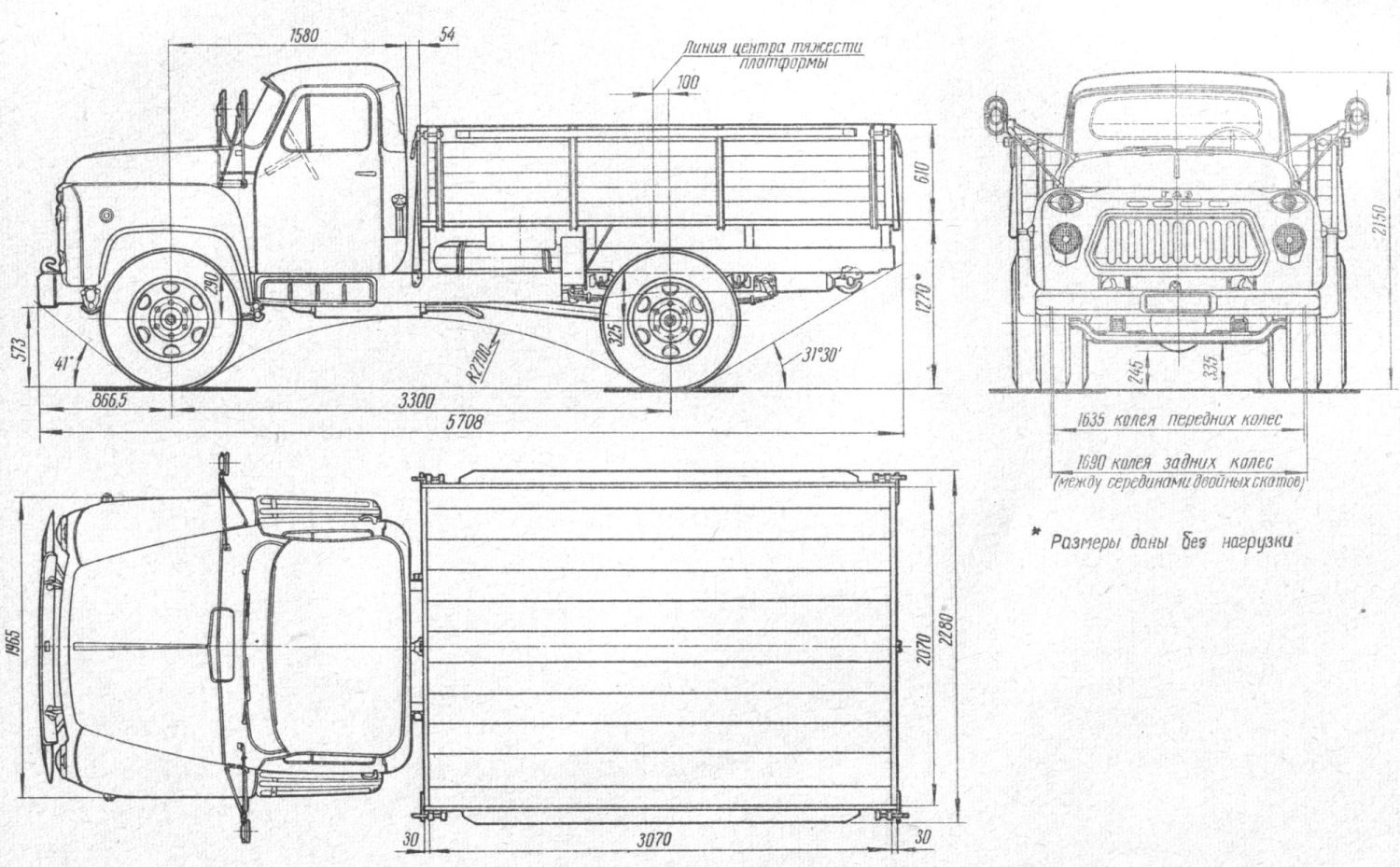
 Schematics, from the blueprints. Note the wide flatbed compared to the chassis.
The GAZ-53N was the first army truck, made from 1966 to 1983 with an extra 105-liter fuel tank, a pre-heater, and additional equipment (shovel, tool boxes, ect). Also known as the the GАZ-53А-016, it was manufactured as said until 1983 but production figures are ellusive. Designed for the needs of the Soviet armed forces, it also performed its assigned tasks excellently. During the final years of production (1984–1992), the gasoline-powered models were supplemented by versions running on compressed natural gas and liquefied gas—specifically, the GAZ-53-19 and GAZ-53-27 trucks.
This model had the ZMZ-53-511-11 from Zavolzhye Motor Plant rated at 125 hp at 3,200 rpm, a sturdy V8, 4-stroke, carbureted, 4,254 cc. Bore/Stroke: 92/80 mm. it was coupled with a transmission of 4 forward and one reverse. The vehicle had a ground clearance of 265 mm and a curb weight of 3,200 kg fopr a payload capacity of 4,500 kg. It had tires 240–508 mm in size, of the military type, run-flat, or standard. The fuel tank capacity was 90 L which translated to 370 km at 40 ph cruise speed unladen (24 L/100 km). On highly it could reach 90 km/h also unladen.
|
| Dimensions: | 6,395 x 2,280 x 2,190 mm |
| Wheelbase: | 3,700 mm |
| Weight: | 3,2 ton |
| Tires: | 240–508 mm |
| Crew: | 1 driver, 2 crew cab +18 infantry rear |
| Propulsion: | ZMZ-53-511-11 4.2L 125 hp |
| Speed: | 90 kph |
| Range | 90 L, 40 km/h: 24 L/100 km. or c370 km total |
| Payload: | 4 ton |
| Production: | GAZ-53A-016 alone: c2-300,000 |
Variants
- GAZ-53F:(1961–1967) dropside truck, 82 hp engine, rear axle GAZ-51, ratio 7.6:1, 3-3.5 payload, 75 km/h
- GAZ-53:(1964-1965) base 115 hp ZMZ-53 V8 model, speed 85 km/h;
- GAZ-53A: (1965–1983) modernized version, 4-tonne payload.
- GAZ-53B: dump truck from 1966
- GAZ-53N (1966–1983): Military variant with extra 105-liter fuel tank, pre-heater, additional equipment.
- GAZ-53-02: GAZ-SAZ (SAZ-3503) dump truck chassis
- GAZ-53-05: Dropside truck designed for continuous operation with 2-axle trailer (proto)
- GAZ-53-40 (1971–1984) extended GAZ-53A chassis, body by Kurgan Bus Plant with KAvZ-685 bus bodies. Others made by SemAR
- GAZ-53-50: Export version of the GAZ-53A, tropicalized climates;
- GAZ-53-70: Export version of the GAZ-53A for temperate climates;
- GAZ-53-12: (1983-1993) upgraded model with the ZMZ-53-11 engine (120 hp 1992 or ZMZ-511.10 125 hp), payload 3.5t, 90 km/h, non-synchro gearbox.
- GAZ-53-19 (1984–1992): Liquefied gas engine 105 hp engine for 80 km/h
- GAZ-53-27 (1984–1992): Compressed natural gas 100 hp engine for 80 km/h.
- MPR-9924 mobile repair workshop (Military)
- ATs-4.2(53A) tank truck, capacity 4200 liters (Grabovsky Automobile Plant).
Use
Lacking true off-road capabilities despite the new military tyres, the GAZ-53A-16 remained in base services, for regular road supply and occasional personal transport between military locations across the Soviet union. It was widespread also in the Warsaw Pact, albeit details are hard to pinpoint. The civilian version at least was exported to East Germany (GDR), Hungary, Czechoslovakia, Romania, Yugoslavia, Vietnam, Laos, Cuba, Mongolia, and the DPRK. On the civiliian market, this model became the "workhorse" of the Soviet economy, found in every sector of the economy, agriculture, construction, freight transport and also in the "Virgin Lands Campaign" in Central Asia, notably the the steppes of Kazakhstan under the initiative of N.S. Khrushchev—cannot. This rustic vehicle that needed only dust tracks hauled grain harvests and was ideally suited to the region's harsh climatic conditions.