AT-T (1947)
 Soviet Union
Heavy Artillery Tractor (1947-1979), +600 built
Artilleriyskiy Tyagach Tyazholiy, or AT-T for "heavy artillery tractor" was a Soviet Cold War-era artillery tractor based on the chassis and drive system from the very first T-54 tank. The hull was inverted 180° so that the engine, clutch, gearbox, steering gear and drive wheels ended at the front of the vehicle under a bonner and with an elevated crew cabin made from the same cab used by the ZIS-150 and ZIL-164 trucks.
There was also a flatbed at the rear with bunks in order to carry a complete artillery crew of 8 plus ammunitions or 16 in a troop configuration. The gun commander was seated with the driver in the cab and 2 more if needed.
Development
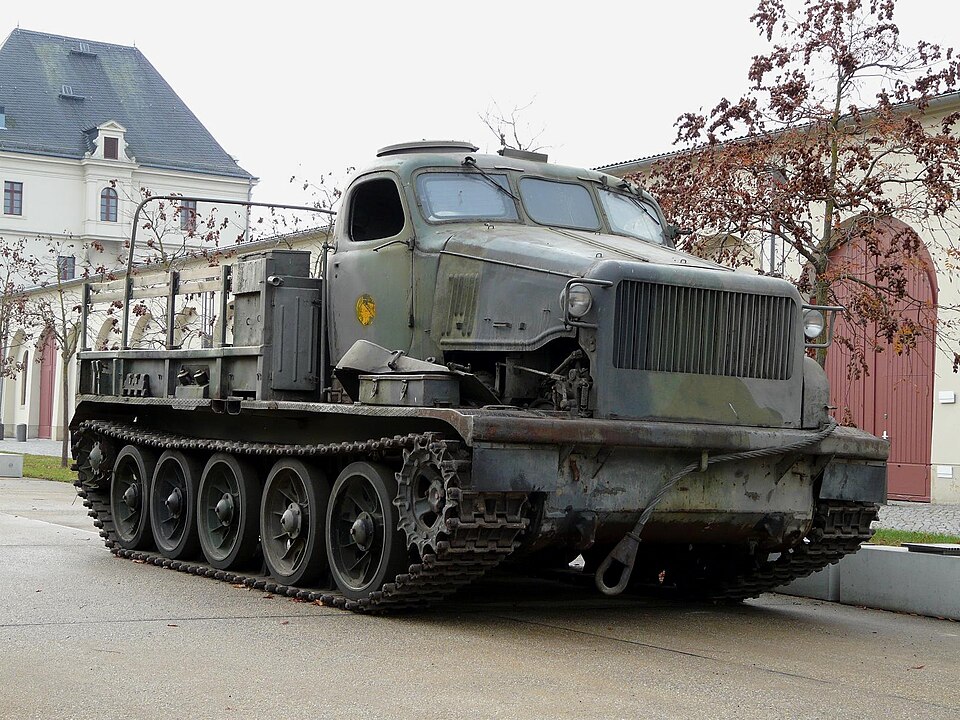
Genesis of the AT-T
It was a new tractor with the need expressed in 1945 to replace legacy worn out heavy tracked tractors and able of towing on all terrain all new artillery and missile systems developed for the Armed Forces of the USSR. This first post-war program was approved in 1946, and if towing artillery, it needed also to carry the gun crew and ammunition along. For the sake of standardization and mass production it was to be based on the brand new T-54, itself in development from the 1944 T-44 medium tank, an evolution of the T-34.85 with the same turret on a new, lower chassis.
The Main Automobile Directorate set the requirements (TTZ) for this new tractor:
-Towing artillery and missile systems and trailers with a mass of up to 25 tons. The list included the following (later expanded):
- 203-mm howitzers & M1931 (B-4)
- 130-mm anti-aircraft gun KS-30
- Other "super-heavy" caliber guns (28 or 30 cm)
- The missile system R-12 Dvina
-Towing these loads at a minimal speed up to 35 kilometers per hour, in any climatic conditions in the USSR;
-A rear flatbed wit a load capacity of at least 5 tons
-Presence of a winch with a pulling force of at least 25 tons;
-The chassis needed to be modular enough to install various equipments for all branches of the military and specialized forces, including its operation.
-Adapation to other uses in civilian sectors.
To anwer the call, engineers just needed to reverse sense of the T-44 chassis, updated with the latest mecanhical innovations of the nex T-54 chassis. The engine and ll its components thus ended from the rear to the front and a common, standard truck cab was used for commonality, loer cost, and easier driver training.
1947 tests and Approval

By the end of 1947, the first prototype of "Project 401" was completed at the Kharkiv Machine-Building Plant, the same behind the T-44 and T-54. For testing, the prototype underwent a gruelling road run along the route from Kharkiv to Moscow (Kubinka). It was reported powerful, durable and mobile, operationally efficient. The towing capabilities and ease of use (driving training as for Tanks). Its commonality of parts eased also field maintenance. Comparative trials were performed across a range of parameters and it turned out to be the most successful among all heavy artillery tractors tested. Its creators were awarded the Stalin Prize in 1948.
This heavy-duty tractor was able to tow wheeled, tracked, and sled trailers as well as carrying 5 tonnes cargo in the back, even recovering stuck vehicles given its winch and enormous torque. It was widely used, in civilian, unarmed variants later for the development of remote areas of the USSR and Antarctica. Using the chassis components from the T-54 enabled a quck production that really began in 1950. Cabin components as said were provided from the ZIS-150/ZIL-164 truck cab, essentially widened to fit on the chassis. It comprised 2 seats (one bunk seat large enough for 3) and was heated, with a cold starter and pre-heater.
Design
General Outlook
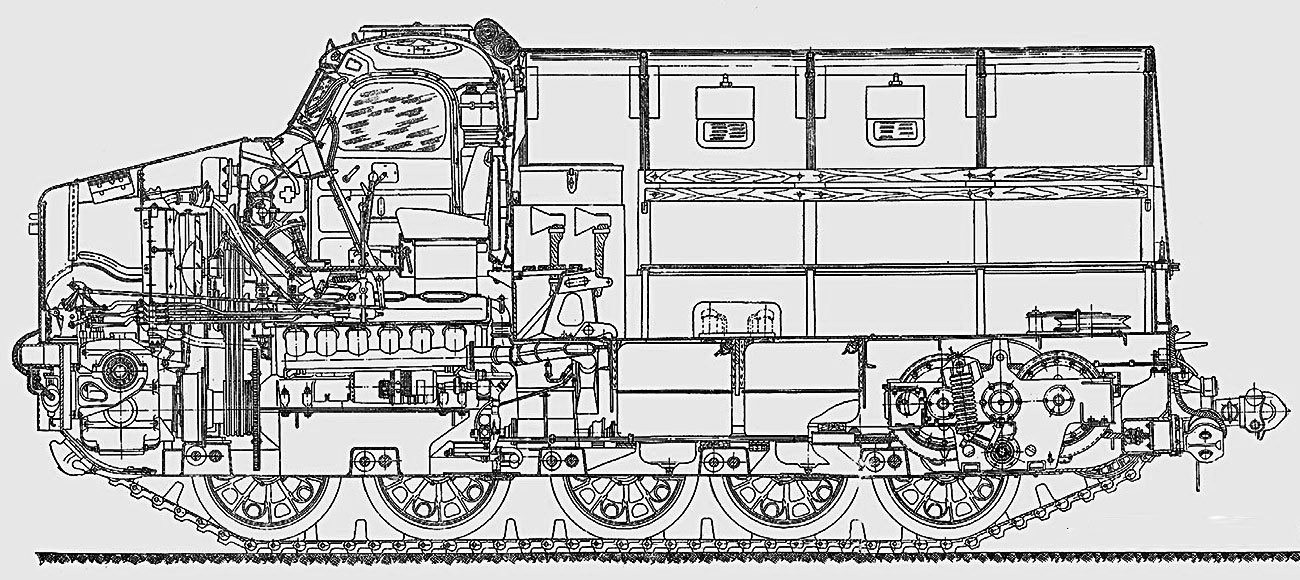
The vehicle as said above was a heavy tractor at 20 tonnes, reusing the T-54 chassis, however the steel used for the lower hull was not of the same thickness, just enough to guarantee rigidity. It was completely unprotected. The tall cab forward was built above the transmission, with the engine further forward under a bonnet and radiator. It measured 7.04 m lenght for a 3.17 m width and an height of 3 m to the cab roof. On the left side was located a hatch for one crew standing and firing with personal weapons.
The cab came from standard trucks but was made wider to fit the chassis and had one separzte seat for the driver and a bunk large enough for three more men. It was followed by the flatbed at the rear with a max capacity of 16 fully equipped infantry if used as troop transport, or 8 in a gun crew configuration with up to 5 tonnes ammunition. It was protected in winter or summer by a tarpaulin fitted on five arches, stored at the other end of the flatbed. Its back panel folded down. Its sides were made of a metal frame and wooden planking.

Performances
The AT-T could also tow a trailer up to 25 tonnes, like its military payload. It was powered by a V12 four-stroke A-401 diesel engine (or B-401 in other sources) also called B-2 type. It was rated for 415 hp at 1,850 rpm. Unlike the original tank, the engine was placed longitudinally rather than transverse forward. It was fully tracked, with the front drive sprockets and 5 forward, 1 reverse gearbox and transmission below the cab, followed by five stamped roadwheels similar to the T-54 and the same torsion bars, rear idlers, and absence of return rollers. The heavy steel tracks rested on the roadwheels. These starfish models were doubled and rubber-rimmed making for a total of 20 roadwheels, for single-pin 500mm wide track link, over a 2,640 wide track, ideal for muddy and snowy terrains.

Indeed, the Average ground pressure with load was 0.652 kg/cm². It had a ground clearance of 0.43 m. Range with trailer reached 1,100 km, it could for 1.1m water without preparation, cross a ditch 1.8m wide, climbe a 40% gradient, reach a top speed of 35.5 km/h on flat with its five-speed gearbox. It had a K-10 fuel pump rated for 210 kg/cm². Fuel consumption was 140 liter per 100 km, and oil capacity was 4 liter. Total fuel capacaciy of 1,500L, with the tanks located above the torsion bars in the chassis, below the flatbed and with fuel caps on the left side. Its power traduced to 21 hp/t unladen, 17 hp/t with 5 t payload and 9 hp/t with 25 t trailer. The sides of the flatbed had straps for various items, tools, spare links and others. Its mud guards ended in a bumber forward, there were also straps and towing hooks forward and aft plus two blackout lights on the sides of the bonnet, protected by guard bars.
Variants
 BAT-M obstacle removing vehicle
BTM-3 high-speed trench digging vehicle
Kharkovchanka Antarctic off-road vehicle
MDK-2M pits digging vehicle
P-40 Bronya self propelled radar (future post)
BAT-M obstacle removing vehicle
BTM-3 high-speed trench digging vehicle
Kharkovchanka Antarctic off-road vehicle
MDK-2M pits digging vehicle
P-40 Bronya self propelled radar (future post)
All projects based on the AT-T
Various engineering vehicles were produced on the AT-T platform: track layers (BAT), BAT-M (blade, overhead crane), earthmoving machines (BTM, BTM-3, MDK-2). The world-famous Antarctic all-terrain vehicle "Kharkivchanka" was also produced on its platform.
- Project 402 — Specialized Tow Truck
- 8K63 Missile System Tow Truck for the Strategic Missile Forces
- 8U227 Launcher for 8K11 (R-11) Missiles
- Project 405 — BAT
- Project 405U — BAT-1
- Project 405MU — BAT-1M
- Products 401A, 403A, 403B — AT-TA Polar Tow Trucks
- Project 404 — "Kharkivchanka"
- Project 404S — "Kharkivchanka-2"
- Products 409, 409U, 409MU — BTM
- Products 426, 426U — "Krug" Radar Station.
 BTM-3 Soviet trench digger
Operators
Sovet Union only reported, and civilian service.
|
| Dimensions: | 7.04 x 3.17 x 3 m (23 ft 1.3 in x 10 ft 4.8 in x 9 ft 10.1 in) |
| Weight: | 20 tons |
| Crew: | 18 maximum: 2 in front, 16 in rear |
| Propulsion: | V12 Diesel 415 hp (309 kW) |
| Suspensions: | Torsion bar |
| Speed: | 35 km/h (22 mph) |
| Range: | 1,100 km (680 mi) on road |
| Payload: | 5 tonnes and more (+trailers) |
| Production: | Unknown, c600 1947-57. |
Combat Use
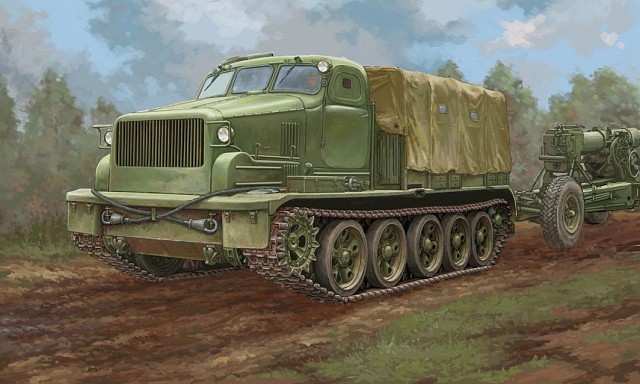
The AT-T started to replace legacy interwar artillery tractors like the Voroshilovets and the Stalinets, in all heavy (divisional) artillery units. It formed with the medium AT-S and ight AT-L the troika of tracked artillery tractors of the cold war, used until 1990... It seems this model, unlike the AT-S and AT-L, was never exported.
At the end of 1958, as part of the 4th Soviet Antarctic Expedition, the vehicles were delivered to Antarctica. On January 10, 1959, a convoy of all-terrain vehicles departed from Mirny Station. On December 26, 1959, a caravan consisting of two "Kharkovchanka" and an AT-T tractor reached the South Pole in the area of Amundsen–Scott Station.