HOTCHKISS M201 (1954)
 Light Utility Car, 27,628 made 1956-1966
The Hotchkiss M201 was the standard light utility vehicle of the French army postwar, and well until the late 1980s and early 1990s, when replaced by the Peugeot P4 and later Panhard VBL. In 1954, France already having thousands of ex-Willys Jeeps left behind US Force in addition to Free French stocks, was looking to improved its stock of spare parts. The best way was a local production, especially when the S Army itself started ti replace its vehicles by a new generation. An agreement was found and in 1955 a licenced was acquired by Hotchkiss to produce the Willys jeep under license. It was parlty funded by MDAP, but little was changed on the original design until it ended in 1966. The last M201 was still used as a demonstration vehicle for reservists, in 2000. Nicknamed "La Jeep", it also made the delight of private collectioners both in France and the US.
Development
In December 1945, the French government was given by the US Army a stock of 22,000 Willys Jeeps and Ford GPWs which saw action in France after June 1944, and others from various depots. On one hand, the diplayed objective was to rapidly re-equip the French army, devoid of any military vehicles after German wartime requisitions, and the remaining Free French stock. Unofficially, it was judged more appealing to the treasury leaving these surplus vehicles behind rather than shipping them back to the US. Many others remained in European mothballs, to be mobilizable in case of a new war with USSR.
Of the 22,000 vehicles listed above however, only about half were in a usable condition. So by 1946 the E.R.G.M. (Etablissement de Réserve Générale du Matériel Automobile) started work on these unserviceable vehicle in a new workshop at Maltournée in the Paris suburb, Seine-Saint-Denis (north-east). The vehicles in the poorest condition were cannibalized as spare parts. This however ended in such as large inventory of spare parts that the same workshiop started to create new jeeps from this stock. With time, this new production went on until 1978, combining old parts with new parts purchases either from Willys, Ford, or Hotchkiss.
Postwar, alongside this park, the military wanted to build new Jeeps, with a park below 10,000 serviceable, added to perhaps 8,000 inherited from the Free French. This was judged not enough. This brought us to the story of the "French Jeeps", the Delahaye VLR and Hotchkiss M201.
Delahaye VLR
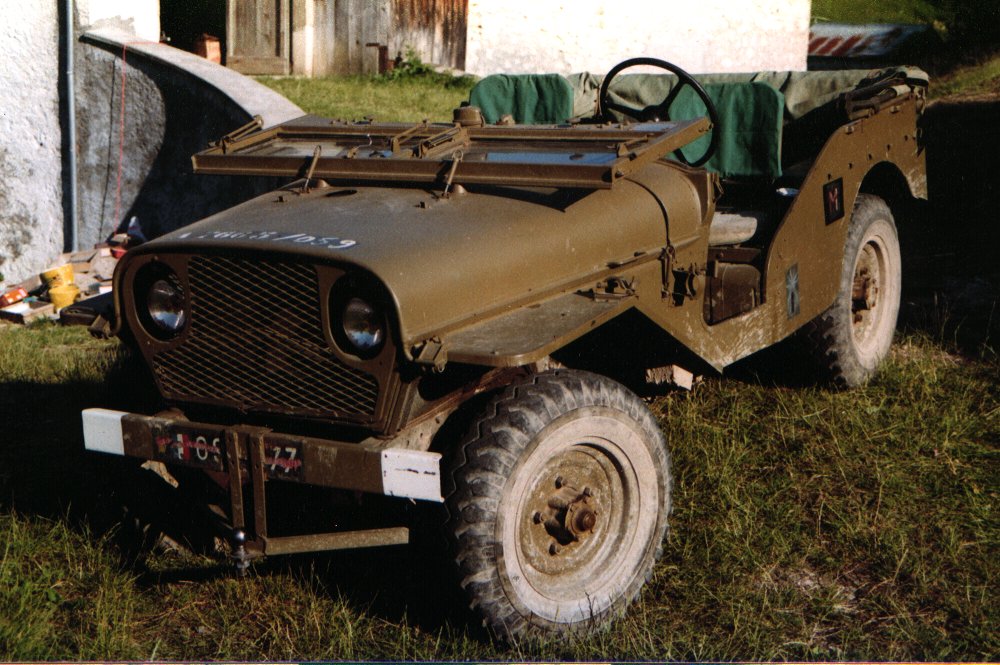 Delahaye VLR
The Delahaye VLR was ordered by the army as a replacement for the Jeep, with a few extra requirements. Delahaye answered with a vehicle still sharing a lot in common with the Willys Jeep, albeit designed from scratch in France, in French requirements. However cost rose and in 1949 when the production started, the Delahaye appeared too complex technically to be affordable. The French military insisted this was not an issue, however by 1955, six years after the prototype, only 9,623 Delahaye VLRs had been made.
This order, which was more a political choice rather than a practical one, was to attempt to save the brand. However a majority in parliament (left-leaning) criticized the company, known prewar for its georgeous roadsters tailored by prestigious bodywork makers, and sport and luxury coupés with a rich sport history. This was an attempt to save the company, financially in dire straits and unable to gather the investments to modernize its manufacturing capabilities. The VLR production dragged on and ultimately was not sufficient to save it. Soon Delahaye was broke and production of the VLR was suddenly abandoned. All its assets fell into the hands of Automobiles Hotchkiss, a branch of the armament's giant, already having long and deep ties with the army and navy.
Birth of the Hotchkiss M201
 Hotchkiss M201; Hermann Historica Gmbh 2018
Back to the E.R.G.M was which supplied reconstructed Jeeps from its surplus parts stocks at Maltournée, now with the Delahaye VLR out of production, the army decided it needed a solution for its light all-terrain reconnaissance vehicle. Hotchkiss already had its hands on refurbishing jeeps, and believed to well understand its engineering intricacies. They were part of the go-to supplier of spare parts to the Maltournée workshop since 1946 and started producing Jeeps itself, but on an ad-hoc fashion for civilian use, and under licence from Willys. Notably the company produced 70 CJ-3Bs under license by 1954. Between former servicemen and many out-door services, notably in the forestry administration and lumbering business, the vehicle was a must have.
In 1955, Hotchkiss already had produced 465 Jeeps as the "Hotchkiss MB". From 1956 when the French and even US Army in Europe were interested by this stock of brand new jeeps, it was standardized as the "Hotchkiss M201". Hotchkiss was then asked to ramp up production for the need of the French Army, replacing the Delahaye VLR, and inveestments were made (partly from MDAP funds) to expand production. By 1959, the company delivered no less than 2,696 of these.
The civilian market by itself was never sufficient, with just 366 JH-101s (civilian designation from 1955) made the same year of 1959, whereas a year prior, it sold 987. So military producion received all priority, and thanks to modern manufacturng techniques inspired by the ones at Ford, by 1966 the production reached 27,628 vehicles, mostly from a new facility built further out in Stains, north of Paris.
In January 1961 the civilian version was oficially homologated as the JH-102, replacing the JH-101, entering a limited production for the civilian market, with many differences. For 1962, Hotchkiss offered an Peugeot Indenor diesel engine from the Peugeot 403. The same year, the Army took delivery of 4,370 M201s. The civilian market part fell to 269, still used in agriculture and forestry. In 1981, there were still 8,000 M201 Jeeps in use. It was long overdue for a replacement, which became a joint-venture between Mercedes and Peugeot, making the
Peugeot P4. Some units continued to operate th jeep well until the 1990s as P4 deliveries were not over.
Design of the class
Hull and general design
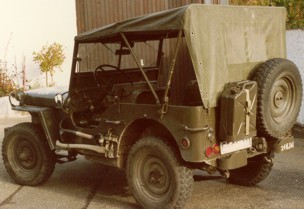
The M201 had a simple conventional structure around a light metal frame, with two rigid axles, and it was suspended on leaf springs, like the original. Its four-cylinder in-line engine, produced by Hotchkiss as well, as was a modified Willys Go Devil engine, positioned at the front. Its gear box was a replica of the original, and it was placed alongside the torque splitter in the middle of the vehicle, alongside the driver. This did not changed from the original vehicle as well. Any US driver could have found its mark immediately, apart for the makings in French. This Hotchkiss 1.9 liters engine was torquy and developed an output of 60 hp (44 kW).
The vehicle externally was also very much like the same old Willys Jeep, without hard roof or doors to facilitate ingress and exit. The forward windshield was folding on bracked over the hood, especially for desert operations as it would have been soon covered with sand and dust. For inter-seaonal operations there was an optional tarpaulin, folded tight in a bow at the rear, and its folding framing resting around the rear cab. On that matter, the standard version had two seats forward, two folding seats aft, with an open load area at the back. A tarpaulin could be erected and mounted quickly, leaving the sides wide open, but making for a roof and rear canvas protection. In winter, like the original jeeps, straps enabled to mount extra canvas panels with plastic windows to completely wrap the vehicle from the cold.
For road use, the rear axle was driven only, thanks to a switchable power, which could be directed for off-road use to the front wheels as well. The gearbox also provided three forward speeds, one reverse for road plus the off-road lower "crawler" ratio repeating the same scheme with more torque. There was no limited slip differential however, like the original. But its light weight and available gearing were qute enough for all the terrain encountered. There was no central inflation system either, but it was relatively easy to deflate the tyres for sand or snow traction, provided a pump was present to reflate the tyres on standard terrains.
Armament
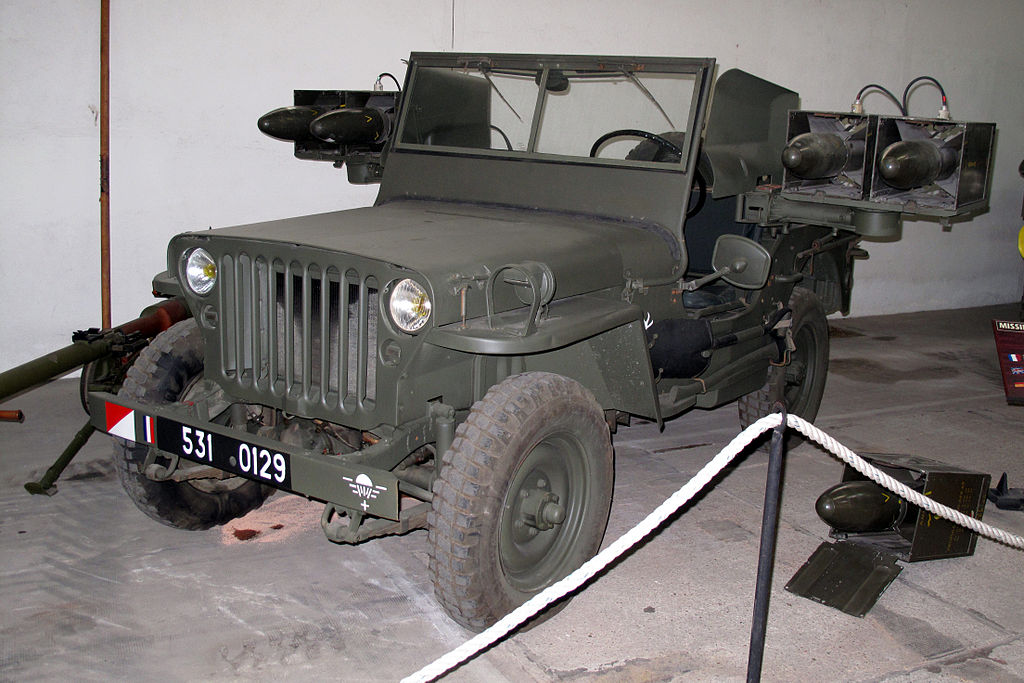 Hotchkiss M201 ENTAC, the most fearsome adaptation of the type.
LMGs and HMGs
Since it was compatible with US plate standard pintle fixations, the central pintle, if fitted, was compatible with either the Browning M1919A4 0.3 inches light machine gun or the M2 Browning 0.5 inches/70 heavy machine gun. Some tests were made with a light Brandt mortar as well. The crew of 4 had personal weapons a well.
Recoiless rifles
The Hotchkiss M201 was compatible also with recoiless rifles, like the 57mm, 75mm, and 106mm or the LRAC F1 Recoilless Gun (with the U-supplied M79 wheelbarrow mount), which could fire HEAT ammunitions in anti-tank role. For example, in Indochina the M-18 57mm RCL was issued to 1er and 2e BEPs to the HQ Company Heavy Platoon as well as the Rifle Company's HQ platoon, using standard US jeeps, but they remained compatible with the M201. Nothing is known about the use of the Milan Anti-Tank Gun, HOT or Eryx however.
From 1954, the 75mm recoilless rifle was used fitted to the Delahaye VLR but when the Hotchkiss M201 was introduced, it swapped on the more effective M40 106mm recoilless rifle from the U.S. From about 1957 onwards it needed a strengthened chassis version. Fo this, the M201 was sent to ERGM at La Maltournée for conversion, which was also compatible with the SS 10 carrier: The back body panel was removed.
M201 SS 10
The vehicle was also modified to carry and fire tge Nord Aviation SS 10 surface to surface missile developed in the early 1950s. The SS 10 launcher was fitted also on to the Delahaye VLR facing the rear, and a some ITM jeeps, then to the Hotchkiss M201 using a strengthened chassis from ERGM La Maltournée with the back body panel cut away. Each carried three SS 10. It weighted 15 kg for 0.86 m long, a diameter of 0.16 m, wingspan of 0.75 m and 5 kg HEAT Warhead efficient against 100+ mm RHA armour, with a contact detonater. It was powered by a solid-fuel rocket for 500-1600 m range at a top speed of 80 m/s, wire guided with control surfaces. This means the operator needed to stay put and focus on an approaching tank, completely exposed.
M201 ENTAC
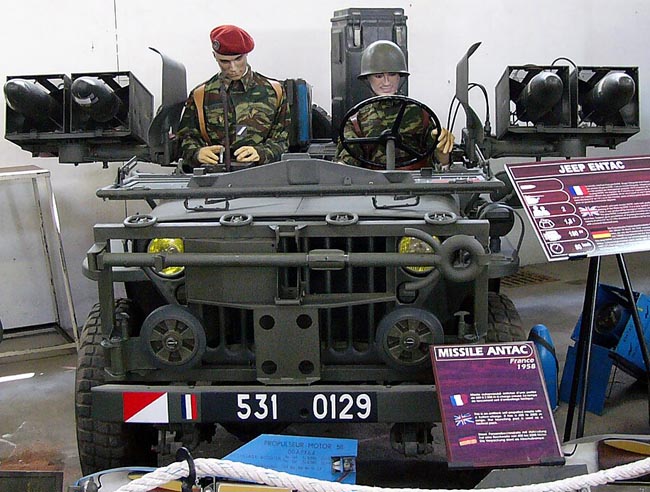 M201 Sahara recoignisable by its forward stowage frame, at Saumur Museum.
This alternative to the SS 10 was developed at the same time by the army and entered service in 1957 under the acronym ENTAC (Engin Téléguidé Anti-Char). It was fully portable, meaning the canister could be dismounted and installed anywhere rather than pointing the Jeep in the right direction. Also the installation comprised two sets of side canisters on pivots, able to fire either side on a 90° traverse. Extra missiles were stored in the rear compartment.
Development took time and it was not installed from 1963 and in limited numbers. However when it was decided to replace the SS 10 by this superior system, production was ramped up until October 1966, with more conversions at ERGM. It was used in the war in Algeria to blast open houses and fortified positions of the FLN, usually installed on the heavily modified Sahara version of the M201 with its reinforced chassis and suspension, converted from 1963 onwards. One ENTAC is famously kept on display at the Saumur Museum. The ENTAC was partly funded by US aid, under MDAP, as it could interest its own services in Europe.
In action, an ENTAC unit comprised three jeeps working together: Two carried four missiles each, and via a box missile selection could be connected bia 100m cables (installed at the rear) to a guidance control unit, with an illuminator, batteries, and tester for guidance and launching station circuit all in the third "command" jeep. They were guided by an operator using binoculars and a joystick. A further four missile boxes could be mounted on a trailer in addition to the ones that could be carried at the rear of either of the jeeps, in that case three additional missile boxes stowed in the rear of the jeep, making for nine spare missiles. This means an ambush could throw at an enemy tannk platoon a first volley of eight missiles, and more id reloaded, albeit the doctrine wanted the jeeps once spotted to retreat and reload at a safer place for redeployment.
Over 140,000 ENTAC missiles (DTAT and Aerospatiale) were produced from 1957 to 1974 and replacement by MILAN. They weighted 12.2 kg for a length of 820 mm, diameter of 152 mm, wingspan of 375 mm, and carrying each a warhead of 4 kg HE shaped charge capable of piercing 650 mm of steel armor, using a nose fuse and powered by a combination solid booster and sustainer for a longer range compared to the SS 10, from 400 m to 2000 m at 100 m/s, guided by MCLOS wire wirth trailing edge wing spoilers.
M201 Milan
In 1972, as the MILAN was accepted for service, it started to replace the ENTAC and SS 10 versions, at least until the workshops at La Maltournée after three years of convertions were closed in 1978. Many were converted back as regular vehicles at ERGM Clermont Ferrand. The Milan was a betetr system, using SACLOS and firing a 16.4 kgs tandem HEAT round usin contact fuse, 2,000 m (660–6,560 ft) range, flying at speed 200 m/s (660 ft/s. SS 10, ENTAC and MILAN jeeps (which only carried one launcher with many spare ammunition) were among the solutions for a fast defensive action in case a Soviet column went through. NATO always assumed to work in clear numerical inferiority in any "hot" war scenario against the Warsaw Pact. Thes Jeeps had the required mobility and off-road qualities to reach the best point for ambushes, and capable of fast redeployments.
M201 Sahara

Not an armament but vehicle variant. The latter was designed for use in Northern Africa, featuring a strengthened chassis, firmer springing at the back, a supplementary tool box under the front grille and a second fuel tank beneath the passenger seat. The M-201 Sahara is a product of the "Algerian events," to use the terminology of the time, and of oil exploration. Developed for the French army for liaison and reconnaissance missions in southern Algeria around the oil and gas fields and its Reggane nuclear base, it stemmed directly from the Saharan experience Hotchkiss had gained with various oil exploration and production companies.
In October 1957, near Timimoun, some Goumiers deserted. After massacring their European officers, they joined a unit of the National Liberation Army (ALN). On November 8, they attacked a convoy of oil prospectors and their legionnaire escort. Lieutenant-Colonel Bigeard's 3rd Parachute Regiment (3e RPC) was tasked with subduing the rebels, who were difficult to locate in this desert region. They had great difficulty obtaining the necessary equipment. It was the heads of several oil companies who provided them with Land Rover vehicles. Bigeard considered them far more suitable than his Jeeps for desert travel. This highlighted the numerous weaknesses of French army vehicles in desert environments. The static presentation of the JH-101 Sahara model took place on April 29, 1958, equipped with sand tires and additional fuel and water tanks:
with reinforced suspension, a variant designed to improve the vehicle's reliability;
with dual controls, as the majority of conscripts did not have driver's licenses, the army had to train its own drivers and issued them a military driving certificate. The "dual controls" option ensured training with a suitable vehicle.
⚙ specifications |
| Layout | Front engined 4-wheel drive |
| Dimensions | 3,370 x 1,480 x 1,300 mm (132.7 x 58.3 x 51.2 in) |
| Curb Weight | 1,050 kg (2,310 lb) dry weight |
| Propulsion | 4-cyl. AC Hotchkiss 2199 cc |
| Speed | c60 kph road |
| Range | c400 km |
| Armament | See notes |
| Crew | 1+5 |
The Hotchkiss M201 in Service

The military defined the M201 as a VLTT ('Véhicule Léger Tout Terrain' aka "Light all-terrain vehicle"). The standard vehicles were mostly used as staff cars or radio cars. Before long the vehicle was also adapted for use as a launch vehicle for anti-tank guns or rockets, and some were fitted with surveillance radar dishes. Indeed versions also included the hard-top (break d'aviation), ZB298 radar, RITA, gun carriers and Maheu-Labrosse fire tender. The SS 10 and recoiless rifle versions were used in the Algerian war. Some WW2 jeeps with parts from E.R.G.M. and a few Delahaye VLM also saw action in Indochina 1946-1954. It's possible some Delahayes were used as well in Korea by the French Batallion attached to the US 2nd Infantry Division.

The M201 more specifically was used by parachutists, the 1 REP (Régiment Etranger de Parachutistes) in Algeria 1955-1961, 2 REP in Zaire 1978, 1 RHP (Hussard) MILAN in 'Operation Manta', Chad 1983, which almost exclusively was equipped with the Sahara variant. The latest operation also included Foreign Legion's own M201 Sahara. As said above, the model was gradually replaced in all units by the Peugeot P4 until the 1990s with more being replaced by the VBL, even those of the reserves. The last was sitll active in 2000. Most ended on the civilian market.
Hotchkiss production of Jeep models ceased at the beginning of 1966 and the technical facilities, including the Stains assembly line, were transferred in 1970 to VIASA-EBRO in Spain, which also held a Willys-Overland license to produce American Jeep models in Spain since 1960.