White 704S (1939)
 US Heavy Truck (1935-40). 704S: 1,500 built
The White 704S was a military variant of the White 704 heavy truck launched in 1935 abd produced from 1936 to 1940. 1,500 of these trucks had been ordered by the French in preparation for the war and delivered. Most were captured after the fall of 1940 and used by the German Army on several fronts. The White Motor Company also produced for the US Military 4, 6 and 40 tonnes trucks in addition to armoured vehicles such as the M3 armoured car and M2/M3 half track cars during the war.

Definition: The White 704
The White Model 704 was introduced in 1935. It was part of the 700 series launched in 1934. The 701 and 702 models were the first, occupying the medium to heavy duty truck branch. It featured an innovative body with a streamlined design created by the Russian-born artist Alexis de Sakhnoffsky. Models produced started with the Model 704, with a limited 1.5-ton payload. Above was the 704A with a 2-3 ton payload and longer chassis, then the 704K tractor made for all sorts of utility trainers below the 10 tons payload. And there was the last and only 704S military model. Production started at the White plant in Cleveland in 1936 and continued until 1940, ending notably with the 704S.
White started to produce military trucks from 1940 onwards for the French and the British. It also collaborated with Corbiit to produce a military truck with off-road capabilites, the White/Corbitt 6 ton 6x6 Prime Mover. White also produced for the US and allies militaries the 4-ton 6x6 Cargo and variants, the 4-6-ton, 4x4 Tractor and a variety of 6-ton 6x6 trucks as well as a 10-ton 6x4 GSLC at te other end of the spectrum.
White ended car production after World War I to focus exclusively on trucks, and went up to sell 10 percent of all trucks made in the US. Although White produced all sizes of trucks from light delivery to semi, the decision was made after WWII to produce only large trucks. Of course, its contribution for the war effort, in addition to soft skinned trucks, could not be underestimated. White mass produced its
M3 4x4 scout car from 1940 and from 1941 the
M2 and
M3 half-tracks, the baseline US Army APC in world war two and its derivatves like the M13 and M16 among others.
Military version 704S
In September 1939, the French Ministry of Public Works requested trucks from the United States, to mechanize the army in emergency as its own manufacturers, Renault, Peugeot, Citroen, and Berliet, were already fully booked. This idea was taken up by the Army General Staff's Armament and Technical Studies Section, which sent a delegatio and commission to study easily adaptable truck designs from all US trus manufacturers.
White was of course contracted and this resulted in an order in September 1939 for 1,500 White 704S trucks, placed alongside additional trucks ordered from Dodge and Studebaker. The White 704S were specifically designed for the French Army, on French specifications, with extra toolboxes, a simplified dashboaed converted to the metric systems, a French regulatory light system and electric system, a French style fuel cap, etc. Manuals were traduced in French as well. The vehicles received more robust bumpers and new protective grilles in front of the original radiator, as well as a military-grade canvas-covered rear bed.
The first White 704S truck arrived in France by shipping by October 1939, after a quick adaptation in a reord time, on the production line. The fact the French renounced many of ther initial specs for speed of delivery eases things as well. But transport across the Atlantic met soon Kriegsmarine's objections, so subsequent vehicles were not unloaded until early 1940. Not all deliveries were completed by June 1940 however. It is widely agreed that the remainder of the order was taken over by Great Britain.
Design
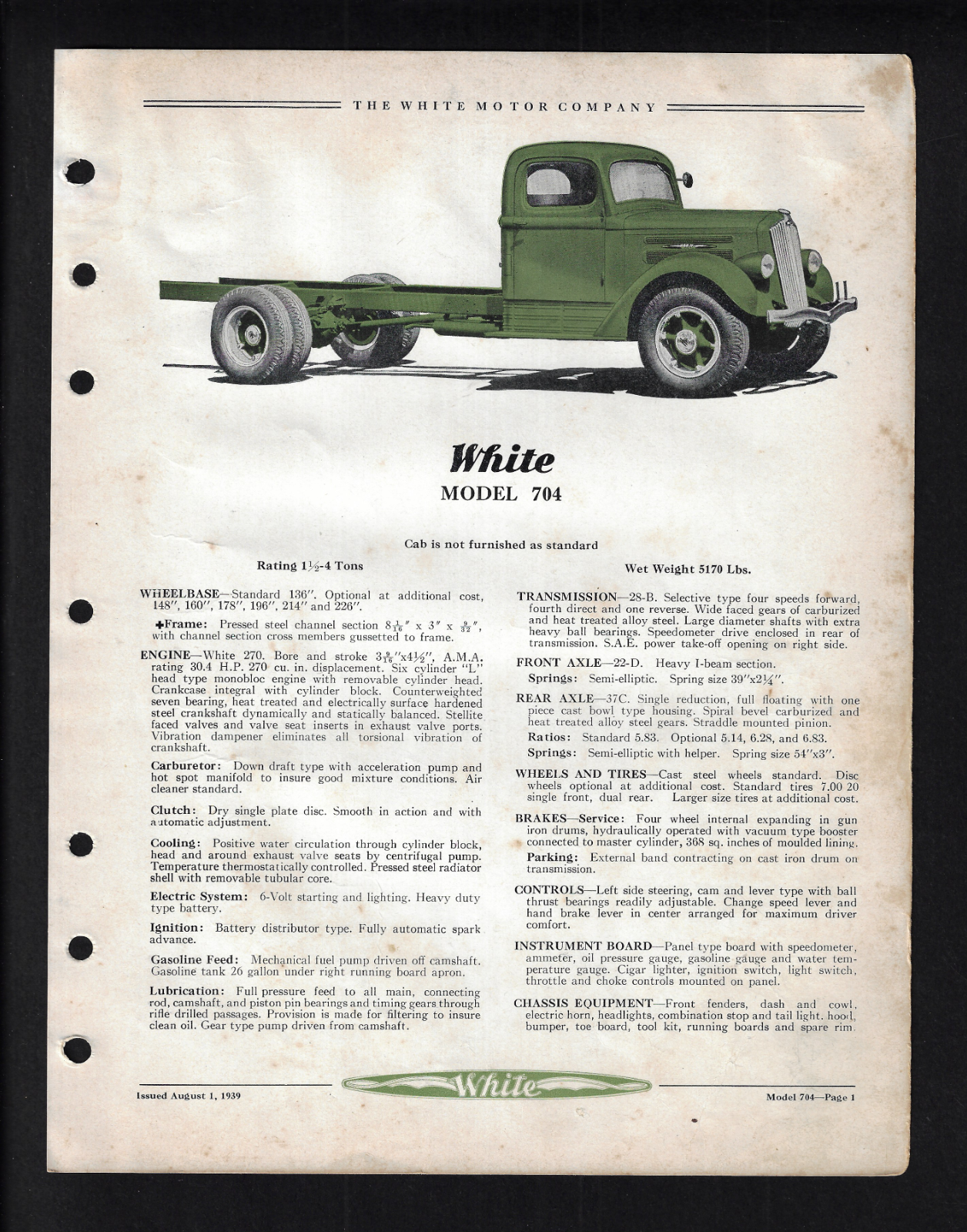
The 704S military truck received little changes compared to the regular production model to gain time in delivery (see above). Production was short, between 1939 and 1940 and it's possible that the last shipments were taken over in May-June 1940 by Britain. The ordnance name was "4x2 3-ton cargo, militarized truck for French Army". Official records stays at 1500 produced until the serie was terminated. The US Army was not interested at this point since it lacked proper off-road characteristics. Instead, better designed models were later tested and eccepted in 1941-42 under US Army standardization effort.
Nevertheless, with its payload, the 704S was the largest in White's truck offer. It was powered under a long bonnet by an in-house engine of the 11A type, 6 cylinders in line (bore and strke unknown), rated for 86hp at 2600rpm,with a capacity of 270 cu.in. (4425 cc) or 4.4 liters.
The chassos was quite long, at 7370 mm for a width of 2280 mm and a wheelbase of 178 inches or 4521 mm. Height is unknown. There was a stadard metal cab and dashboard like for the civilian version, heater and purpose electric system (capacity unknown). This engine was assisted by a gearbox of 4-speed forward and on rear. The Clutch was likely planetary, no more details.
The vehicle despite its great lenght had only two axles, albeit with double roadwheels at the rear, and used hydraulical brakes with vacuum servo assistance. The engine used both air and liquid cooling. The front axle was rigid with semi-elliptic leaf springs and the rear axle was also rigid with semi-elliptic leaf springs. Top speed was recorded as 63 km/h unladen and on road. Fully laden and off-road it was probably halves, and consumption skyrocketing. However the vehicle kept ts civilian tyres, 9,00-20 inches, and thus, had limited off-road cababilities.
Fuel consumption is unknown, as the range. The uladen weight is approximately 4 t, with a 3t payload which was a good ratio.
The White 11A six-cylinder gasoline engine, had the following ratios: 3 9/16 × 4 1/2 in (90.5 × 114.3 mm) with a displacement of 4.4 liters. At 3,000 rpm, it produced 80 hp and 251 N/m of torque. A source for the French 704S version indicates a power output of 86 hp at 2,600 rpm but Frech measurements were a bit different from US measurements. The gearbox has four forward speeds and one reverse gear. 63 km/h top speed seems not a lot consideing the the civilian 704 model is given as 85 km/h. The loaded vehicle could climb still a 38% grade, according to commercial information.
White 704S specifications |
| Dimensions (L-w-h) | 7,370 x 2,280 mm |
| Wheelbase | 4,520 mm |
| Curb weight | c4 tons unlanden, payload 3 tons, max 7 tons. |
| Crew | 1 driver, 2 cab seats +30 troops |
| Propulsion | White 11A Gasoline 6-cyl. 4,425 cc: 86 hp (DIN), 251 Nm |
| Transmission | 4 Forward + 1 Reverse |
| Top speed | 63 km/h unladen on road |
| Max range | c400 km |
The White 704S in Action
White 704S trucks were used extensively during the
Battle of France. They were appreciated for their heavy payload, only matched by Berliet trucks, but were found a bit too large for many French countryside roads. After the fall of June 1940 and surrender, some were retained by the Vichy French Army for use in Metropolitan France, but others were shipped to the Levant (French Syria-Lebanon protectorate), and French North Africa, Algeria (French territory) and Morocco (also a protectorate).
Many (around 400-600) were also captured by the Wehrmacht (as the "White 704S, 5-ton, 4x2, Cargo") just after the surrender in the occupied zone. They were kept on Western European roads given the lack of parts and off-road limitations, never seeing action on the eastern front, or from good roads only. They were also sent to North Africa and saw some service with the DAK (Afrika Korps). The Germans also used the White 920 18000 litres tank lorry, also captured n France.
Some were even recovered by US and allied forces during the Liberation of France in the summer of 1944 and reconditioned with the help of White's own spare parts network, pressed into service as part of the red ball express. They were used for supply and troop transport, with the flatbed covered by seven arches. Use in British service is not known, a few vehicles only were obtained and likely sent to a single unit, kept in Britain because of the lack of spares.