Fordson WOT (1939)
 Light to Medium Trucks, 130,000 produced
The Fordson WOT ("War Office Truck") series were British military trucks built by Ford Britain in World War II, at the Dagenham plant, from 1939 and 1945. On all, circa 130,000 trucks were manufactured of all types, so it became one of most important wartime vehicle programs in Britaon by WW2. Nearly half of these were WOT2 light truck. They all shared a Ford 3.6-litre side-valve V8 engine, 4-speed manual transmission as well as a rugged military chassis and suspensions with standard tyres. Many body variants existed outside of the standard cargo, the wireless radio truk, the ambulance, fire tender, fuel tanker, workshop, etc. This article is about the general purpose WOT-2 light truck, with future updates on the other WOT types.
The WOT Lineage
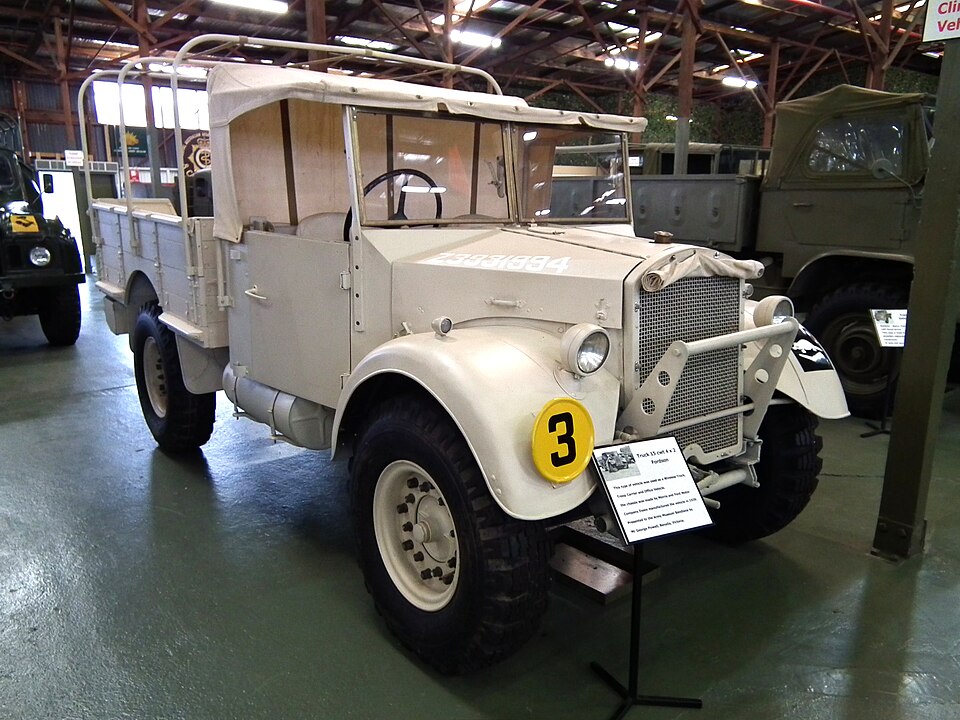 Fordson 15 Cwt Truck, North Africa 1941
The Fordson WOT (from War Office 'type'/'truck') was produced by Ford in Britain in the Second World War, in massive quantities by using the famous latest taylorisation methods From Ford, between 1939 to 1945. Of the 130,000 units produced at the gigantic Ford Dagenham plant, extendd in wartime, almost half were the WOT-2, which is the main topic here. This was the light truck variaant, the most common (see below).
Fordson was originally ta separate tractor division of the British Ford company, the name being later applied to commercial vehicles. The acronym WOT for "War Office Truck" meant it was designed from September 1939 by the War Office, to meet standard military requirements. They concerned a a light-to-heavy vehicle, available in five base models. The smallest was the 15cwt and the largest the 3.5 tons, so from a modest lorry to a heavy-duty specialist. However they were not used as tank tractors.
These WOT trucks were earmarked to be all equipped with the same mass-produced 3,621cc V8 side-valve engine. The only differences were that the WOT 1 and 2 as well as WOT 3 were all rear-drive, with a bonnet, whereas the WOT6 and 8 not only were all-wheel-drivebut they has also a forward control cab. In any case, this Ford design was both basic and rugged. It saw action not only with the Royal Army in all sub-branches of the supply train and infantry units, but also with the Royal Navy and RAF.
The majority, mostlu WOT-2 were used for troop and supply and the others were modified as specialists for various uses, such as water carriers, mobile field radio stations, ambulances or airfield fire engines (for the RAF). The WOT8 had more torque and better suited to be assigned to Royal artillery units, deployed as field gun tractor. It becae a familiar figure in the North Africa campaign. The WOT-2, the great workhorse with c65,000 vehicles was declined into the versions A to H.
Fordson trucks were not only from Dagenham, but they also soon came out from Morris Commercial and Bedford. The WOT1, WOT2, WOT3, WOT6 and WOT8 saw action on all terrains and latitudes, with the for the first three, good to average off-road performances, followed by the forward cab trued 4x4 WOT6 and 8. No rigid roof, they were mostly given tarpaulins. Their common 3.6L Ford sidevalve V-8 rated at 85 hp at 3,800 rpm coupled with a 4-speed manual and additional reduction gearbox for the four wheel drive were also ported on the WOT 3D.
About Ford UK
Ford's British story began in 1909, when the company established Ford Motor Company (England) Ltd. The UK became Ford's first major manufacturing base outside North America and eventually one of its most important overseas operations. In the Early Years (1909–1931), Ford initially assembled cars at Trafford Park in Manchester. The famous Ford Model T was built there, helping introduce mass-produced automobiles to British buyers. Ford quickly expanded its dealer network and local manufacturing presence. Then came the Dagenham Era, when in 1924 Ford purchased marshland beside the River Thames at Dagenham, east of London. The enormous factory opened in 1931 and became one of Europe's largest integrated automobile plants. Its location allowed steel, coal, and components to arrive by ship directly to the factory. The first vehicle built there was a Ford AA truck. During the following decades Dagenham produced millions of cars, trucks, tractors, and engines.
Fordson and Wartime Production: Ford UK created the Fordson brand for tractors and commercial vehicles. During World War II, Dagenham produced: Fordson tractors, Bren Gun Carriers, Military trucks including the Fordson WOT series and Special-purpose military engines and equipment. At one point Fordson tractors accounted for about 95% of UK tractor production. Britain's Best-Selling Cars were Fords postwar, until the 1990s, the Anglia, Cortina, Escort, Capri, Fiesta, Sierra or Transit diluted or obsscure the massive role played by Ford in Britain to win the war. For enthusiasts of the Fordson WOT trucks, it's worth remembering that those wartime vehicles were products of the same Dagenham industrial complex that later produced millions of Britain's most famous Ford cars and commercial vehicles.
Many wartime Fordson WOT trucks survived and are praised today by collectioners.
Development
- WOT 1: 6x4, 164 in (4.2 m)
- WOT1A was a 178 in (4.5 m) wheelbase version.
- WOT1 and 1A was mostly used by RAF eg as Fire Tenders
- WOT 2: 4x2, 15-cwt
- WOT 3 4x2, 30-cwt. used by RAF
- WOT 8: 4x4, 30-cwt. Used as artillery tractor in North Africa, supplied to USSR as a Katyusha rocket truck
- WOT 6: 4x4, 60-cwt. longer wheelbase version of WOT8
Variants
WOT1
The largest conventional-cab model, featuring a 6×4 drivetrain. Most were delivered to the Royal Air Force and frequently appeared as Airfield fire engines, Fuel tankers, Barrage balloon tenders and Mobile airfield workshops: Over 9,000 were produced.
WOT2
The most numerous variant, with roughly 60,000 built. It came in several sub-types (A–H) and served as, Infantry transport, Wireless/radio trucks, General utility vehicle, and Light cargo carrier this truly was the "workhorse" of the series.
WOT3
A medium-duty 30-cwt truck primarily used by the RAF. Nearly 18,000 were produced between 1939 and 1944.
WOT8
A compact 4×4 vehicle developed as an artillery tractor. It saw notable service in North Africa, in British artillery units and Soviet forces under Lend-Lease. Some Soviet examples were adapted as carriers for Katyusha rocket launchers. About 2,500 were built.
WOT6
The best-known heavy WOT variant. Essentially a larger, longer-wheelbase WOT8, it featured a 4×4 drive, a 3-ton payload and excellent cross-country performance. It had an Optional roof hatch for observation or machine-gun use. Nearly 30,000 were produced, and some remained in military service after the war into the 1970s.
WOT 2
The Fordson WOT was a light truck designed and manufactured by Ford Britain in the Second World War, all by Dagenham, near London. From 1939 to 1945 they represented 60,000 vehicles, almost half of the 130,000 WOTs produced total, with the other most common being WOT 6s. The abbreviation WOT as seen above stands for "War Office Truck". "Fordson" was originally a separate company from Ford specialized in tractors. However it started to independently develop commercial vehicles and Fordson was the brand name used for those from Ford. So as World War II started, Ford Britain was manufacturing the Fordson Thames 7V and Fordson E83W. Next, the Fordson WOT developed in Dagenham arrived in park by mid-June 1940 and each day the capacity was of 130 trucks.
The WOT 2 was the smallest of all six models, based on a small payload of around 750 kilograms. The WOT2 had a flatbed but some were completed instead with a van rear cab. For six-years the WOT-2 was gradually improved, with constant small changes being made, reflected by letters added to the name, WOT-2A, B, C etc. The last was the WOT-2H also the most produced of them all. The A introduced an open cab with canvas roof on new army standards, with small windows not completely sealed off. The E model had partially closed metal doors and no windshield. The electrical system went from 6 volts to 12 volts. They were soon delivered to all fughtining units, used extensively from NNorth Africa to Siculy and Italy, then France, Belgium and the Netherlands, to end in Germany. The British forces in Germany just after WW II started then to supply some European militaries postwar, like Denmark and the Netherlands.
Technically the Ford WOT2 started with a standardised 4x2 15-cwt truck chassis, a type that was ordered into mass production to foce the full mechanisation of the British Army in the late 1930s. Other manufacturers of the same basic chassis were the Morris-Commercial CS8 and C4, as well as Commer, and the Bedford MW and the Guy Ant joining the fray. This represented close to half a million small trucks. Their small size also was a deloberate choice to privilege lower costs for mass production. So in 1939, the Ministry of Supply commissioned the new "War Office Truck" to Ford Britain, a famuly using in -house chassis and engine and standadized into six models covering the weight classes 15cwt, 30cwt and 3 ton.
The WOT2 family started with "infantry trucks" using open cabs, with folding windscreens and canvas doors instead of the hard cab of the WOT-3. They had tiltless bodies similar to the 'GS trucks' and semi-enclosed cabs plus GS bodies with full-length canvas tilt (the "GS Vans"). They also were completed according to specialized roles with van cabs and special equipments for fire service. Some were converted also to light AA trucks, with 20 mm Polsten or Hispano canon, seeing a lot of action in North Africa. The fact they could fold down their windshield, and have the tarp removed completely opened the forward arc for firing the gun on the move.
The WOT2 series changed as said above from WOT2A to WOT2H and the first WOT2A as well as the C were common infantry trucks combining open cabs and GS bodies but the WOT2B and D were the first introducing a GS Van body. With the need for better weather protection by 1943, the new WOT2E, F and H appeared with semi-enclosed cabs, this time with full width windscreen, metal half-doors. There was no WOT-2G. It was proposed by never made. Below are techniocal specifics shared by all variants.
specifications WOT 2 |
| Dimensions | 4.50 x 2.30 x 2.00 m (177 x 79 x 90 inches). |
| Weight | Empty 2,050 kg, fully loaded d3.327 kg (7.395 lb.). |
| Payload | 750 kgs. |
| Crew | 1 driver +7 passengers |
| Propulsion | V8-cyl. 3.621 cm3 (220 cu. in.) Petrol: 60 hp at 2.840 rpm. |
| Transmission | 4-speed, no transfer case |
| Electrical System | 12 volt (early models 6 volt). |
| Tyres | 9.00 - 16. |
| Brakes | Mechanical, drums. |
| Suspension | Leaf Spring |
| Speed (road) | 70 kph on road |
| Range | Fuel Tank 104 litres (23 gallons). |
| Production | c60,000 1940-45 |
Additional: The vehicle was identified both as "Ford" and "Fordson", the latter being the name generally used for the Company's commercial vehicles.
The WOT 2 in action
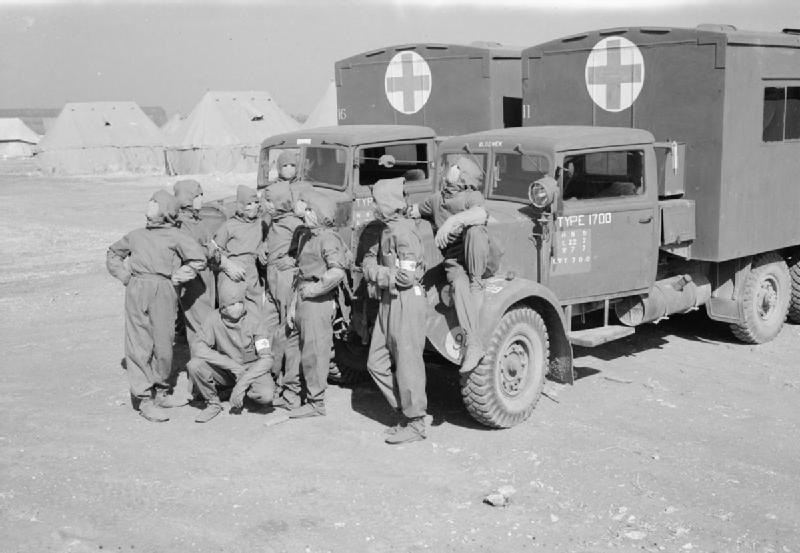 WOT-2s used by a RAF field hospital
The WOT-2 followed the standardization of the late thirties planned by the war office to motorize all infantry units. It looked simple enough before 1939 as the British Military as a whole was a small force, and the BEF deployed in France only counted at its peak, just before the May 1940 invasion, some 390,000 men for 13 divisions, 1st Army Group, North-Eastern Front. It came also with 7,096
tanks mostly assigned to the two tank divisions, but ten infantry divisions needed to be motorized. Part of these were armoured, with some 11,800+ Universal Carriers, but amazingly this unit also concetrate the entirety of the motorized assets of Britain at the time, some 200,000, mostly used to transport infantry and part of the logistic train from rear depots or from Ports.
 A Fordson WOT2 15cwt truck is marooned on a flooded railway line near Kranenburg after the Germans had deliberately blown dams in the area, 14 February 1945.
Most of the early WOT trucks depliorted were destroyed or abandoned and scuttled around Dunkirk. Before military operations resimed in North Africa, the sturdy WOT-2 truck and other models arrived in numbers, ready for Operation Compass, carrying troops that accompanied armoured divisions spearing their way through the Italian Army in Libya. WOT trucks dlivered supplies and carried troops, but soon the specialized cab versions arrived. Royal Navy ports started to use them in their usual grey livery, and the RAF, mostly camouflage to fill many indispensible airfield roles, just as RAF WOT-1 3-axles trucks took part in the Battle of Britain, illuminating bomber formations by night. Other were used to start engines, or for communication, or as workshops. They soldiered tht way until the Afrika Korps was defeated in Tunisia in 1943, and continued along a growing number of lend-lease trucks, including other Ford trucks in Sicily and Italy, through D-Day and up to Germany. The WOT-2s remained in service in the British Army well into the late fifties, but eventually they were superseded by the 1-ton post-war Morris-Commercial MRA1 and Austin K9. Many also ended in other militaries.
WOT 2 Gallery
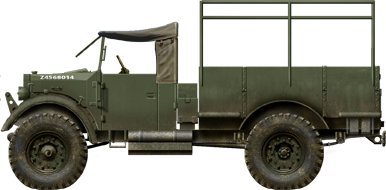 WOT-2, base
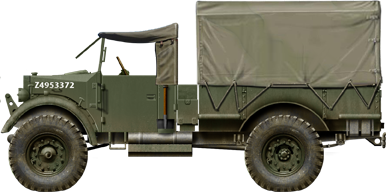 WOT-2H with tarpaulin, 1941
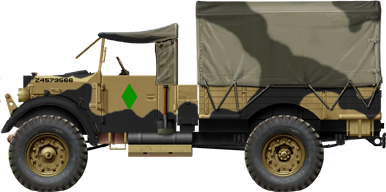 WOT-2E, North Africa
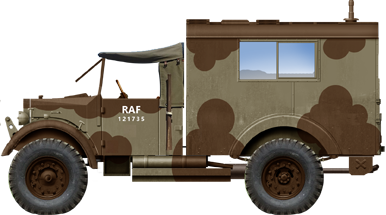 Fordson WOT-2 Communication Cab RAF
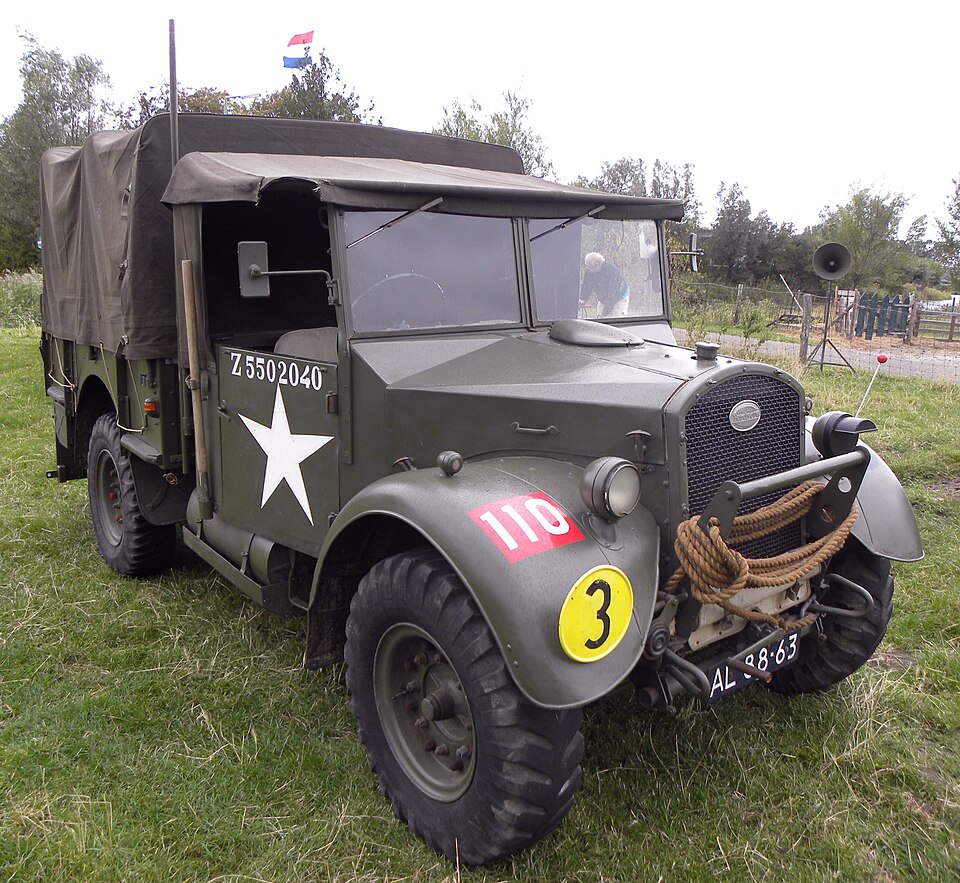 WOT-2
WOT-2
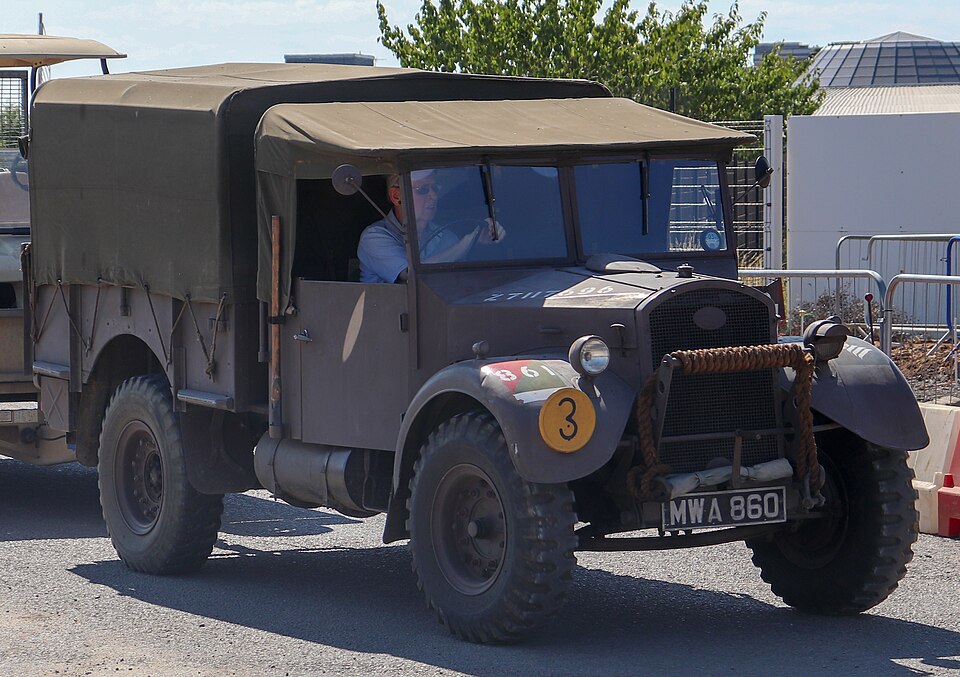 WOT-2 3.6L
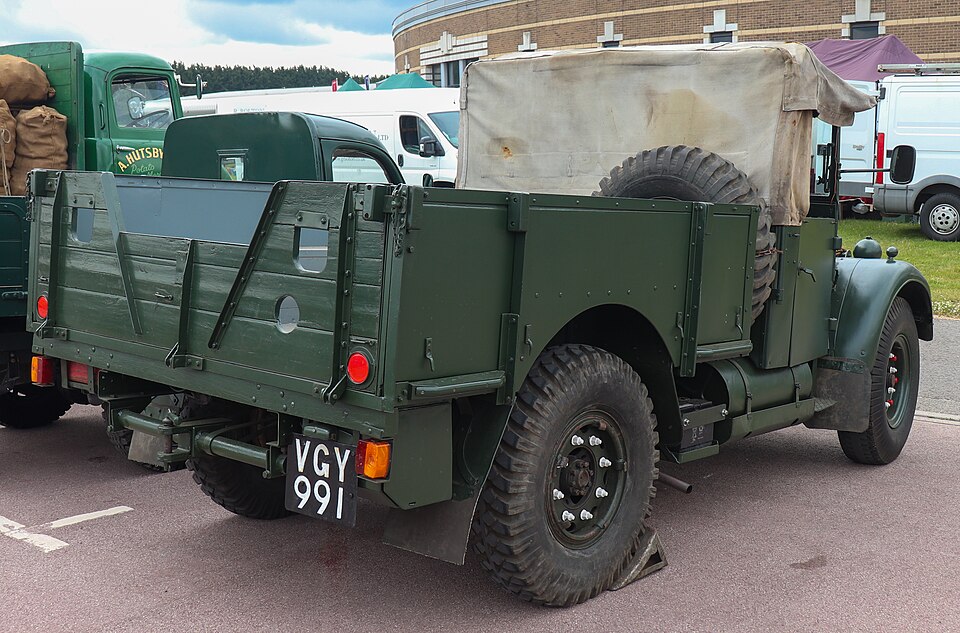 WOT-2 3.6L rear
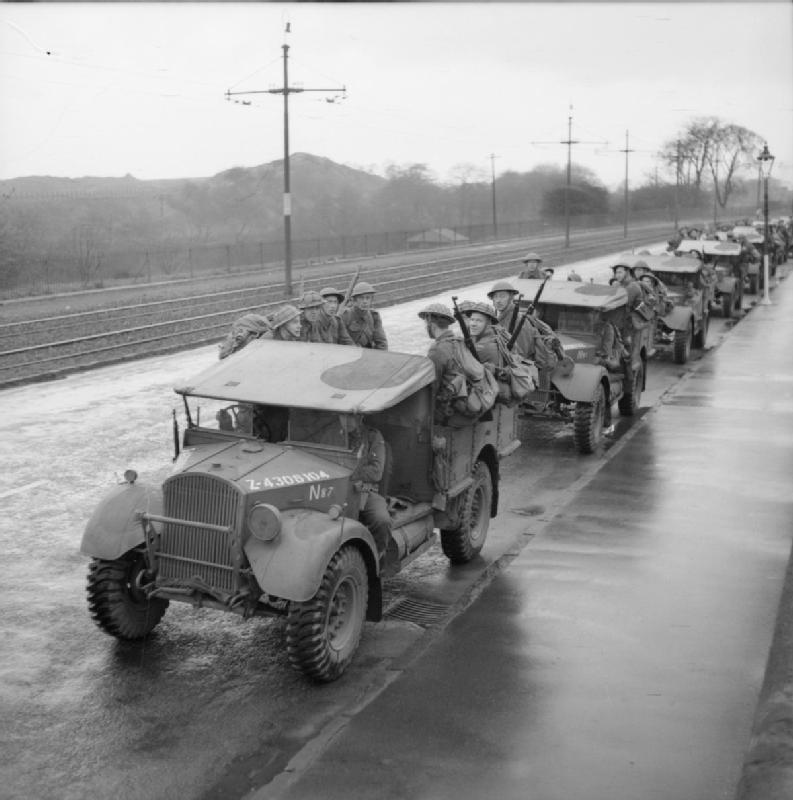 WOT-2
WOT-2
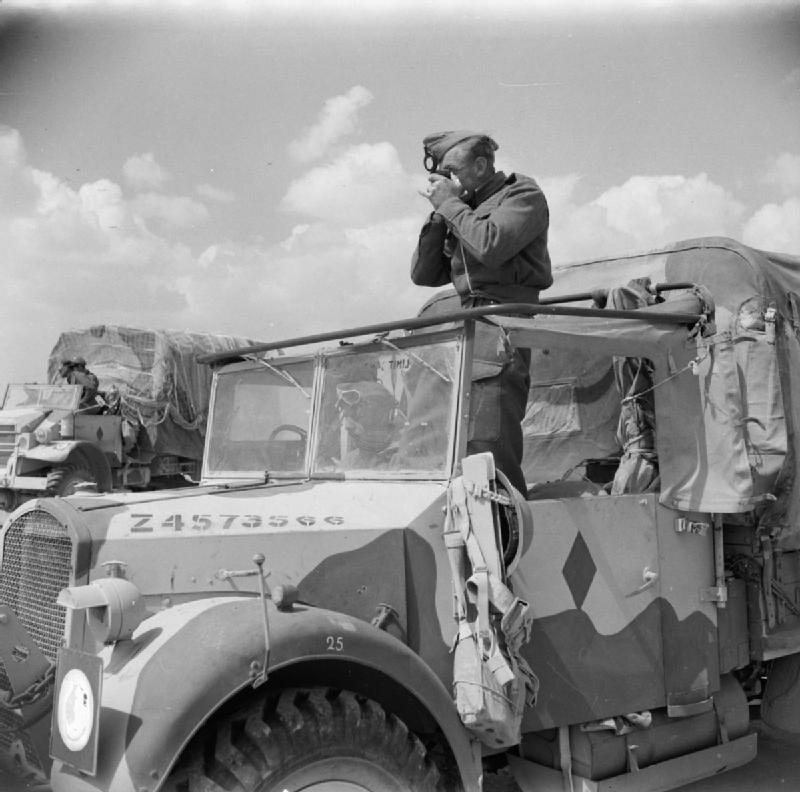 North Africa 1942, Fordson WOT2
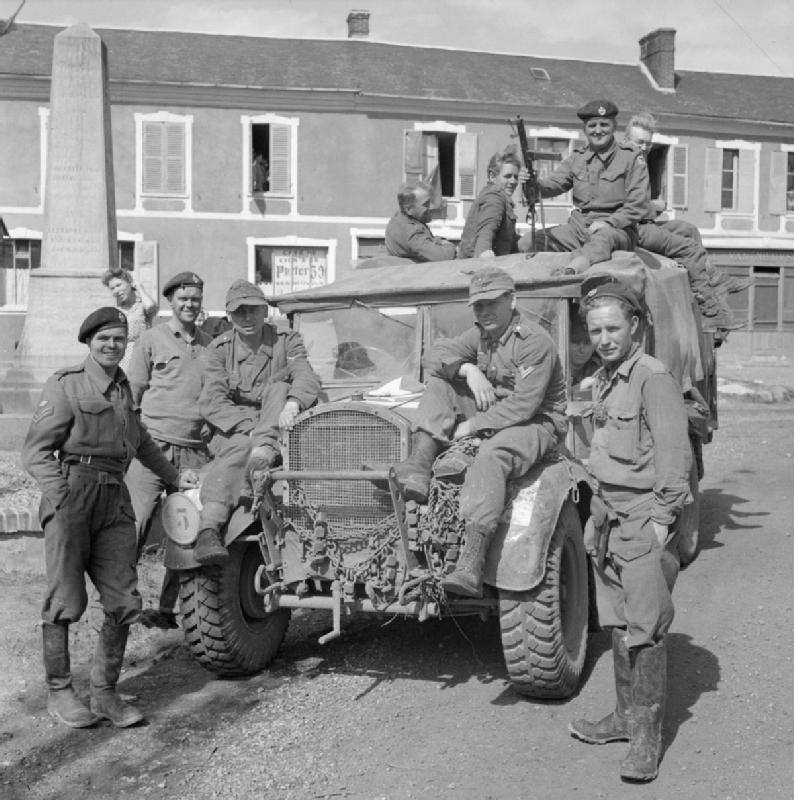 British troops with German POWs being transported on a Fordson WOT2 15cwt truck, near Gournay-en-Bray, 31 August 1944.