Morris Tilly (1939)
 1.3/4 ton utility 10HP, c20,000 produced
The Morris Tilly was a development of the Civilian Morris 10 HP series M of 1938-39, part of the four brands (with Austin, Standard and Hillman) that provided cars for the masses prewar. They filled gaps in mobility to lower level of the Army (Regimental and Batallion), soliving mechanization issues by their fast conversion to military service, heavily standardized and produced until 1945. More survived today than many WW2 trucks, as they were cheap and easy to maintain.
Development: The Tillies (generic)
The Problem: Mecanization at Regimental/Batallion level
From September 1939, the British Army was still mechanieing. At that stage however, the bulk was already done and only two out of 22 regular cavalry regiments were mechanised, that is replacing horses for vehicles. In 1940 the army was already provided trucks between 0.75 and 3-ton payload, the earliest introduced by the late 1930s, to transport motorised infantry and logistical duties. But a shortage of vehicles of all sizes remained when general mobilization commenced, and in particular, light vehicles for local liaison and communication, light transport and casualty evacuation or general utility at company or battalion level remained. Indeed, only divisions had their own logistical train. If senior officers had a staff car, junior officers and below had none, and lacked a local transportation.
This general lack of utility vehicles pushed the Ministry of Supply to reach the largest general public car manufacturers. Lord Nuffield of Morris Motors, with Nuffield Mechanizations and Aero was the first contacted, to produce military utility versions of existing saloon cars, all under the same "Car, Light Utility 4 x 2" ordnance designation.
A standard: The "Car, Light Utility 4 x 2"
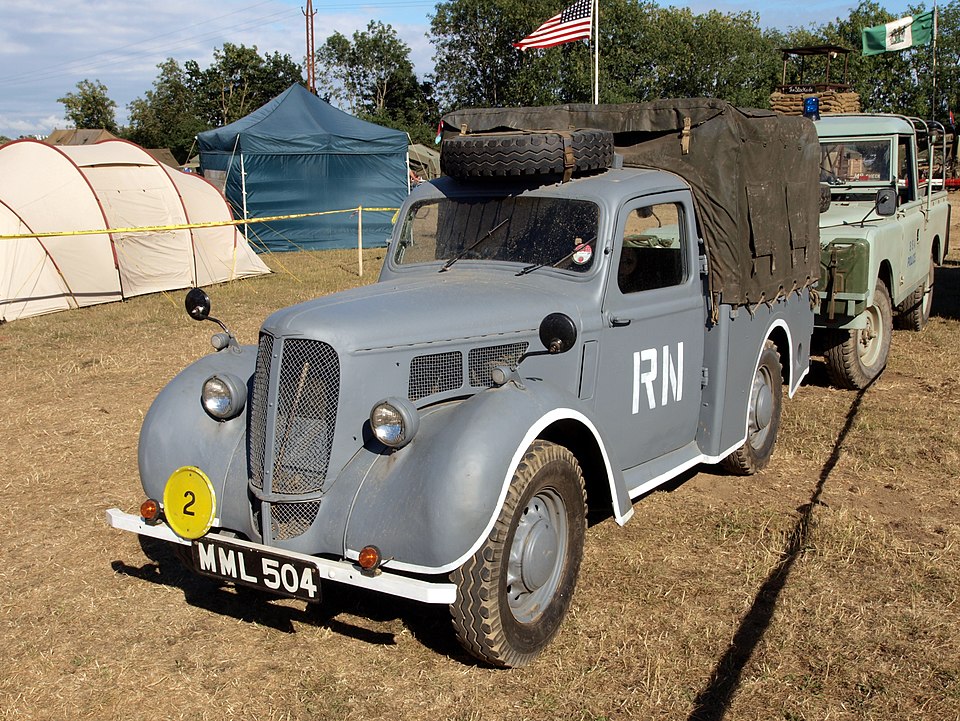 Hillman 10HP RN
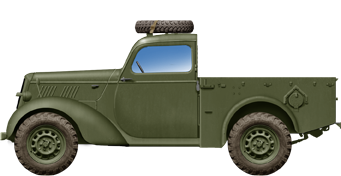
An adaptation of each model was necessary to a military Utility specification. It varied in detail but the standard was identical. The rear body was cut out and replaced by a flatbed, to create a small pickup truck, with canvas roof cover. It was called the "tilt". Thus, from 5 seates, the vehicle became a 2-3 seaters confined into the forward cab. The bodywork was simplified for mass production but the cab remained all metal. There were adaptations, with some models adopting simpler, angular flat-panel wings or doors. Cast or moulded body parts were also replaced by simpler pressed-steel stampings. Chrome were not applied and replaced by military paint, notably on the grille and bumpers.
The ornate grille when it existed was alsp removed. Simple wire mesh was used whenever possible. Interiors and seats were simplified. They were untrimmed, paint replacing bakelite, carpets and leather no longer present. The Electrical system, civilian 6-volt type, was changed for the military-standard 12-volts. Headlamps were smaller, standardised for blackout use, lighting only the road with covers. Back light and brake lights were also standardized to military grade. Engines were now all set to low-compression to run on poor-quality petrol. The rear spring suspensions were sometimes reinforced, provisions for utility stowage boxes sometimes added, and militar tyres were adopted, often the same size, with serrations and inflation for off-road use. They mechanically remained rear-drive only vehicle however.
Most car manufacturers already by 1939 worked on civilian models to be proposed to military standards, and made adaptations for colonial use, under extreme climates and on poor roads. Some had larger radiators and fans as well as uprated suspension for greater load capacity as well as an increased ground clearance. The taller and wider tyres mentioned above also improved traction as well as ground clearance. In rare cases, the chassis were strengthened in part, notably at the rear. The name 'Tilly' was soon commonly applied to this new wartime production, carried out by Austin, Hillman, Morris and Standard, the "four great" of general public car industry in Britain.
Wartime Evolution
In time, they dropped more and more civilian parts, with extra simplifications in their interiors, functional grilles as well as further simplifed wings and bodywork to create a cheap, and simple utilitarian vehicle fit for any purpose and filling that niche at below divisional level. The average weight of a Tilly was about two tons (2,000 kg). Many were fitted with a towbar at the rear to pull a single-axle trailer. Many were however often overloaded and with just their original engine rarely above 30 bhp because of interwar taxes, the 'Tilly' could only reach 50 mph unladen but far less when loaded, especially when climbing hills.
Conversely descents taxed the original braking system. And if they sported large military tyres and had a good ground clearance these vehicles performed poorly off road. They were simply underpowered. However by the numbers, they formed an indispensable small unit utilitarian mobility for any tasks of the military, while being still reliable and easy to maintain thanks to their origins from great brands. The very name "Tilly" seems to be a popular contraction derived from "utility" their official name.
Gradual replacement by the Jeep
These Tillies were a British solution to a wartime problem, while the Americans chose instead to develop for the same a dedicated off-road vehicle that became the Jeep. Manufacturing capabilities in Britain still provided hundreds of thousands of "Tillies" until the Jeep started to replace them on the frontline by 1944. They proved more useful albeit their lacked the pickup aspect of the Tillies, so they remained into many rear lines roles until the end of the war.
A number of vehicles existed under the ummbrella name "Tilly":
-Austin 8 HP Series AP (With the model 10, 29,000 units until 1945)
-Austin 10 HP Series G/YG, from the 1939 Austin 10 GRQ
-Hillman 10 HP, based on the Hillman Minx
-Morris 10 HP Series M
-Standard 10 HP
-Standard 12 HP Series UV, bfrom the "Flying 14".
Design of the Morris Tilly
 Morris 10HP working for the Ministry of Information in 1940.
The Morris 10 HP series M is the one for we are concerned here. The Morris 10 was introduced in 1932 as a medium-range FR layout saloon car. It was produced until 1948 at Crowley, Oxford (Oxfordshire). There were the Morris Ten Four made until 1935, then the ten-six for a year until 1935, the Morris Ten series II until 1937, and from 1938, the Morris Ten series III or series M saloon 1938 with 13,719 produced before the war started. It was the basis for the Tilly Military variant.
Chassis and general design
The Morris 10 HP Tilly was originally a 4-door saloon or 3-foot coupé, transformed into an utility pickup with the cab cut and enclosed just after the front seats, and a flatbed installed at the rear. The interior was spartan, with two seats and a lever style crank case, simplified oil and gas gauge, a standardized military tachometer, and a speedometer. The flat bed at the rear had a rear back panel that could fold down to eas loading. It could be used as a troop carrier, but limited to six men then, making a 2+6 transport.
The Morris 10 HP Tilly also protected the 500 kg standard load in the flatbed by a tarpaulin cover supported by a set of three arches, one at the front, another at the back and one in the middle, with fixations to be stored aside. The fuel filling cap and access was also simplfied and standardized. The vehicle kept its wheelbase of just 98 in (2,489 mm) (Series III) or 94 in (2,388 mm) for the Morris series M making it one of the smallest, of not the smallest of the Tillies.
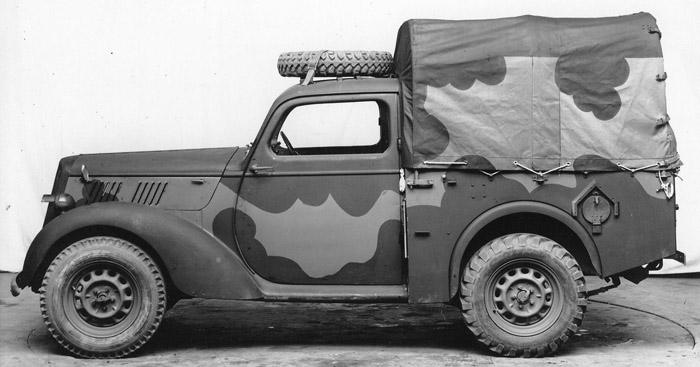 Factory photo of a 1944 late Morris Tilly.
The first model based on the Morris Ten series III had a length of just 160 in (4,064 mm) and 61 in (1,549 mm) wide, with an height of 70 in (1,70 mm) with the new military tyres, and more with the tarp tilt cover mounted. But the Majoity of the Tillies were converted from the more recent and more powerful Morris Ten Series M: They measured 158 in (4,013 mm) in lenght for a width 61 in (1,549 mm) and height of 65 in (1,651 mm) to the cab roof, which received fixations and straps to hold a spare tyre. The roadweels were shared between all four brands, just as the tyres. Later in production, mesh radiator grille became standard, as well as a simplified tarpaulin.
Mobility
Some Morris Tillies converted from the Series III rarely kept the original powertrain, a 1,292 cc (1.3 L) Morris overhead valve engine I4 coupled with a transmission, 4-apeed manual gear. An output of 37.5 bhp was more frequent. The original chromium-plated radiator surround was replaced by a painted one, all paint schemes were single tone, and soon changed to Khaki overall. The more common Morris 10 Series was the bedrock for the Morris 10 Tilly. It was powered by a 1,140 cc (1.1 L) Morris XPJM overhead valve engine I4 with a 4-speed manual transmission, and received military standard tyres of large size 6.00-16, with some setting to have a greater ground clearance. The had hydraulic brakes and a one-piece canvas tilt.
Advantages of the Model M
On the technological standpoint, the last Morris 10 series M brought many adantages before conversion: It was a completely new car with unitary construction, a new and more capable engine as the 1140cc X-Series, with an output of 37 bhp (28 kW) at 4600 rpm. Still an overhead valve system, that improved reliability iand even cure it for good. This 'free-flow' eight-port cylinder head was looking at contemporary American engines and also had a pressurised pump-driven cooling system. There was a fully filtered lubrication system and an automatic tensioner for the camshaft chain.
Like the Vauxhall 10-4, the Series M was the first to feature an OHV engine, praised for its smoothness and efficiency as well as quiet-running, an advantage on the frontline. Original top speed of the 2-doors coup was around around 62 miles per hour (100 km/h) but it fell to 50 mph or less for the Pickup Tilly. Its running gear was otherwise conventional with solid axles and longitudinal leaf springs and it is not known if they had been reinforced for the rear axle. The unitary-construction with independent front suspension and Rack and pinion steering were planned, but shelved in 1939 to simplify construction.
Morris 10HP M series Tilly specs. |
| Lenght | 158 in (4,013 mm) |
| Width | 61 in (1,549 mm) |
| Height | 65 in (1,651 mm) cab |
| Weight | 2 tonnes (Military standard) |
| Crew | 2 (driver, passenger) +6 troops |
| Propulsion | 1,140 cc (1.1 L) Morris XPJM OVH I4 |
| Suspension | Leaf springs |
| Speed (road) | c50 mph |
| Range | c300 km (unknown) |
| Armament | None. |
| Production | c20,000 |
The Morris Tilly in action
As seen in the introduction, the Morris Tilly assisted the British Army since 1940, both back home and with the BEF, at Regimental and Batallion level. They were used for ammunition, food and parts supply and occasionally troop and wounded transport, or officers liaison vehicle, for example from Regiment to Batallion HQ. Many were lost in the Dunkirk evacuation already. They were also soon in use with Royal Air Force units, both at home and deployed in North Africa in 1941 and bases of the Royal Navy through the Principal Supply and Transport Organisation (Navy) PSTON, sticking to roads because of their limited off-road capabilities. They were also often used by female personel due to their close relations to civilian cars, the WAAF (Women Auxiliary Air Force), WRENs (Navy) and Auxiliary Territorial Service.
As the war progressed they were still used in rear lines operations, especially in Britain, in Sicily 1943 and Italy from 1944. Then Western Europe from the summer 1944 onwards, albeit in rear echelon again. Jeeps were now largely distributed for frontline duties. As the war ended in September 1945, they were still in use in RAF airfields and RN Naval Bases, each having their distinct grey-blue liveries and markings. The ones used by the army had often the typical "mickey mouse" spotted camouflage in browns and greens. They were also used by the Australian Armed Forces, from the same brands made in Australia. Postwar, this utility vehicle became a popular civilian model, the Morris Commercial J4, notably as a combi.
The Tilly survived the war in droves, many remained in service in various serviced until the 1950s, returning to civilian life as surplus, or preserved in collections. In fact, tens of thousands survived to this day, especially in Britain. Others are present in many museums, such as the tank museum at Lesany (Prague), the Yorkshire Air Museum (RAF model), at the Angers Regional Air Museum, Malta Aviation Museum (Ta'Qali), Muckleburgh Collection in Norfolk and many others, adding to the privately owned Tillys, shocased notably at the 'War & Peace Show'. Owners created a website, the Tilly Register in 1996 to repertoriate all Tilly owners, help to locate and record surviving vehicles worldwide for all four brands.