Radschlepper Ost (1942)
 Germany (1942-44): Utility Tractor, c450 built
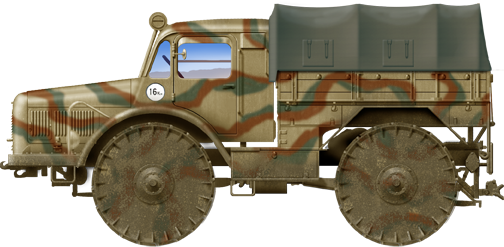
The Radschlepper Ost, or "wheeled tractor east", also known as Škoda RSO, Porsche 175, was a German heavy four-wheel drive military tractor designed by Ferdinand Porsche in 1941 and produced by Škoda, Mladá Boleslav, but only 206 were produced in 1942–1944. The large diameter wheels was not a new idea for off-road, muddy or snowy conditions, artillary tractors already used that solution in WWI. Many interwar tractors such as the Italian Pavesi also used it. But the RSO was the first multi-function model planned for the invasion of USSR in 1941. However only 206 were manufactured by Škoda Auto. The reason were multiple starting with a very high ground prssure and very high consumption. Instead of the Eastern Front, they ended in the West...
Development

Context of the Eastern Front
A type of truck that would have never though of in peacetime and seen at the time like an automotive engineering feat, is the Radschlepper Ost (RSO) for "Wheeled Tractor East" that ended in production at the Škoda plant in Pilsen, then under German in World War II. The start of Operation Barbarossa of course quickly showed the limitations of existing German and Czech (or other nation's) trucks given the poo state of its hetwork, but the need for such vehicle was planned well before the summer 1941, in fact as early as the start of 1940, before the attack on France and the low countries.
The Wehmacht expressed the need for an off-road wheeled tractor capable of traversing marshy terrain, hauling cargo, and towing heavy artillery but it was not considered given the bonanza of vehicles that were obtained, when seized, in France, the Netherlands and Belgium, in addition to Denmark, adding to those from Poland and Austria. After operation Barbarossa commenced, the soil was dusty but firm and no issues arose before the autumn and its rasputitsa. Suddenly, the whole logistical network was broken, from the train to the frontline. Deep mud found all western vehicles, designed for good roads, stuck in place. Many suggested to wait for the winter to fall and roads to harden again, but then extreme cold went in. "General Winter", wiped out a large part of the Wehrmacht truck pool by early 1942, including its fleet of artillery tractors
Soltions were found, like manufacturing more half-tracks, converting trucks as half-tracks (as the Maultier) or creating fully traked tractor such as the other RSO, the Raupenschlepper Ost. The situation became truly critical in late autumn 1941 already, as in a few days, nearly all motor transport ground to a halt, bogged down. Infantry units also faced an acute shortage of horses. Captured Russian tracked tractors started to be used as prime movers, alo turret less tanks, despite facing maintenance challenges. Winter was a window that authorized moving again, ...until the the snow started to melt in the spring of 1942, General Raputitsa replaced General winter on the frontline.
Ferdinand Porsche at the Helm
The German army knew it needed beter mobility, and for yesterday. Von Schell, the General Staff’s commissioner for automotive equipment, tasked the Ministry of Armaments to rationalize military vehicle production, halt the manufacture of a nightmare of diverse vehicles and focus instead on a few stanrads, the best models, and this resulted in focus on the Volkswagen Kübelwagen, Steyr 1500A and Opel "Blitz", and its tracked variant the Mautlier, but also two models of "RSO" to continue this line, one tracked, one wheeled to avoid bottlenecks.
Department 6 of the Wehrmacht Ordnance Office (WaPrüf 6) then established a commission led by Professor Ferdinand Porsche to evaluate designs for a tracked tractor called the Raupenschlepper Ost, to be developed by Steyr in Austria, based on components of the Steyr 1500A truck. But since manufacturing was still insufficient, another project for a wheeled prime mover designated Porsche Type 175 (RSO), was started.
Choosing the Company
 From Pinterest, one of the first batch vehicles
And like the tracked RSO, another manufacturer was to be selected, since German manufacturers were all saturated of orders and already at max capacity. This time, it was looked after Czechoslovakia. The "super-tractor" was to be built at the large automotive plant in Pilsen, in occupied Czechoslovakia, which was already fully engaged in aircraft engine components, spare parts for Messerschmitts, fuzes, and a wide range of other items. However in the past, in World War I, the same company already manufactured tractors designed by Austro-Daimler, those to tow notably siege mortars manufactured nearby.
So by January 1942, Dr. Ferdinand Porsche arrived at Skoda, to meet with the plant's chief designer, Oldřich Meduna. The Czech engineer already designed specialized vehicles for the Eastern Front, and until there, he was required to spend two weeks every month at the Porsche design bureau, in Germany, working on the new project. Other Czech designers also were sent there for six months until the vehicle's plans were completed, showcased as a model, approved, and construction of a prototype followed, approved by the ministry in short order, eve before trials were fully completed. The first RSO prototype was indeed ready by September 2, 1942, starting testing this winter, dealing wih deep snow.
Tests ans Trials
Preliminary trials started by October 1942 on the marshy plains of Radus, near Pilsen, closely followed by Porsche which never lost an occasion to personally test his creation. He was not satisfied with the results as the prime mover struggled across soft ground and was unable to negotiate slight inclines, even with its torque. It was decided to cancel official testing and returned the vehicles to the workship to address its shortcomings and work on launching the production in parallel. However for approval, it still needed official trials, which were executed from November at Berke proving ground, near Eisenach, in front of Albert Speer, Minister of Armaments. The RSO had reworked shape for its track grousers, new transmission gear ratios, a Voith 384T fluid coupling was located behind the clutch, the muffler was relocated above the roof.
Since the vehicle had been capable of fording a 1.18 m deep stream, climbed a 33° slope this was ocnsidered overly successful, albeit it was still underpowered, towing up to a 5-ton trailer, too slow, had a large turning radius of 14 meters, high profile and very difficult to handle on rough terrain. Driving on icy roads was also impossible. On paved roads, the metal wheels generated excessive noise and vibration.
Production

Still, nothng could be done for thes shortcomings and another, final demonstration for Hitler was held close to its East Prussian headquarters (the Wolfschanze) on January 4, 1943, and it impressed the boss, that approved the RSO for production. Skoda eceived a first production run of 400 units after a first "trial" batch of 10 in 1942, 154 in 1943, and 42 in 1944, but by then production was cancelled. By that stage the plant was running out of resources. In fact hndreds of starter motors were found remaining at Plzeň after the war, indicating 430 engines were manufactured, many remained unused. The above defaults never had been addressed and regular 4x4 and 4x6 trucks were found more versatile.
Design

General Layout
The RSO prototype was a four-wheel-drive prime mover featuring an enclosed, three-seat cab made of wood and metal that accommodated the driver and an assistant. It had a cargo space in its rear flatbed large enough to accomodae up to fifteen soldiers. This wooden cargo bed was covered by a canvas tilt with 4 arches. Additionally, the cargo bed could accommodate eight bunks containing shells in hauler configuration, carryng the ammunition and gun crew on one go.
To be self-sufficient in complicated conditions, Porsche added a mechanical winch with a 5-ton pulling capacity driven by the transmission, located beneath the cargo bed floor. It could be accessed via an a bed hatch to be serviced. The three-seat all-metal cab was standard, but shared only limited parts with existing Skoda vehicles. One version with a shortened cargo bed were also produced.
Mobility

The Radschlepper Ost was powered by an air-cooled, overhead-valve, 4-cylinder gasoline engine Klöckner-Humboldt-Deutz F4L. This torquy and proven unit displaced 6,024 cc (115x140 mm) for 90 hp (66.2 kW) at 2,000 rpm. It was placed ahead of the front axle under a bonner, with a dry single-plate clutch and main five-speed transmission, then two two-speed transfer cases with inter-axle differential locks. Torque was transmitted via two pairs of side-mounted driveshafts, to the final drives located either sides of the solid axles through short shafts to the bevel gear units at each wheel.
The axles were suspended on longitudinal semi-elliptical leaf springs. The bevel gear sets allowed all wheels to be angled slightly for steering. The rear-wheel steering linkage was designed to be disengaged. The vehicle also had an auxiliary two-cylinder gasoline engine (565 cc, 12 hp), basically a halved "flat-four" KdF passenger car used as a starter in cold temperatures. The initial then vehicles preserie batch had these.
There was a wheelbase of 3 meters, but in reality it looked shorter due to the massie tractor style all-metal wheels, each with a diameter of 1.5 meters, and presenting a contact surface 30 cm wide at the front, 40 cm at the rear and fitted with grousers to ensure soft terrain mobility. To reduce weight the first prototypes had these wheels holed but later for production simplification this was dicontinued. The ground clearance was remarkable at 49 cm, for a curb weight of 12 tons. However this tractor was specifically made for low speed, at best up to 16 km/h and with a fuel consumption which rose to an appealing 100 liters per 100 kilometers. So with a 250-liter tank that means 250 km at best. An that was on trials, without towing anything. When used in deep mud towing heavy artillery, fuel consumption soared to 600 liters per 100 km, which massively complicated logistics.
Tech details:

Type: Heavy tractor, 4x4 (Radschlepper Ost) by Skoda RSO (Porsche Typ 175), Plzeň, Czechoslovakia
Design: Dr. Ing. h.c. F. Porsche KG, Stuttgart, Germany
ENGINE: 4-cylinder, inline, gasoline, OHV, air-cooled 6,024 cc (115 x 145 mm), 90 hp at 2,000 rpm
Compression ratio: 5.45:1.
Wheel type: Steel discs, 1,500 mm diameter; width 300 mm (front), 400 mm (rear)
Carburetor: Solex 48FNVP. ELECTRICAL SYSTEM: Bosch.
AUXILIARY 2-cylinder, inline, gasoline, OHV, air-cooled; voltage: 12V (1 battery, 105 Ah)
565 cc (75 x 64 mm), Power output: 12 hp at 3,500 rpm, Compression ratio: 5.8:1, carburetor: Solex
WINCH: Load capacity: 5,000 kg.
Wheelbase: 3,000 mm, Track (front/rear): 1,820/1,720 mm, ground clearance 490 mm (at the axle)
Fuel tank capacity: 250 L, Weight repartition 4,000 kg on front axle, 3,000 kg on rear axle
Gross weight: 12,000 kg
Max. speed 1st gear 2.44 km/h, 2nd gear 3.62 km/h, 3rd gear 5.73 km/h, 4th gear 9.16 km/h, 5th gear 15.00 km/h, reverse 2.92 km/h
Range: 125 km.
Gradient capability: 33 degrees
Max. fording depth: 1,180 mm, Turning radius: 14 m.
The Radschellper Ost in combat

By 1943, the front fell closer to the borders of Poland and Czechoslovakia, so roads were better making the RSOs redundant. It was decided instead to send them in the winter of 1944–1945 to the West, Netherlands and France. However, they were still rarely seen on the roads as no fuel was allocated for them. Attempts were made to use them in engineering units of demolition of railway lines and a few appeared during the the Ardennes Offensive, captured by the Americans. The latter tested it, knowing it was from Porsche, but were not impressed. Several surviving evehicles, notably from the Kummersdorf proving ground, remained in service in East Germany until the 1960s, notably when converted for rail operations. So overall, not a war winner design but adding extra strain on already depleted manufacturing resources.
Radschlepper Ost specifications |
| Dimensions | 6,220 mm lenght x 2,300 mm width x 3,065 mm height |
| Weight | 7 tonnes, Gross 12 tonnes, towing 5 tonnes |
| Crew | 3 cabin, 14 flatbed |
| Propulsion | Skoda 4-cyl. OHV AC 6,024 cc: 90 hp/2,000 rpm |
| Top speed | 16 kph |
| Payload | 4 tonnes |
| Transmission | 4+2 speeds, see notes |
| Suspension | None. |
| Maximum range (on/off road) | c250 km unladen, see notes |
| Production | 450 produced, c400 deployed |