Henschel Type 33 (1928)
 Germany (1928) - Medium Truck - 11,234 built, subtypes D 1, G 1 and FA 1 1934-43.
The Henschel 33 was a "medium, all-terrain truck" developed in various versions for the German Reichswehr and used by it, as well as later by the Wehrmacht. Many different units used this robust 3-ton payload vehicle during World War II until 1945, and a total of 11,234 were manufactured into the subtypes D 1, G 1 and FA 1 1934-43, not even counting the Magirus licenced versions. Development went over 13 years but the type, extremely robust, as it was propelled by cardans to the rear axles, had limited off-road capabilities and a light payload compared to its dead weight. By 1943 all production ceased as there were far better propositions in its category, notably half-tracks.
Design development
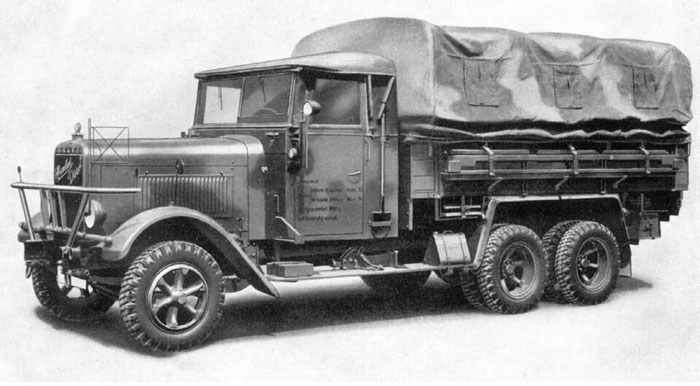 Henschel 33 G1 Diesel 6x4 truck for the Wehrmacht in 1937 (factory photo)
The first program for motorising the Reichswehr in 1926, stated the need for a three-axle cross-country 3-ton payload lorry among other classes. Three companies answered the tender, Büssing, Henschel and Krupp, retained as winners after a first paper review.
In 1926, the Reichswehr started to consider future equipment and lead a general motorization, following an effort all armies had been pursuing since the end of the First World War. This was cnsidered a critical aspect of potential future wars. Off-road trucks notably, able to replace large horse-drawn vehicles had been absent in the Imperial Army, and could be a reason why (among others) the spring 1918 offensive failed. There were no such vehicles being produced in Germany in enough numbers to make it happen. Experience had already been gained however with subsidized trucks in the standard 3-ton range.
Thus in 1926, the Reichswehr formulated precise requirements for such a truck, with a tender proposed to all commercial vehicle manufacturers. The specification called for a :
"three-axle truck with twin rear wheels, a 3000 kg payload, high ground clearance, driven rear axles, and good traction".
According to the Reichswehr's description, this class was a "medium off-road truck (o)," where "o" stood for commercially available, i.e., an industrial design." Henschel was the first to answer in 1928 with its Type 33, Krupp presented soon after its Type L3 H63 and then Büssing-NAG with its Type III GL 6, but much, much later, in 1932/33. Finally around 1935/36, Mercedes presented its Type LG 3000. Orders for all were received.
Since the Krupp and Henschel models were available early and with still low international tensions, both vehicles were produced in small batches only for testings, albeit quite extensive. The German Reichsbahn was also involved in these fow its own needs. A few dozens were thus delivered until 1934. However after 1934, the Henschel 33 became the most produced in its class.
Henschel 33 D1 (1928)
Henschel proposed their type 33 B 1, creating a prototype delivered two years later, for testing, in 1928. The civilian version wa developed alongside as a backup plan, with single tyres on all axles, and disc rims. The main difference with the military model was their spoke rims (three spokes) with rear dual tyres to better spread the load. The company also developed a three-axle omnibus chassis called the type 34 D 3. The Aarmy loked the overall design, but found it underpowered. Thus, the next Henschel type 33 D 1 had a beefier "D" engine and other modifications asked for; It was greenlighted and ordered, entering serial production.
The Reichswehr however at that stage had a limited budget and only procured small numbers of the D 1 type Lorry. Unlike the civilian Henschel type 33 B 1, the D 1 had a longer engine bonnet. After extensive use, with Hitler coming into power, the new military logistic department had a second look at the vehicle. By the 1933 standards it appeared obsolete, and still underpowered.
Henschel 33 D2 (1933)
In the new motorization plan of the newly created Wehrmacht, now more massive, it was asked to Henschel to revise the design. The result was a brand new vehicle, the D 2. However it, too, was manufactured in small numbers merely for field testing. The D2 had had a lengthened wheelbase and strenghtened suspensions for a superior payload of 4-5 tons, and also declined into the civilian B2 model. WW1 systems were still in use, as the two rear axles were sttill propelled by separate cardan shafts. This was considered obsolete by 1933 standards still.
So Henschel provided a widely improved version of the its type 33 D 1 from 1934, with rear axles now propelled by only a single cardan shaft with an additional short cardan shaft between the rear axles. The wheelbase was increased from 3,400 to 3,750 mm to close on the D2, and performances however remained the same. However one innovation was the addition of simplex rims with six spokes on th wheels.
Later Henschel types (1937-39)
From 1937, the Henschel type 33 G 1 appeared. This was a mixture between the best features of the reworked D1 and D2, now propelled by a mdodern, much more powerful diesel engine and both this model and the D1(mod) were manufactured until 1943. Then in 1936 the Henschel type 33 FA 1 entered service, manufactured until 1942. However its chassis was exclusively used for the Tankspritze 2,5 (Kfz. 343) fuel tank truck powered by the in-house type FA engine rated for 126 HP.
Magirus 33 G1 and H1 (1937-42)
Magirus joined the production of the G 1 under license from 1937, and until 1941, with an in-house 100 HP diesel engine, keeping the Henschel crankcase and Deutz cylinders, cans and pistons. From 1939 to 1941, Magirus also produced the type 33 H, now powered by a 125 HP Deutz diesel engine, following the Tankspritze 2,5 (Kfz. 343) own evolution.
Production of the Henschel 33
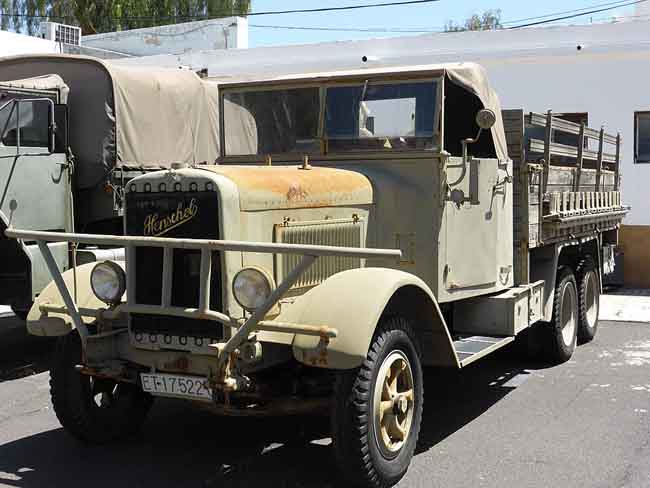 This heavy truck, manufactured in Germany by Henschel und Sohn between 1934 and 1937, is currently on display at the Almeyda Fort in Santa Cruz de Tenerife, Spain, at the headquarters of the "Canary Islands Military History Museum." It arrived in Tenerife in 1940 and was used by the Spanish Army.
The Henschel type 33 was chosen as standard heavy truck (for the 5t payload category) and 11,234 of the subtypes D 1, G 1 and FA 1 (for Henschel alone) were manufactured from 1934 to 1943 according to the chassis number lists. Until 1934, 400 were made but soon Magirus added an extra 3,870 vehicles from 1937 to 1941.
Variants of the Henschel 33
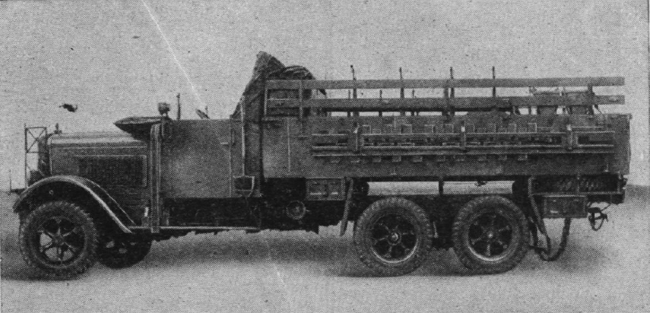 D. 600, mittlerer Flakkraftwagen mit Fahrgestell des mittleren geländegängigen Lastkraftwagen (o)
The model 33 led to many variants to be produced:
Main variants:
Open flatbed truck (standard)
Frequently used by the army in ammunition columns, pioneer units, and bridge convoys; by the Luftwaffe often as a prime mover for 8.8 cm Flak guns; field kitchens were also transported on the loading platform.
Kfz. 72:
It had a closed body with vertical wooden slat walls (radio operating, teletype, telephone operating, radio listening, weather, and printing trucks).
Pioneer combat truck:
It had a special body with storage compartments accessible through hatches from the side. The related Pioneer truck I had a special body in the flatbed version for access to storage compartments by opening the side panel.
Tank pumper Ts 2.5 Kfz. 343:
FA1 version (fire engine/mounted pump) based on the D1 model, also classed as a "special vehicle". The entire flatbed is converted to mount a water tank for fire fighting. Used notably on Luftwaffe and Kriegsmarine bases.
Others:
-Field cable truck: Conversion kit for flatbed version.
-Medium Flak truck – corresponding accessories.
-Medium searchlight truck – corresponding accessories.
-Workshop truck Kfz. 79: box body, split side panel to be swung open.
-Crane truck Kfz. 75
-Survey vehicle
-Kfz. 92a for Chemical Troops, Later transferred to the Medical Service
-Clothing decontamination truck Kfz. 93 (same, Later transferred to the Medical Service)
-Water truck Kfz. 94, same again as chemical warfare never took place in WW2.
-Civilian fire engines (a few, also used postwar)
-Omnibuses of the German Reichspost.
All variants:
- mittlerer geländegängiger Lastkraftwagen, offen (o)
- mittlerer geländegängiger Lastkraftwagen, offen (o) für Betriebsstoff
- mittlerer geländegängiger Lastkraftwagen, offen (o) für Betriebsstoff & Gerät
- mittlerer geländegängiger Lastkraftwagen, offen (o) mit kleiner oder großer Feldküche
- Feldfernkabelkraftwagen (telephone cable vehicle)
- Fernsprech-Baukraftwagen
- schwerer Fernsprechkraftwagen
- mittlerer Flakkraftwagen
- mittlerer Lastkraftwagen für Feldfernkabel
- Lastkraftwagen für Fernsprechbau
- Lastkraftwagen für Werkstattgerät
- Lichtmessgerätekraftwagen
- Pionierkraftwagen I (2 versions, engineering vehicle)
- mittlerer Scheinwerferkraftwagen
- Druckereikraftwagen (Kfz. 72) mit Fahrgestell des m. gl. Lkw. (o)
- Fernschreibkraftwagen (Kfz. 72) mit Fahrgestell des m. gl. Lkw. (o)
- Fernschrei-Vermittlungskraftwagen (Kfz. 72) mit Fahrgestell des m. gl. Lkw. (o)
- Fernschreib-WT-Kraftwagen (Kfz. 72) mit Fahrgestell des m. gl. Lkw. (o)
- Fernsprechbetriebskraftwagen (Kfz. 72) mit Fahrgestell des m. gl. Lkw. (o)
- Funkbetriebskraftwagen (Kfz. 72) mit Fahrgestell des m. gl. Lkw. (o)
- Funkhorchkraftwagen a (Kfz. 72) mit Fahrgestell des m. gl. Lkw. (o)
- Funkkraftwagen a und b (Kfz. 72) mit Fahrgestell des m. gl. Lkw. (o)
- Umfüllpumpenwagen (Kfz. 72) mit Fahrgestell des m. gl. Lkw. (o)
- Wetterkraftwagen (Kfz. 72) mit Fahrgestell des m. gl. Lkw. (o)
- schwerer Vermessungstruppkraftwagen (Kfz. 73) mit Fahrgestell des m. gl. Lkw. (o)
- Triebwerkkraftwagen (Kfz. 75) mit Fahrgestell des m. gl. Lkw. (o)
- Werkstattkraftwagen (Kfz. 79) mit Fahrgestell des m. gl. Lkw. (o)
- Nebelkraftwagen (Kfz. 91) mit Fahrgestell des m. gl. Lkw. (o)
- Mannschafts-Entgiftungskraftwagen (Kfz. 92, 92b, 92/1) mit Fahrgestell des m. gl. Lkw. (o)
- Bekleidungs-Entgiftungskraftwagen (Kfz. 93, 93/1) mit Fahrgestell des m. gl. Lkw. (o)
- Wasserkraftwagen (Kfz. 94) mit Fahrgestell des m. gl. Lkw. (o)
- Kammerkraftwagen (Kfz. 95) mit Fahrgestell des m. gl. Lkw. (o)
- Tankspritze (Kfz. 343) mit Fahrgestell des m. gl. Lkw. (o)
- Landebahnleuchtkraftwagen (Kfz. 353) mit Fahrgestell des m. gl. Lkw. (o)
- Kfz. 72, Rüstwagen & Waldbrandlöschfahrzeug
Design
 6 views (pinterest)
The early Henschel Type 33 D 1 from 1929 had a stronger D engine with a capacity of 10.8 litres for an output of 100 HP. The chassis was identical to B 1 but it differed by a longer engine bonnet. A few were built but the 1934 appeared soon with a new designed chassis under the same name and known in documentation as the Henschel Type 33 D 1 neu. The original D 1 had a tall square cabin, a flatbed after with a folding back plate, and a tarpaulin fixed on four arches nd simple tubular bumper.
The D 1 neu from 1934 had a better power transmission with a large and additional short cardan shaft between the rear axles, extra wheelbase between the first and second axle and revised tubular bumper, on two levels. The cab was now open, with tarpaulin, and lower. The side of the flatbed were revised and made taller, albeit it still used four arches. The front fenders were simplified in shape and notek light added when available as wel as back blackout lights, and revised, greater stowage boxes under the flatbed, and larger fuel tanks.
The windshield was the same split model, but now folding forward for desert use. There was a single driver-sise rear mirror and three small projectors. A new large road light was installed on the left fender. Also, from 1937, new triply-lateral divided Trilex rims were introduced with a missing lip and clearly visible screw joint.
The Henschel FA1 had a new type FA petrol engine rated for 12,742 ccm for an output of 126 HP at 1,400 RPM. The block had a bore of 130 mm and lengthened crank shaft for a front-mounted fire pump. It was only used for the fuel tank variant of the Henschel 33. The G1 was identical to the D1 except for the "Diesel" label on the radiator grille. Given its heavier diesel, the payload was reduced by 150 kg.
None of the variants except a few were armed, with only the personal weapons (pistol or MP38 submachine gun). Some variants might have been armed like the engineering vehicles, notably telephone cable laying vehicle still close to the frontlines and others, when facing partisan activity. One that was indirectly "heavily armed" was the mittlerer Flakkraftwagen, towing a 8,8 cm FLAK gun. The Henschel type 33 had a pulling force of 3.5 tons cross-country but up to ten tons on good roads so it could two the even heavier 10,5 cm Flak 38. The lack of payload made impossible an adaptation of heavy guns, apart some field conversion with 3.7 cm or 2cm FLAK guns as organic AA trucks in some units.
Caracteristics
- Early version B1 and D1: Enclosed cab and 3-spoke wheels
- Mid-range version B1: Open cab with fixed windscreen and 3-spoke wheels
- Late version B1: Open cab with fixed windscreen and 6-spoke wheels (Trilex)
- Early version D1: Longer engine hood than B1, open cab with folding windscreen, angled fairing of the transition between engine compartment and cab
- Mid-range version D1: Continuous running board from front to rear fender, compressed air tank (from 1937) under the rear of the vehicle
- Late version D1: Now reinforced front bumper with 3 additional vertical bars in the center
Appreciation
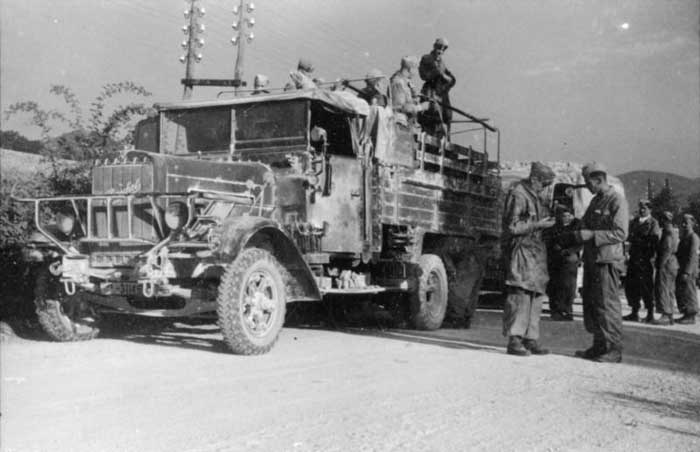 D1 used in Italy, Abruzzo in a unit returning from the Gran Sasso on September 13, 1943.
Overall, the Henschel type 33 was a trusted medium-heavy truck, sturdy and solid albeit better suited for European conditions, with good, paved or hard roads. Indeed, after the summer 1941 invasion USSR, and the autumn, deep into the east, it soon showed insufficient cross-country mobility. The dual rear tyres had to be swapped by better models and the payload to be reduced to 3 tons, which compared to the deadweight was way below the performances of more modern lorries like the Opel Blitz. In fairness it must be said, that the famous American 2.5 ton lorries from GMC and Studebaker had also dual tyres on the rear axles. Still, it's rock solid construction maintained this model until the end of the war.
Henschel Model 33 specifications |
| Dimensions | 7,400 x 2,500 x 3,200 mm. |
| Wheelbase | 3,750 + 1,100 mm |
| Weight | 5,685 t (Gasoline), 6,100 t (Diesel) |
| Payload | 3 tonnes |
| Crew | 1 driver, +12 troops |
| Propulsion | Henschel Type B(F** 126 hp) Otto/Type G* diesel: 100 hp |
| Transmission | 4+1, differential with cardans |
| Capacity | D1: 10,782CC, FA1: 12,742CC, G1: 9,123 CC |
| Top speed | 52–55 km/h |
| Suspension | 6x4 Leaf springs |
| Tyres | Size 7.25-20 |
| Rrange | 120/126 l gas/diesel, 420 km road, 280 km off-road |
| Production | 6,293 D1, 592 FA1, 4,349 G1. |
*FA1 **G1