Unic P107
 Half-Track Tractor 1934-1940, about 3,276 built
Citroën developed half-tracks based on the Kégresse patent and by 1934, it introduced its P107 model to succeed to the ageing 1929 Citroën-Kégresse P17. Citroën however went bankrupt, Michelin, the new owner, decided to focus on civilian markets. Unic therefore took over the license and started to produce the P107 under its name. It entered service with the French armt from 1937, in variants such as the P 107 B, P 107 BU or P 107 U1, based on an order in 1935. The army in May 1940 fielded the 75mm light prime mover, also able to two the short 105 mm Bourges and Schneider, and another for engineer units, then one for transmission units for a grand total of 1,274 until 1939 and 1,896 more until June 1940 for a total of 3,276.
About UNIC
Unic was a French manufacturer, founded in 1905, in automobiles until July 1938 and in commercial vehicles, mostly trucks, notably for the army, until acquired in 1952 by Henri Pigozzi, into Simca. The founder Georges Richard left Richard-Brasier and from 1905 was funded by Baron Henri de Rothschild to create the "société anonyme des automobiles Unic" in Puteaux. The brand name was a reflection on the French "unique" (rather than mainstream) for its vehicles. It started with light cars and taxis in 2 or 4-cylinders. It became France's prime taxi provided for three decades, until WW2.
In WWI its taxis were prominently used with Renault models in the famed "Marne Miracle" in 1914, and he provided rapid texi conversion as troop transports for the Army until 1918, making its entry into this market. In 1919 it launched a new four-cylinder (1847 cc) and in 1922 introduced its first three-ton truck Unic MSC. It was remarked by the military, albeit not an off-road vehicle yet. Unic also from 1930 entered the military business, taking over the order for thousands of Unit P107 from Citroen, perhaps its best known, but the company also made the light TU-1 light half-track that was also adopted and fielded in 1939 by the Polish Army. But for lorries the range was considerable from 1932, and comprised the Unic CD 2, CD 3, CD 12, CG 26, S 12, S 17 M, S 18, S 20, S 25, S 27, S 28, S 33, S 40, S 45, S 50, S 55, S 75, G 40 and G 50 plus their variants. Postwar, Unic also procured the French Army the U130 in the 1950s, its last military production.
Development
In 1933, as Germany was started to rearm, and with the effects of the 1929 crisis mostly absorbed, the Army wanted to reinforce its overall mobility, mechanized all its remaining horse-drawn artillery unit and motorize auxiliary corps such as engineers, repair and communication units. Part of that effort was to provide them vehicles capable of dealing with all-terrains and mud close to a battlefield that was believed to resemble WWI. Adolphe Kégresse, wich developed the first half-tracks for the Tsar of Russia before the war and revolution, and returned to France to exploit its patterns with Citroën.
Thus, Citröen, and later Panhard, developed military utility half-track trucks in a whole serie. Among the best known and most produced was the
P17 of which 1,442 were built 1930-1933, but criticized for being underpowered. It was still the case of the Citröen P107 but the later Unic model managed to boost the output. It was tested by a commission and accepted for production in 1935. Production was slow at first but accelerated between September 1939 and June 1940. However already in 1936 the model was considered too tall and conspicious, leading Unic to work on its own design, the TU-1. Much lower, lighter, the TU-1 was supposed to be a fast personnel half-track and was accepted in 1938, but delays meant production only started in 1939, just 236 were delivered until June 1940. Comparable to the Krupp-Protze with a payload of only 475 kg. It was also used by the Germans and considered much smaller than the Sd.Kfz. 10 Demag.
Design
General Layout
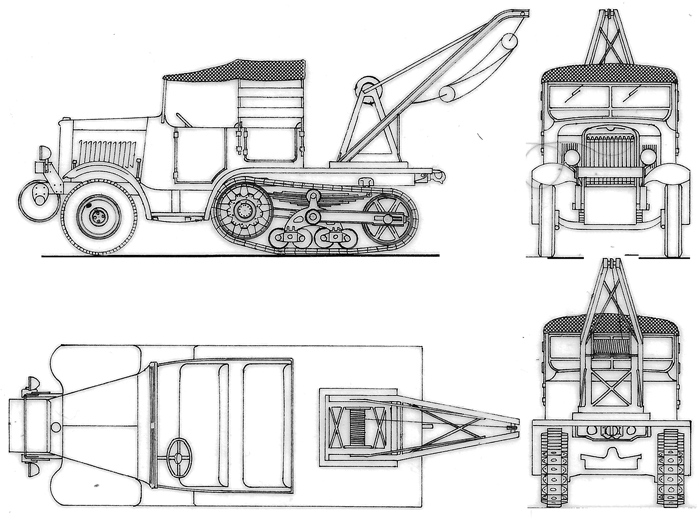
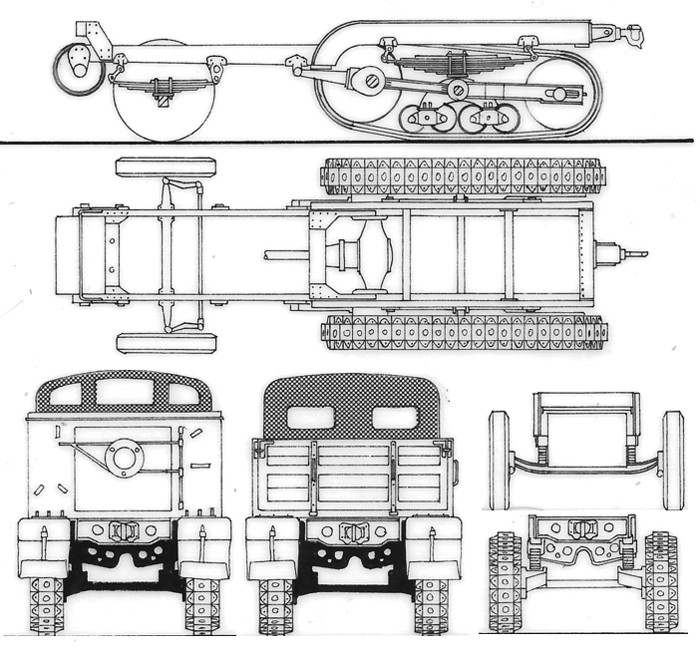
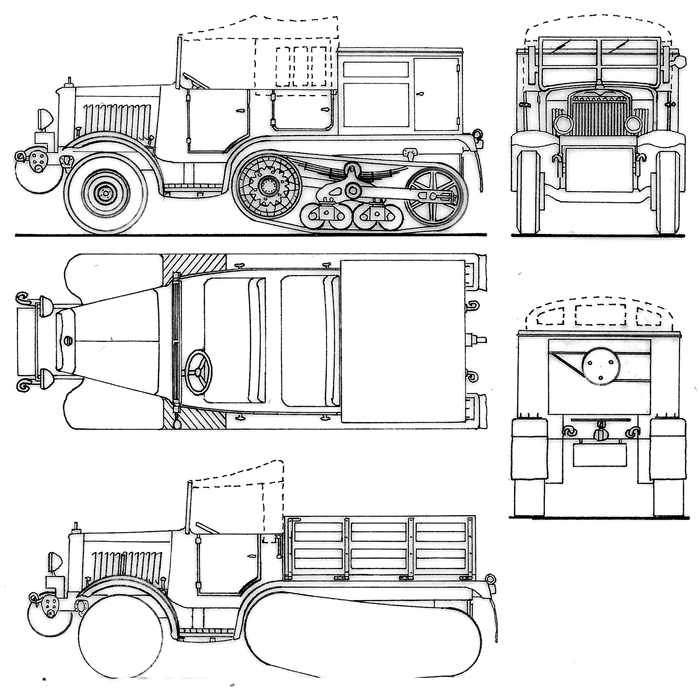 Unic P107, versions, Mike Bell drawings, CC
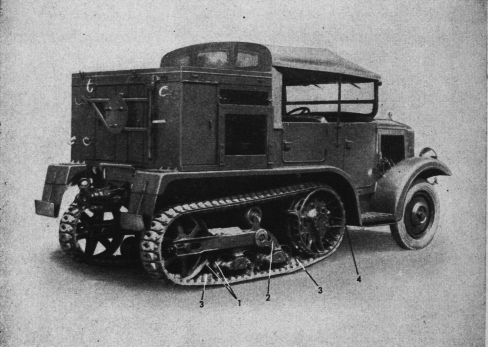
The Unic P107 was very much like the Citröen P107 prototype, and comparable to the Somua MCG, the other late 1930s French utility half track tractor. It was quite tall, with a short bonnet, canvas roof, optional plastic windows and a flatbed was installed aft, which shape and organization differed. The supply variant had a classic lorry-type flatbed with sliding down rear panel, and four arches for a tarpaulin. The artillery version carried ammunition stowage bins instead. The engineering version also had specific storage bins. The Specialized radio variant had a wooden cab.
The vehicle also featured for extra mobility, but it was classic on French military trucks and half-tracks of the interwar, a forward unditching roller of large size, to deal with trench crossing. It can be filled with fuel or water as well. The Unic P107 had a set of two road lights than could be covered over in wartime to be used as blackout lights. The cabin was large enough for a driver ad co-driver, with up to four to six men seated aft depending of the configuration. Artillery tractors generally carried four men and a large ammunition bin. The P107 was of couse unarmed (apart the crew's own service pistols and small arms) and unprotected.
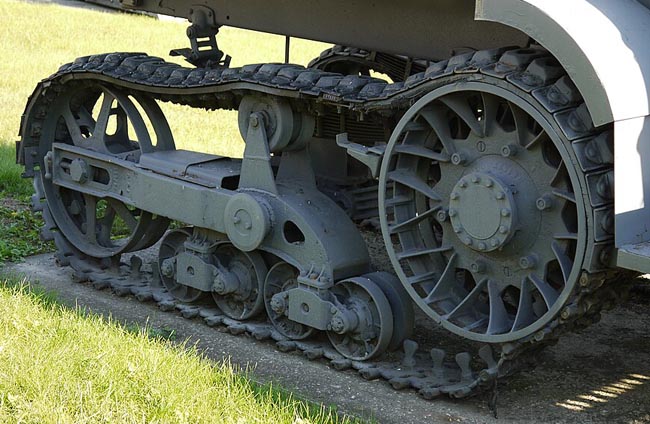
The vehicle weighted 3,000 kg (gross weight: 5,400 kg) for a nominal payload of 1.5 tonnes. It was still relatively compact at 4,85 m, overall in lenght for 1,80 in weidth and a height of 2,28 meters. It had a road clearance of 34 cm. Its front track was 1,395 m wide and rear track was 1,340 m. It share the same track arrangement as the Somua MCG and other Citroen half-tracks, with a large drive sprocket forward, a smaller idler aft, and two suspension arms resting on a central axle, on which were attached a double bogies (two arms of eight roadwheels each). The flexible Kegress type rubbera and composite track was of the double pin and teeth type, supported above by a twon return rollers on top of the main suspension rocking arm.
Mobility
The Unic P107 was powered by an "in-house" P39 engine rated for 60hp/2800rpm, liquid cooled 4-cylinder with carburettor, 4-stroke OHV, 3450cc and probably Compression ratio of 1. It had a 2-speed auxiliary gearing and 2,9 or 3,2 :1 axle gear ratio. The Clutch was of the dry plate type. There were hydraulic brakes on sprocket wheels, also used for steering in sharp turns and a rigid front axle with semi-elliptic leaf-spring suspension. The electric system used a 6 or 12 Volt battery. The front axle had tyres of the 30x5 size. The engine had a fuel consumption of c50L/100km for a fuel tank capacity f 160 L, making for a 260 km in normal conditions. Top speed was about 45 km/h on flat, 30 kph or less off-road.
| Specs Unic P107 |
| Dimensions : | 4.85 x 1.80 x 2.28 m |
| Total weight: | 3500 kg empty, 5000 kg loaded |
| Useful load: | 1.5 ton |
| Crew: | 2+5 |
| Propulsion: | Unic 4-cyl. P39 4-stroke OHV, 3,45L: 62 hp |
| Speed: | 45 kph flat |
| Range: | c250 km |
| Production | 3,276 June 1940 |
The P107 in service

Under French service, the French artillery divisions were motorized with the Somua MCG and some 3,500 Unic P107s as standard artillery tractors for the 75mm as light prime mover, but also the heavier short 105 mm Bourges howitzer and short 105 mm Schneider gun, 1915/35 pattern. There was a version with platform cargo transport for engineer units and a third version for transmission units with a wooden cab. With Only part of the 1,274 delivered as the war broke up to frontline unit, but in between Unic ramped up production and managed to deliver 1,896 more were delivered until June 1940, but few joined the frontline. Many were catured in transit or in depot by the advancing Germans.
 The most extreme conversion of the P107 in German service, the Schützenpanzerwagen auf Fahrgestell U304(f)
In German service, it was Unic called the P 107 resp. Zugkraftwagen U 304 (f) and used in its original role as artillery tractor, for the same 10,5 cm howitzers notably as well as short barrel mountain guns and antitank guns like the PAK-36 and PAK-37 and PAK-40, notably on the eastern front given its half-track chassis. Alongside it, the lighter Unic TU 1 was also used as the resp. Zugkraftwagen U 305 (f). However "only" about 200 Unic TU1 U305(f) and 300 Unic P107 U304(f) were used by the German army.
Some were converted into armoured half-tracks (photo) like this rare Schützenpanzerwagen auf Fahrgestell U304(f) and the semi-protected supply vehicle as the Leichter Zugkraftwagen 37 Unic (f) or Zgkw. U 304 (f). The armoured variants developed by Major Alfred Becker in 1944 to be deployed in Normandy, 21 Division based in Caen were the leichter Schützenpanzerwagen (light armoured personnel carriers), but some armed with 2cm FLAK of 37mm PAK antitank gun versions, with a few rocket-launching SP Stalinorgel also made. They were lost in the storm of the allied offensive in June-August. Many more were captured by the Russians in Operation Bagration. One is today on display at Moskow under German colors.