Panhard K125 (1937)
 5t truck about 350+ built 1937-40
The Panhard K 125 was a 5-tonne truck from Panhard made from 1937 to 1940, adopted by the French Army, and 200 used as a mobile workshop truck with 20 used as general-purpose transport truck. They were ordered in batches, the first in late 1937 and the last in August 1939. The eneral Purpose ones were sent straight to Morocco in May-June 1940. Its bodywork was improved in October 1939 and it was inteneded for mass production in the wartime program. But the fall of June 1940 brought this to a halt with the Wehrmacht takeing over the remainder.
Development
Specifics of Panhard
The relation of Panhard and the army was fructuous, with the company founded in 1887 providing the very first cars in France, from a Daimler patent. In 1891 the Levassor system allowed a licence-free production for a brand new model that met instant success. In the prewar years Panhard developed a sleeve valve tech that was pretty unique, enabling 16v engines from the start. Reputed for its tourism cars prewar, what was named Panhard & Levassor then in wartime, manufactured scores of K4 military trucks, V12-cylinder aero-engines, gun components, 75 and 105 mm shells. The military to brass soon fell in love with its powerful staff cars like the 20CV and General Joffre used two 35CV type X35s to ream the frontline, both featuring a massive 4-cylinder 7,360 cc (449 cu in) engines. They became the favourite way to go fast from the Élysée Palace to rear lines for military and politicians alike.
In the 1930s Panhard & Levassor contninued exploring powerful 4-cyl, 16V engines with a range of sportscars, saloons and sedans with personalized bodyworkds, and it was a prestigious brand across Europe. Before WW2 its models had engines 6-cyl. with valveless cylinders an the first monocoque bodies from 1936 onwards. Truck production went on indluding for the miitary, comprising the K 48, 61, 73, 85, 91, 944, K 101, K 11, K 113, K 125, K 128, K 13, K 140 in the 1930s and in the 1940s, the K 155, K 162 and K 172. The company also had a wide range of armoured cars in the cold war, like the VBL, PVP and EBR.
Production of the K-125
The Panhard K 125 was a 5-tonne truck designed on 1937. It was proposed to the French Army as a standard heavy truck. However a Berliet and renault were ordered instead and still, the latter decided to order it only as a mobile workshop (200 on order). Later extra general-purpose transport trucks (TTN) (20 on order). The TTN were produced from late 1939, to equip French troops in Morocco. They were delivered in May and June 1940.
This general purpose, TTN bodywork was revised and improved in October 1939 and after an order for 49 more in late 1939, the new K 125 TTN was ordered at last in very large quantities, at a monthly rate of 200 as per the new wartime industrial program. A further 494 mobile workshop variants were also ordered under the same program. The army designated the K 125 variants as "voiture spéciale 204" (special vehicle 204) for the TTN and "voiture spéciale 206" (special vehicle 206) for the workshop.
However the French defeat in June 1940 stopped dead all deliveries. Production was however restarted by the Germans, for the Wehrmacht. Former Captured K 125 trucks also added to the mix, and old and new vehicles ended in the Wehrmacht, making ultimate production number difficult to assess.
Ultimately by 1940, Panhard developed a new version with a redesigned forward-control cab that enabled a longer cargo bed. The K 155 remained however at prototype stage by June 1940. Production was restarted postwar.
Design
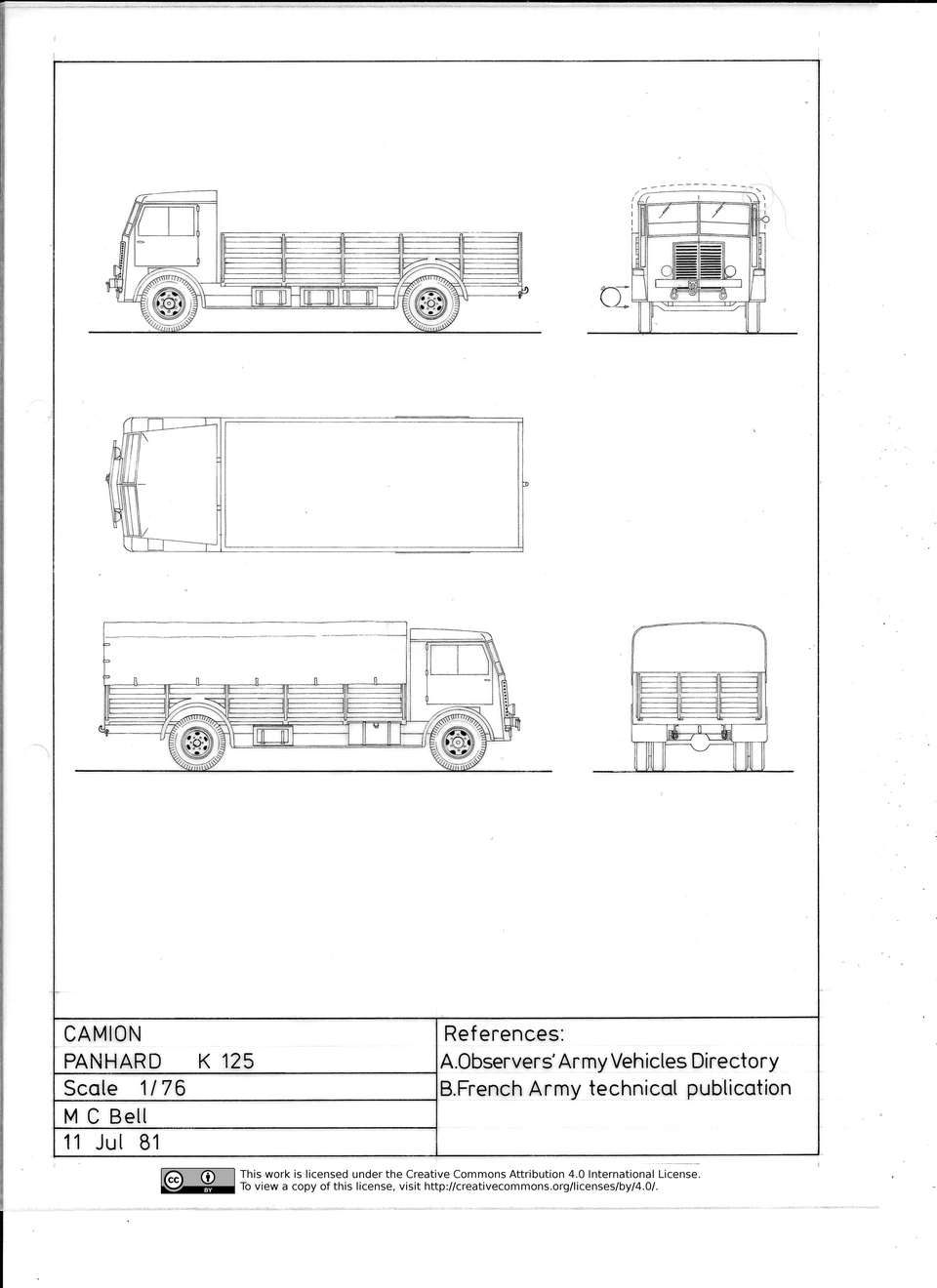
The Panhard K-125 was a classic COE (Cab Over Engine) configuration 5t truck class 4x2 vehicle, with single directional axle forward and a driving axle aft, fixed, with dual tires. The chassis was of the ladder type. The vehicle had a curb weight of 6,000 kg for a payload of 5t, and measured in Length 7,000 mm for a Width of 2,500 mm and Wheelbase of 4,700 mm, the Track front was 1,960 mm and rear 1,760 mm. Shapes were simple, with flat sides, flat bonnet and nose, a three side roof that could be formed and welded together.
The windshield was split, with non-folding windows. The side windows could be winched sideways. There was a simple bumper welded in front for two standard lights that could be converted as blackout lights. The sare wheel was located below the ladder frame at the rear. There were suspended steps below the chassis for several storage boxes, for tooling and cables. The eight rim bolts were typical for the Type K 101 while the Type 125 had typical ten rim bolts. A futher distinctive feature besides the larger wheel base of the Type K 124 was that the doors of the Type K 101 had just two hinges while the Type K 125 doors had three hinges.
The Engine was a Petrol, 4,849 cc Panhard 4-cylinder 16 valves rated for 85 hp mted to a manual Gearbox with 4 forward speeds and a 1 reverse speed. They had Mechanical Brakes Top speed was 63 km/h with a consumption of approx. 20 L/100 km on road and a total achievable, still on road, of approx. 600 km. The body type(s) were the TTN 30-31 for the general purpose and TTN 39 for the Workshop/PMO/Store which had a metal roof and wooden sides over a frame. The same could be converted as a Tanker.
Workshops
In fact three variants of mobile workshop trucks were developed:
-The standard mobile workshop truck, most common type.
-The machine-tool carrier (PMO)
-The supply truck, with spare parts.
The PMO and supply trucks differed from the standard workshop truck by featuring side doors. By June 7, 1940, some 288 mobile workshop trucks had left the factory.
General-purpose transport (TTN)
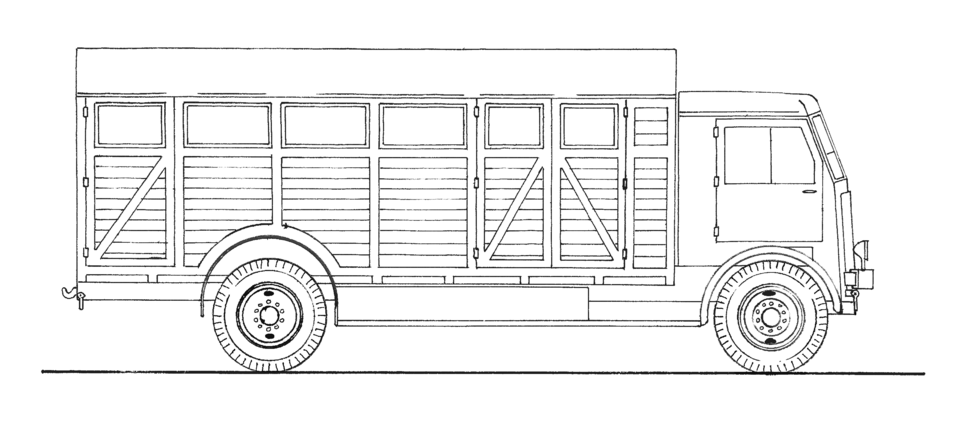
The first TTN version had its specifications issued in 1930–1931. The unofficial designation was TTN 30-31. These vehicles needed to transport horses and troops, normally horse-drawn. They could also carry other equipments. They featured a reinforced, high-profile body. They had a floor height of 1.35 m as it sat above the wheel arches. Loading was by ramp at the rear, or two ramps to enable boarding of horses or vehicles. Only 20 were were delivered in 1940.
TTN 39 Workshop Bodies
A new version was developed in October 1939 by Lieutenant-Colonel Dutertre-Delmas. It was designated TTN 39. The prototype body was tested on a K 125 workshop chassis. It had a lower body with a floor height of 0.90 m. This time the wheel arches were posted beneath inclined benches. The vehicles also featured two 120-liter fuel tanks mounted under the body, right side. There were military grade with easier fill caps for raw recruits. In addition there were racks for several 50-liter cans for the TTN 30-31. The range exceeded 600 km. About fifty K 125 TTN 39 were produced in 1940.
Also, Panhard provided four chassis to either pf the four French manufacturers. So the TTN 39 module could be installed on their own chassis:
-Renault: Renault AGK2 TTN 39: 500 units produced May–June 1940
-Berliet: Production of a TTN 39 version scheduled for October 1940
-Rochet-Schneider/Saurer, production planned TTN 39 bodies from January and March 1941.
-Tanker truck: Featuring a 5,000-liter tank. Four were delivered in January 1940.
Service
In France service these vehicles were sent to dedicated units, organic for example to motorized and armoured divisions. There are no precise records of their assignations, but they were part in the support units at divisional level. Further variant were produced too late to enter service. In German service, they were standardized. Further modifications were made for the Wehrmacht, notably installing two Notek type blackout lights, and straps for shovels and pickaxes. Contrary to the similar early Panhard K 101, the K 125 had ten rim bolts. In addition, the doors hat three hinges, making them more resistant. They were used mostly in France due to their inability to serve off-road and thus on the eastern front.
| Specs Panhard K-125 |
| Dimensions: | 7000 x 2500 x 4700 mm, tracks 1,96 mm/1,76 mm |
| Total weight: | 6 tonnes in working order empty, Gross 10t |
| Useful load: | Payload 5 tons |
| Crew: | 1+2 (16 troops) |
| Propulsion: | Panhard 4,85L, 85 hp, Gearbox 4+1 |
| Speed: | 63 kph |
| Range: | 1200L (600 km: 20L/100 cons.) |
| Production | c350 |