Murmansk BN
 Russian Electronic Warfare Truck (2014)
The Murmansk BN is a modern electronic warfare system from KRET, usable for long-range communications jamming, fit for the new modern Russian strategic electronic warfare system, in a network-centric way. Entering service in 2014 it was deployed at the 475th Independent EW Centre of the Russian Navy in Crimea, south of Sevastopol to eliminate High Frequency (HF) broadcasts from NATO, like the US HFGCS and HF military satcom. It is claiming a range from 5,000 to 8,000 km. From 2024 more were posted on strategic locations across Russia. The carrier is a Kamaz 53501 8x8 carrying a gargantuan telescopic antenna.
Development
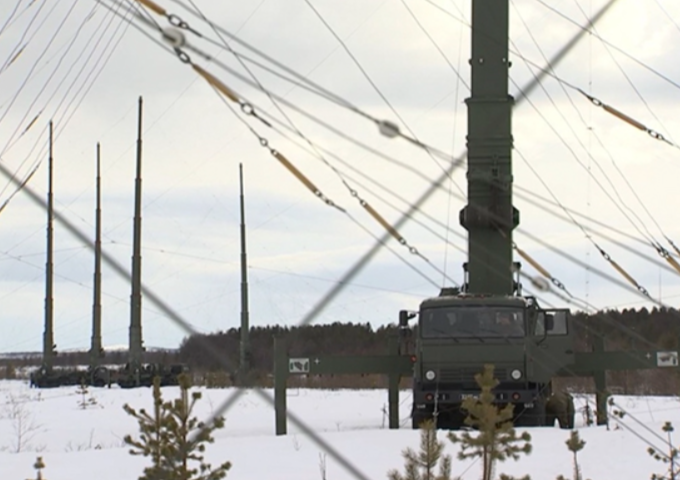
The Murmansk-BN (Мурманск-БН) is a Russian mobile coastal electronic warfare system based on the KamAZ-5350 truck, in service by 2014 but developed as far back as 1992, and never completed due to the collapse of the Soviet block and suspension of the program. This concept was formulated in the early 1980s already, and worked on throughout the Cold War. But no workable system could demonstrate these ideas of long range jamming on a large scale. Studies resumed in 1992-93 until being postponed again in the economic conditions of the time. The final vehicle was probably finalized in the 2009-2012 period, designed as a shortwave coastal electronic warfare system able to conduct COMINT operations, to intercept and suppress enemy signals up 5,000 kilometers (or more as claimed), as well as performing operational jamming in the shortwave band.
KRET, was its developer and manufacturer, of recent formation. This holding regroup for most electronic warfare companies of post-Cold War Russia and is heavily dependent on export sales for its funding. Its marketing agressively exaggerate or imply capabilities not available for export as a mirror.
Design
The System
A full system comprises an assortment of seven KamAZ vehicles. The antenna array is mounted on four trucks (the others three are for support and command), each with a telescopic supported antenna reaching 32 meters or 102 feet, positioned in a square. Each group of 4 antennas has a c400 kw generator. It takes 72 hours, from arrival and deployment, for the electronic monitoring system to be calibrated and activated. Once operational one site, it could detect supporting typical shortwave (HF) radio communications and interfering with HF radio communication line both in strategic and tactical command and control.
For the new network-centric system, it is quite useful monitoring radio signals over long distance, locating precisely where a transmission is coming from, with largely automated monitoring, forwarded to high command for a missile strike. In any cases, groups of up to four extendable antenna masts, two each on a dedicated Kamaz or Ural truck, towing a further antenna on trailer for a total of sixteen. They can operate individually if needed. Each group of four vehicles is supported by a Kamaz 6350 Command vehicle and Kamaz 6350 generator vehicle for 400 Kw. Further vehicles are added to the unit with food and shelter, and troop protection. Frequency of the antenna is 3-30 MHz, for an area of jamming of 640,000 km2.
Use
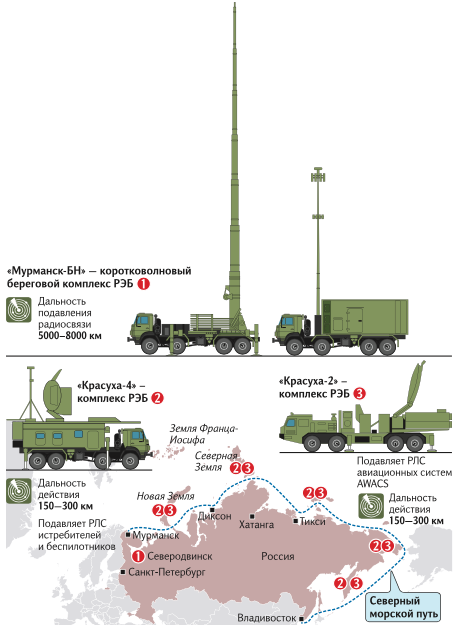
The Murmansk-BN was initially desifned to be the largest, longest range, best electronic warfare system in the world. Its communications jamming system specifically been designed to take out NATO or US high-frequency military satellite communications was an asset that did not existed in USSR, and was now owned by Russia, albeit at a great cost given the verly long R&D and the few systems built, just two so far for the two fleets and perhaps one vehicle to Iran. The system was versatile as its frequencies range were commonly used both by warships and aircraft.
Its second ability, to detect and support typical shortwave (HF) radio communications, interfere with HF radio communication or jamming in general all high-frequency (HF) communications systems, and Global Communications Systems of any adversary, and since its introduction in Crimea in 2015, Russian claimed once a USAF F-35 had its onboard systems failing when in range. It is reported that many F-35 suffers frequent avionic equipment failures close to to specific areas, namely the the Black and Baltic Seas.
An other advantage of the system is its automatic scanning of all signals over 5,000 km. This makes it essentially a "Land AWACS". As these emissions are detected, the Murmasnk BN's transmitters starts jamming it via narrow bands, curtailing the data exchange, in all dimensions, sea, air and allegedly satellites. In theory this deprived the latter to accurately guiding missiles.
The Kamaz 53501 8x8 Truck
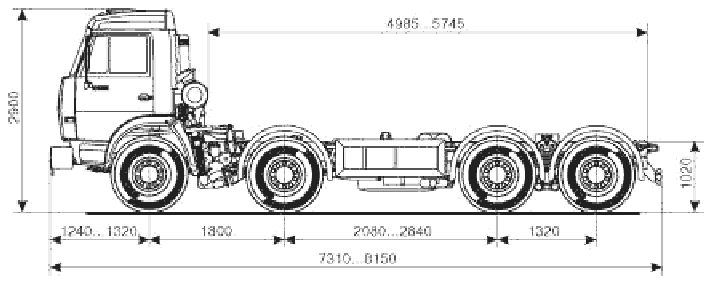
The antenna truck is generally a Kamaz 53501 8x8 military truck. These trucks could operate alone, but the full systems dictates each towing another antenna of the same type mounted on a trailer. The Kamaz 5350 is a truck family that existed in the 1980s as a 4x4, 6x6, and 8x8 chassis and the Kamaz 53501 is an evolmved version, the 8x8 is also used for the
SAM system Pantsir S1 as well. The model used for the Murmansk system is relatively barebones (see later). Its cab has one driver seat and a bunk seat for two more operators. The weight is estimated around 18 tonnes, whereas the empty truck weights 9,200 kg, but with a payload capacity of 6,000 kg.
Behind the bonnet is a KamAZ-740.13.260 turbocharged diesel engine, rated for 260 hp. Top speed, max, is 100 km/h and maximum range estimated around 1,000 km for the base model, light, albeit between Russian claims and the nature of the Murmansk BN its more likely 90 kph and c800 km seems more reasonable when towing an antenna trailer. Now, the Truck was modified for its role: The rear chassis had been cleaned up and over it is mounted a rectangular low structure with a large cutout inside, a well in which the main antenna mast could be partially retracted down in order for the vehicle to clear under bridges. The same chassis platform is used as a base for many elements. Immediately aft of the cab there is a spare wheel. Then comes a small generator, enough to power up the electric systems in addition to the diesel, activating hydraulic arms and lifting the antenna up, deploying the four side legs, with a large span, to the ground.
After the generator lays supports for cables, both rollers, and supports for larger attachement tubes. The two main securing cables are attached on a roller affixes to the first stage of the antenna, the largest, so when it started to deploys, cables could be deployed to secure the antenna when fully deployed. It is said to be 32 meters from the base, and visibly made of seven stages when completely extended, with more cables attached to the top level and secured to the ground to counteract the sail effect of gale force wind on the antenna, which could topple over the vehicle.
⚙ specifications Kamaz 53501 8x8 |
| Weight | c15 tonnes |
| Dimensions | 8.15m long, 2.4m width, height 34m. |
| Propulsion | KamAZ-740.13.260 turbocharged diesel, 260 hp |
| Speed | 80 kph on road |
| Range | c800 km |
| Armament | None |
| Protection | None |
| Crew | 2 |
The Musmansk BN in action
The Murmansk-BN was identified by satellites as field tested in 2013 already. It is still a foggy system with little data to show for, as US reconnaissance satellites recording Russian long range systems rarely goes to the public. In short: In December 2014, the Northern Fleet received this capability. In 2017, it starts operation in Crimea, with the Black Sea Fleet's own electronic warfare (EW) center. In late 2018, the Murmansk-BN system enters service in turn for the Baltic Fleet, in the 841st Separate Electronic Warfare Cente of Kaliningrad Oblast. In April 2022 it was observed in Ukraine. None are left even close to the border as of 2026, due to its large size, deployment time and drone attacks. Iran has been cited as well as an operator.