Kaiser M715
 1-1/4t Tactical Truck (produced 1965-1969)
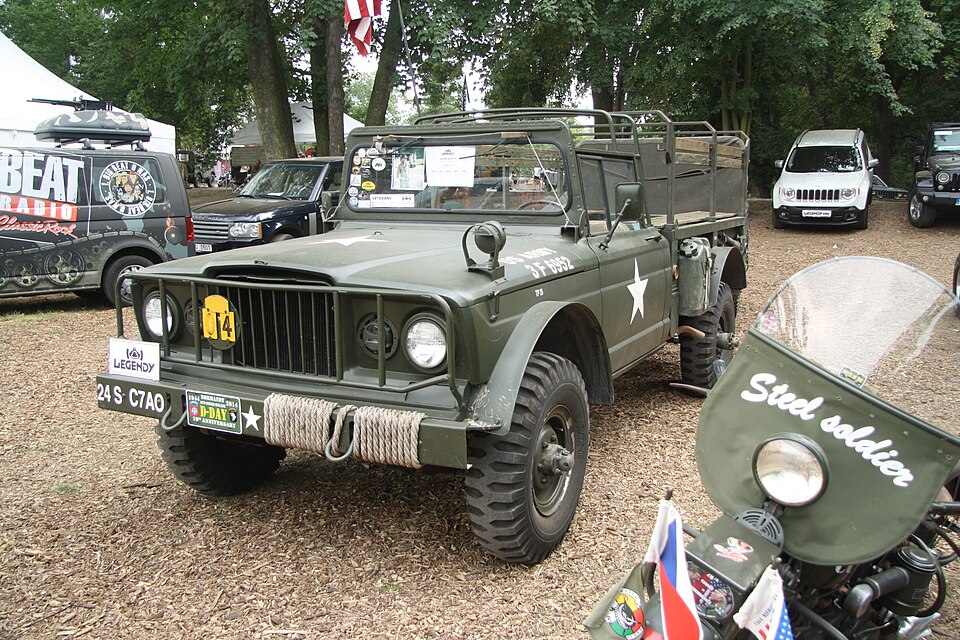
The M715 was a replacement for the Dodge M37 tactical truck of the Korean war, itself replacing the Dodge WC series of WW2. The army obtained by Kaiser Willys the 1 1/4 ton series truck, with 33,000 manufactured from 1965 to 1969 at the Toledo plant. It was the first US Army tactical truck using a large COTS (commercial off the shelff) inventory to reduce costs. However in service in Vietnam, Korea and Europe, it proved finnicky (crews lacked training with the new engine) and fragile. It was declined also into the M724, 726 or 725 ambulance, and was also later buuilr in South Korea, to this day, as the KM450. In the US, it was replaced from 1979 by the Dodge M880 series 1+1⁄4-ton militarized COTS.
Development
Kaiser/Willys, Keeping a Tab on the Military
In 1953, Willys-Overland became part of the Henry J. Kaiser Corporation but did not changed name (too profitable). The latest iteration was the
CJ3B which continued in production until 1968, along with the CJ5, with the latter going on from 1955 to 1984 for the cvilian market (and some military customers aside de US). Kaiser was aware that the Willys Jeep was now produced from plants in 30 foreign countries, and marketed in more than 150 nations. The CJ3B saw limited adoption in the US as the M606, notably by the U.S. Navy.
In the late 1940, on the civilian market, Willys proposed the two-wheel-drive “Dispatcher” (DJ) model which later pickup and boxy-bodied stationwagon became moderately popular in rural areas of the midwest' ranchers and farmers. Many were happy with the “four-wheeling” however the pickup mania as not going to pop before the mid-1960s. In 1956, Willys introduced the “Forward Control“ pickup truck (cab-over-engine design) and already the U.S. military contracted Willys/Kaiser for declining it in four basic tactical versions to be tested, the M676, M677, M678 and M679.
In 1960, Willys won a bid for a quarter-ton delivery van for the U.S. Postal Service (14,000 produced at Toledo) and many were later converted to popular ice cream trucks. Meanwhile the mass produced US Army Willys
M38/M38A1 started to be phased in favor of the
Ford M151 MUTT. Willys still had the ear of many higher ups in the Military and won a bid in 1962 to join the production and deliver 9,000 MUTTs, with a second contract for 9,800 additional MUTTs and in the end, made 20,000 M151s at Toledo alone, 100,000 at South Bend maintaning links with the Army.
In 1963, Willys Motors became the "Kaiser Jeep Corporation" and continued to approach the civilian market with its “J” line, which popular models quickly became the Gladiator pickup and the Wagoneer. The first was the largest, with dual rear wheels. With the new modern engine “Tornado”, the serie became even more popular. This engine had a capacity of 230-cid inline and was a six-cylinder with a cast-iron block and head plus aluminum components like the overhead cam, albeit it had issues. In 1964, Kaiser Jeep purchased Studebaker's facilities at South Bend (Indiana) to start production of the M54 5-ton truck. In May, this was followed by the M35 2 1/2-ton at South Bend (112,000 5-ton, 150,000 2 1/2-ton trucks). Willys/Kaiser also developed prototypes for the
M247 Mule, the Willys “Bobcat” (later
AM M422 Mighty Mite).
Replacing the M37
However as years passed, the US Military noted at some point it will need to replace its 1950 park of very useful
Dodge M37s, which themselves replaced the WW2
Dodge WC. The WC series had been during the war, the "great brother" of the Jeep, capabe of carrying much heavier loads while retaining excellent 4x4 capabities. The U.S. Military looked at the M37, designed in 1951 as a vehicle simple, rugged, reliable and in many ways appeared as a perfected Dodge WC. It was a purely tactical military truck, almost flawless, simple and inexpensive to upgrade, with new powerful engines for 60 mph. But in the Pentagon, te top brass wanted a "new kit" in replacement instead.
Chrysler Corp. was contracted to design a completely new vehicle, the same light tactical truck with all the same desirable features, however its cost was already estimated twice the M37, still in production. GM's Chevrolet Division also proposed the replacement prototype, also expensive. If the top brass preferred the even costier, but more impressive
M561 Gama Goat in development, in the end the Chrysler and GM prototypes were rejected in favor of a quick-made, cheap alternative alternative if the Gama Goat.
So in 1965, Kaiser Jeep started to develop the M715 1 1/4 ton series truck, which was purchased by the U.S. military to replace the M37. This was the first U.S. military tactical truck built with "mostly" off-the-shelf civilian components, since before WW II. This drastically lowered the overall cost, and this pleased the General Accounting Office since it was presented as $4,400 per unit to the department of the treasury and Congress. It fact, the new vehicle cost was even half a modernized M37. So the Army sanctioned a production of 33,000 vehicles. Production started from January of 1967 at Toledo plant, Ohio. There are however discrepancies in production, with some argues only 30,500 had been delivered (Doyle, David (2011). Standard Catalog of U.S. Military Vehicles - 2nd Edition).
Design of the M715
Dimensions and Layout
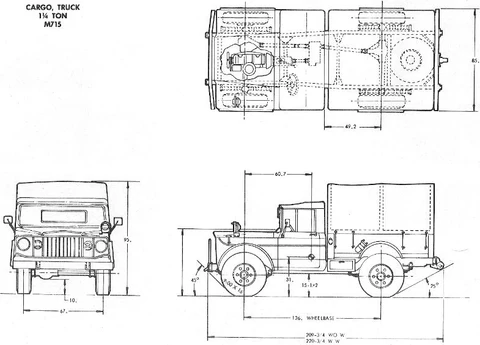
The M715 was a large vehicle compared to a Jeep, yet smaller than a Dodge WC or M37, at 209.75 in (5.33 m) long without winch and 220.75 in (5.61 m) with winch, for a width of 85 in (2.16 m). It was ha full eight at bed, with tarpaulin installed of 87.7 in (2.23 m) but without, at cab height, it could go from 75 in (1.91 m) with the frames and windshield up down to to 59 in (1.50 m) with frames and windshield down. Gross weight was 8,400 lb (3,810 kg) but for this, it could carry a Payload 2,500 lb (1,130 kg) off-road and up to 3,000 lb (1,360 kg) on-road (way more in service as reported). The Net weight was 5,500 lb (2,490 kg) without winch and 6,000 lb (2,720 kg) with winch.
As far as the layout goes, the vehicle had a squarish, long bonnet retained by two hood latches, at the front corners, engaged to lock the hood in position. Its road lights protected not only bu the overhanging bonnet's nose, but by a bull bar welded in front of the base plate, above the main dimple bumper (a folded steel sheet, same aft). On the front bumpre were located to towing rings. On the right side wa slocated the main road blackout lamp. The forward axle, directional, was not encased in the body but under two prominent mud arches, like those aft, but the latter were much larger. The single piece flat windshield (stowed on two 1” x 39” straps on the bonnet when down) could be folded forward. The side windows were two-pieces, with only the first part glassed, fixed but with glass screws to be opened in the summer. There were two rear mirrors with hindges, and two top wipers. The folding windshield and removable canvas top with its supporting members are stowed behind the cab seats when not in use.
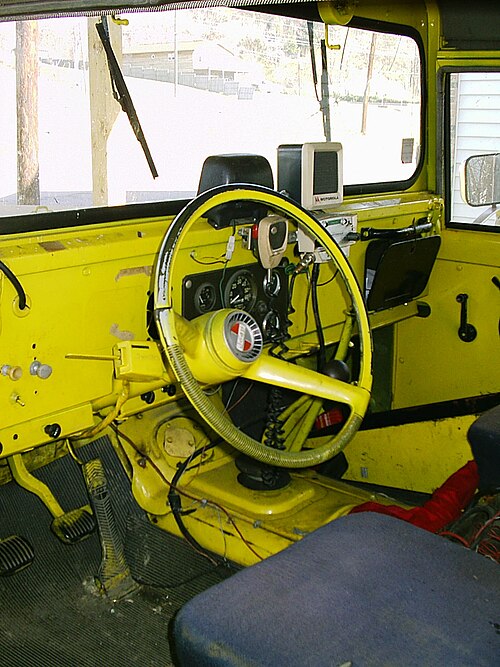
The dashboard was rudimentary, and reused civilian gauges, comprising the Fuel gauge, Speedometer, Temperature gauge, Battery-generator indicator, Instrument cluster light, High beam indicator and Oil pressure gauge. For night driving there was a dimmer switch, accessible to the driver's left foot. The Turn Signal Indicator was located on the left of the steering column. Also in the cab were located the Windshield wiper control valve, Parking brake handle, Transmission gear shift lever, Foot starter switch, windshield wiper motor and Main light switch plus a Choke, Ignition switch, Horn button, Safety rail, Glove box 21 and Headlight dimmer switch plus Transfer case shift levers and Directional signal switch.
The base vehicle had not solid top but a canvas top, stored aft of the cab and strapped on the top arch of the windshield. Below the cab, large enough for three men (driver seat plus bench) there was the pickup flatbed with all metal walls and folding back plate. Side pillars could be mounted for a six-wooden planked sides. Three arches were stored, inverted, near the cab, to be installed for a rear tarpaulin used as cargo cover. Inside banks acting as stowage bins were larger enough for four men either side with their equimment, making for a total max. of 11 men, rouhly a platoon, plus equiqument. There was also a fire extinguisher located on the back of the drivers seat, and NBC coldwar obliges, a decontaminating apparatus mounted on the back of the commander's seat.
Powerplant and Performances
The M715 engine was an inline 6-cyl, 230.5ci overhead camshaft Tornado rated for 132.5 hp (98.8 kW), coupled wih a Warner t-98 four-speed transmission, with synchronized manual Transfer case of the New Process NP200 two-range, 1.91:1 low range. On the front axle there was a Dana 60 case and at the rear a Dana 70 full-floating case with a ratio of 5.87:1. The Electrical system was 24 volt, with two 12 volt batteries in series.
The Brakes used Hydraulic, 4-wheeled drum types. It ran on gasoline, with an internal fuel capacity of 28 US gal (106 L; 23 imp gal).Top speed was 55 mph (89 km/h), for a turning radius of 28 feet (9 m) and it sat on tires of the 9.00 × 16 8-ply standard run-flat M37/Dodge WC compatible military type with double serration. One the left flatbed panel was the gas plug, for Gasoline (MIL-G-3056) Octane No. 85 min. Refueling Rate (max.) 20 gpm as well as strappings for tooling, pickaxe, shovel and crowbar.
Full Manual
TM 9-2320-244-10.
DEPARTMENT OF THE ARMY TECHNICAL MANUAL OPERATOR’S MANUAL
TRUCK CARGO: 1 1/4 TON, 4x4, M715 (FSN 2320-921-6365, FSN 2320-921-6366)
TRUCK, AMBULANCE: 1 1/4 TON, 4x4, M725 (FSN 2310—921—6369)
HEADQUARTERS, DEPARTMENT OF THE ARMY AUGUST 1968
Kaiser M706 (1965) |
| Dimensions (L-w-h) | 209.75 in x 85 in x 59-87.7 in (5,328 x 2,16 x 1,5-2.3m) |
| Wheelbase | 126.5 inches (3.2 meters) |
| Weight | 8,400 lb (3,810 kg) gross |
| Payload | 2,500 lb (1,130 kg)/3,000 lb (1,360 kg) |
| Crew | 1 driver + 8-10 |
| Propulsion | V6 230 cu in (3.8 L) Tornado I6 gasoline |
| Transmission | Warner T-98 4-speed manual |
| Top speed | 60 mph (100 kph) |
| Maximum range | 225 miles (370 km) |
Variants
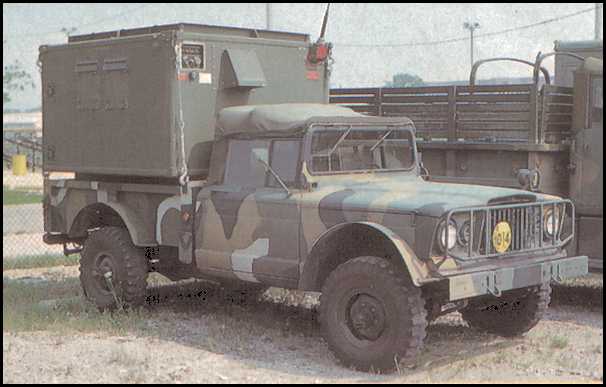 M715 with M142 Shelter Carrier src vintagemilitarytrucks.com/
M724 (bare cab and chassis)
This vehicle is usually combined with a contact maintenance utility tool body. The same box body is also used for different variants, notably on the M725 and 726.
M725 Ambulance
The "TRUCK, AMBULANCE: 1 1/4 TON, 4x4, M725" is the main variant of the vehicle, sharing the same manual. The onbly major difference is the body, with hard top over the cab followed by a rear body larhe enough for four stretchers, reusing equipments from the WD series ambulance and M37's. Two ventilator blowers are provided to draw hot air or odors from the patient compartment. Each blower motor is controlled by a switch. Openings in the blower ducts are controlled by the ventilator blower control valve handles. There is a surgical lamp with a toggle switch to turn the lamp on or off. There is also a Dome Lamp, located in the top of the vehicle, controlled by an ON-OFF toggle switch and a Spot Lamp is mounted on the roof of the drivers compartment, operated by the driver. The Patient Compartment Heater is controlled by a heater control box, located on the inside wall of the compartment. The heater is located under the left front patient seat
More to come, next update
M726
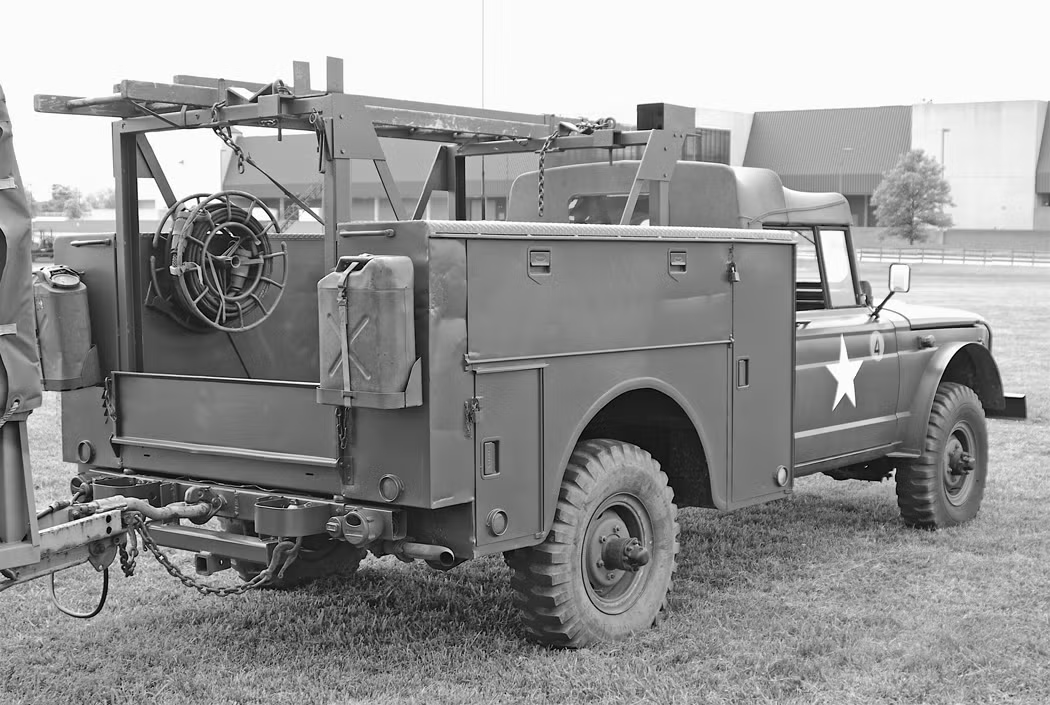 M726 telephone maintenance truck. src militarytrader.com, see below.
Telephone maintenance utility tool body variants 1+1⁄4-ton, 4×4.
KM450
Kia currently still produces a M715 based design, as the KM450, for the South Korean Army, under on license from the U.S. government. The K311 on it side, was a Korean Dodge M37 produced from 1980.
More.
The M715 in Service
From 1967 to 1969, from 30,500 to 33,000 M715s were produced at Toledo, seeing service right from the start of the Vietnam War, alongside the "Might Mite", M274 Mule, and Gama Goat, but it soon appeared was considered underpowered and fragile, compared to the military specs and built Dodge M37, so the latter was recalled. Already by 1970, M715s were shipped back to the US. From 1976 onwards, the U.S. military started to replace the M715 by the Dodge M880 series 1+1⁄4-ton militarized COTS.
Instead of Vietnam, M715s were also relocated to the quieter, less demanding Korean Demilitarized Zone (DMZ). Others were shipped to various European bases, notably in Germany.
Its main issues were the overhead-cam six-cylinder engine, that proved not very reliable, not because of inherent issues, but due to lack of knowledge on overhead cam designs in the US Army and thus, improper maintenance. The M715 also was an "oil guzzler", with records of consumption and leaks developing in combat. The M715 front winch had a bad design, make it dangerous in rough cross country use as it would sometimes separate and then foul the truck's steering.
From 1968 those sent to Korea from the US had improperly welded frames causing, breakages. Thus, Kaiser Jeep to fixes these, hired a local Korean company to repair those in depot stocks and thus by 1970 most of the 1968 models were from cannibalization yards. This was the start for its later contruction by Kia, pretty much the only other user of the vehicle outside the US.
On the civilian side however, the vehicle, which ended from the 1980s in the surplus market, was largely adopted, and its still today a must-have for collectioners and 4x4 aficionadoes in search of originality. As recently as 2010, Mopar developed the "Jeep NuKizer 715" as a tribute and later the Jeep Crew Chief 715 concept. Unlike the classic WW2 Jeep and subsequent M38 and CJ series, the Kaiser M715 remained one of the most obscure, seeing little military service overall, and that also made its attraction in the civilian market, as it remained relatively in good state, and notably for the abundance of spare parts in all accessible retailers.
Users

Argentina: Called the Rastrojero M715, purchased from surplus.

Chile: Unknown numbers sold from surplus.

Lebanon: It was used in the 1980s civil war by the Christian militias

South Vietnam (ARVN): Passed on vehicles in 1969-73.

USA: Used from 1965. Retired from 1979 onwards.