Bedford OY (1939)
 Medium 2x4 3 ton lorry, 72,385 produced 1940-45.
The Bedford OY, especially its transport variant OYD was the mainstay of medium British trucks in WW2, present on all fronts from 1939 to after the Korean War. This army lorry was designed by Bedford specifically for the British Armed Forces when introduced in 1939, based on the civilian O-series but with a modified front end, and single rear tyres. The 3-ton payload OYD was the general service vehicle by far th most common, with the tanker OYC coming second. These vehicles were widely during and after World War II, superseded by the Bedford RL.
Development
The British army needed a way to make infantry fast and mobile, with trucks and the government in 1939 sollicited all manufacturers for lorries and medium to heavy trucks. The four-wheeled, two-wheel-drive Bedford OY series was designed haul to 8,500 lb (3,800 kg) even if it had an official three-ton (3,000 kg) designation. In 1925, GM bought Vauxhall Motors and in 1931 started producing Bedford trucks in Vauxhall’s assembly lines. They were popular and respected brand in UK, with sales breaking 30,000 trucks in 1937.
In September 1939, the War Department had a park of some 85,000 vehicles, including 26,000 ex-civilian trucks. Vauxhall already started developing a 4x4 military truck and with the war the development process was completed fast in order to obtain an contract "off the shelff" and start mass production of 4x2s, the majority being of the OY family, derived from the civilan O series.
The Bedford OY was a slighlty modified commercial design ready for service, with a simplified bodywork, single rear tires of military off-road type. Early-war models had wooden rear bodies to spare strategic materials, but during the war they swapped to metal panels. The three-ton truck OYD totalled more than 72,000, to compare to 250,000 twhich was the global war effort from Bedford for trucks alone. Production started al Luton in early 1940 as soon as the contracts were signed.
Design
Chassis and general design
This classic lorry had a ladder frame identical to the one used by the interwar O series, only the tyres and reinforced suspensions were realy new. The cabin was still civilian, all metal and shaped like previous series instead or a military style canvas topped cabin with simple flat doors or canvas doors. The front bonnet was simple to manufacture, a simple flat front place pierced for lights and with a large space for a simple meshed radiator grille, bolted on the frame. The bonnet above was a simple thn sheet metal formed and bolted over the frame above, with hinged panels and the same meshed louvres either side for ventilation.
The flat bumper was a simple folded sheet metal bolted on the frame and the two flat ends of the formed sheet mudguards above the driving wheels. There were two secondary lights with blackout features in top. Above the bumper and attached to the end of the ladder frame below the radiator was a pair of supports for a roll bar onto which could be attached id unit plates. The whole design was the same as the smaller military lorry Bedford MV. The bonnet side plates were locked by two spring-loaded brackets either side.
Behind the cab, provided with a rear window and classic single-piece windows on both sides, there was an intermediate space before the flatbed front plate for a spare wheel on brackets. The flatbed was classic but came either with wood or metal sides on a frame. One the long wheelbase standard version OYD, the wooden panels were hold by six riveted plates. The OYD flatbed walls, which can be folded down, side and rear, had four sections, and the shorter OYD, six. On both cases wee installed brackets and hooks to mount the tarpaulin, with either five or four bows depending of the chassis. The split windhield came with top-mounted wipers. The rear mirror and its folding mount was close to the top of the cab on straight horizontal.
All in all, the vehicle, between the many parts it shared with others and simplifications for easier manufacturing, was cheap and fast to built en masse. Yet the engine was reliable and somehwat advanced. The type was classic, longitudinal front engine to make the bonnet shorter, and rear-wheel drive (2x4).
Mobility
The Bedford OY was powered by the same Bedford 6-cylinder, type WD, which had a capacity of 3,519 cc (214 cubic inches) displacement, and was liquid cooled, running on petrol. Despite of this there was a radiator forward, air cooled. It was rated for 72 horespower at 3,000 rpm. This engine was coupled with a 4-speed manual gearbox for the transmission three forward and one reserve, no transfer box. For the starter, de-icing, lights and dashboard, there was an electrical system rated for 12 volt.
The Brakes were of the Hydraulic drum type on all wheels, with vacuum servo assistance. The Bedford OY had Tyres of the 10.50-16 front and rear, single on the rear axle. Only the front axle was directional, propulsion was on the rear axle through a transmission tunnel. Top speed was about 65 km/h (40 mph). For autonomy, the OY had a fuel capacity of 145 litres (32 gallons) with two tanks either side and rapid filler caps, military grade. In addition most received optional toolboxes suspended below the flatbed support chassis frame as well as extra jerrycans (British metal tank type, later German types) un racks large enough for three close to the back tailgate. Range was 450 km (280 miles) on flat but it went down on advserse terrain, off-road and mud or snow.

specifications OYD |
| Lenght | 6.22 m (20 ft 5 in) |
| Width | 2.18 m (7 ft 2 in) |
| Height | 3.09 m (10 ft 2 in) |
| Kerb Weight | 6,568 kg (6.46 long tons) |
| Crew | |
| Propulsion | Bedford 3.5 L 72 bhp I6 petrol |
| Transission | Manual, 4-speed: 3 fwd, 1 rev. |
| Suspension | Leaf Spring |
| Speed (road) | 65 kph |
| Range | c450 km |
| Armament | None |
| Production | Luton 1940-45: 72,385 |
Production & variants
If the prototype was presented tested and accepted in 1939, production concentrated at the Luton plant, with a grand total of 72,385 made until 1945. However production went on until 1953, for civilian use and of variants, but no numbers available. The 72,000 were military trucks, only OYD and its sub-variant, but not the OXD.
Variants
OYD: general service truck, sub-variants with wooden or metal side panels.
OYC: General service tanker, either for drinking water, or petrol, oil or diesel.
OWS: Civilian 5-ton short wheelbase (post 1945).
OWL: Civilian postwar 5-ton long wheelbase
OWB: 32 seat bus based on the long wheelbase with even longer body and roof gallery.
Bedford OXD
To be mentioned as a derivative, this is not part of the OY family. The OX was a short-wheelbase version of the OY, designed for a 30 cwt (1.5 ton) payload, so half the original OY lorry. Its semi-forward cab resembled the 15-cwt Bedford MW but otherwise it shared most parts with the OYD. This general service vehicle had abody that was 8 ft 8 in (2.64 m) by 6 ft 6 in (1.98 m) by 2 ft 3 in (0.69 m). The OXC was was a sub-version tailored to use a Scammell semi-trailer as a tractor.
The shorter, yet strong and powerful (same engine) OXD led to experiment with an armoured body creating the Bedford OXA (or "Lorry 30cwt Anti-Tank") developed in 1940 and produced for home defence only. It's well possible the bedford OX will be treated as a standalone post in the future.
The Bedford OY in action

The Bedford OY according to the wealth of iconography found, was present on all fronts. It was already shipped to France to be part of the logistic train of the BEF, the British Expeditionary Force present in France which lost almost all its vehicles, including many Bedfords in the Dunkirk pocket (and later more in Greece and North Africa). Later they were found in the African Campaign soldering with the "desert rats" from late 1940 and Operation Compass to the fall of Tunis in 1943. They took part in the Campaign of Italy and of Northern Europe from the beaches of Normandy to the shores of the Baltic. They were also lend-leased to USSR and in Soviet service in limited numbers.
The OY series was almost sinonymous wth the OYD, the most common, referenced in the Royal Transportation dept of the war office as the "Truck, Three-Ton, 4X2, Bedford OYD". This proverbial general-service truck, was primarily used as troop transport with tarpaulin, able to carry up to 16 infantry, as well as up to 4 tonnes of supplies, but it was also modified as mobile workshop and mobile office. The second common model was the OYC tanker, that carried 800 Imp gal (3,637 L) of fuel. The Armadillo was a Bedford OXD of the home defence in 1940 fitted with a wooden pillbox with pebble-filled, double-wall "armour" on the flatbed as a last resource mobile defence point in case of a German invasion. Some 660 Armadillos were built in 1940, then for some, recycled as radio command vehicles.
The issue with the OYD and its two-wheel-drive was its inability for towing any significant ordnance. So the OYD was mostly used for general troop transport, and only towing the light 2-pdr anti-tank gun or the equivalent anti-aircraft gun.

OYD in German service (facebook)
src
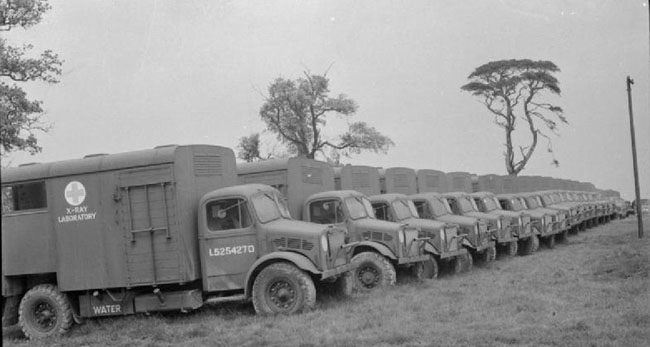 Invasion Build-up Pre D-day Landings UK 1944
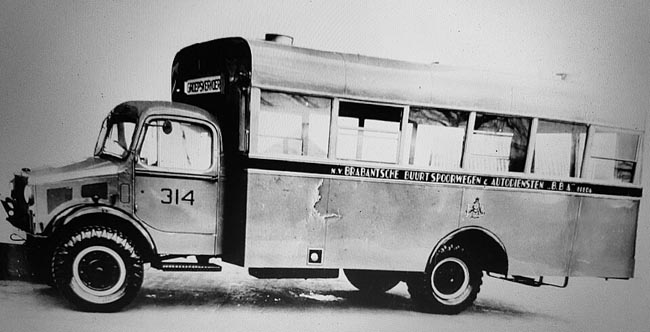 Bedford noodbus
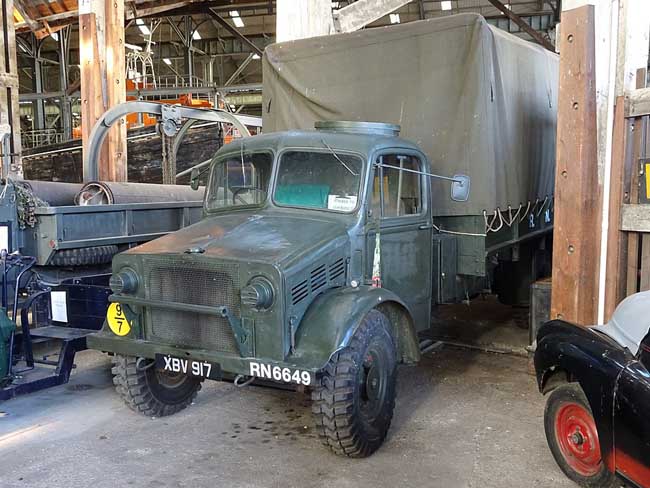 Bedford OY Museum
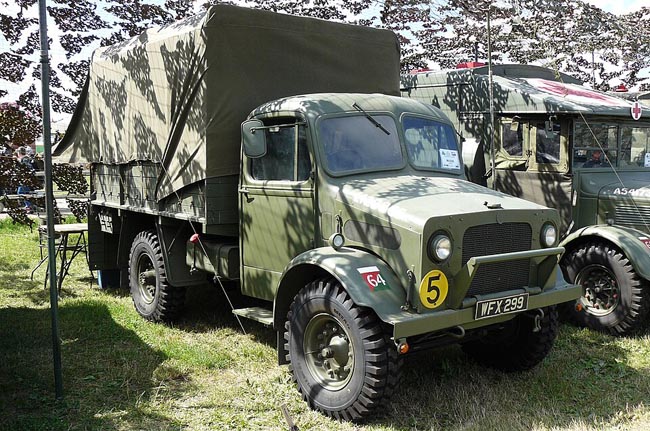 Bedford OXD
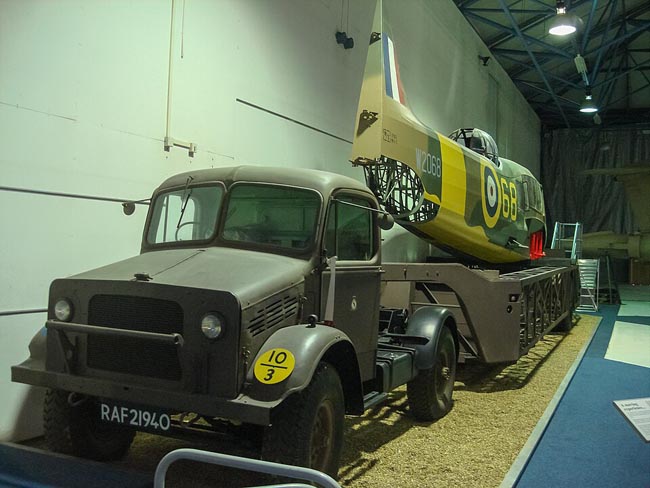 RAF Museum London OXA tractor
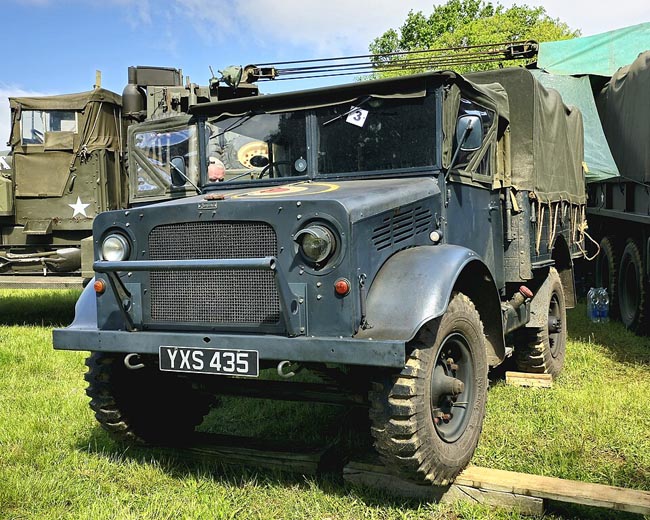 1942 Bedford OY
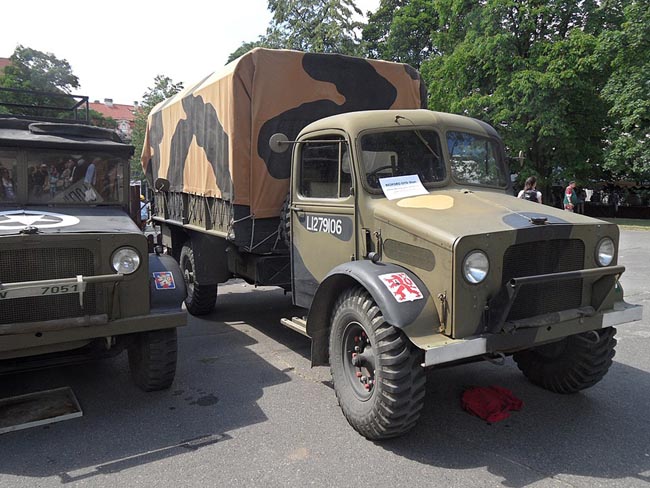 Bedford OYD 3ton
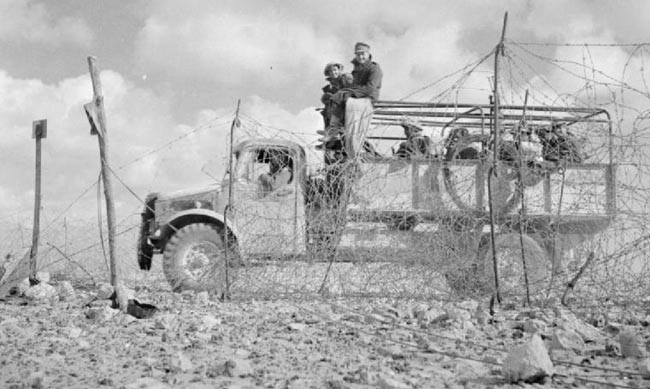 British Army in North Africa 1941
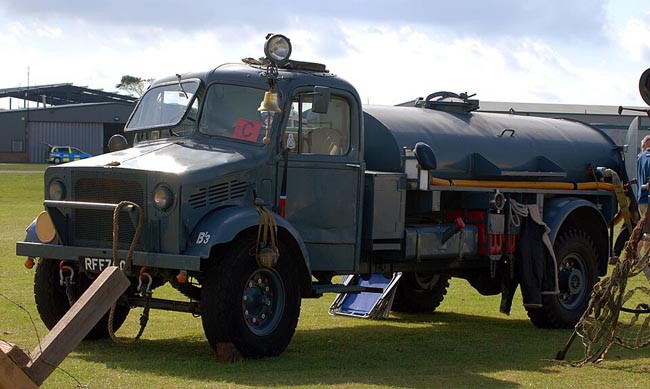 Bedford-OYC Tanker
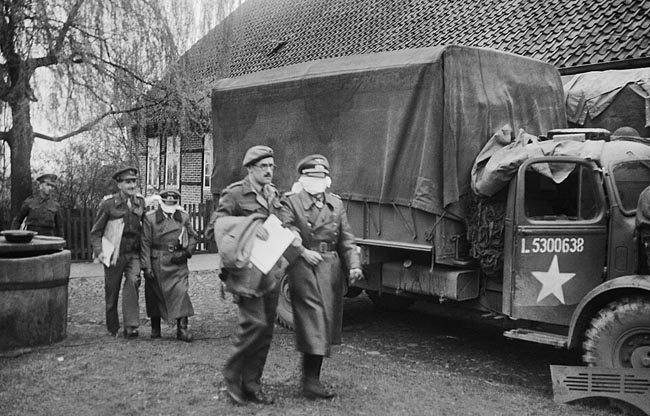 Liberation of Bergen-Belsen OYD April 1945