Alfa-Romeo 6c 2500 Coloniale
 Italy (1939). Staff Car, 150 built
The Italian VIP staff Car Alfa Romeo was one of the most prestigious Italian car brand in the interwar. It's history was also linked to racing and sports, as a young Enzo Ferrari worked for the Alfa scuderia. What was also called the "Trifoglio" produced all sorts of cars, mostly sporty, powerful, luxurious or simply prestigious, and when it was decided to convert the legendary 6c 2500 in 1938 into an army staff car for Italy's modest colonial Empire, this led to one of the rarest and most sought-after staff car of the axis, especially in Africa. Rommel, which used numerous vehicles, had one for its quick visits to the frontline as soon as he realized this powerful car could reach an almost unheard of 130 kph on flat, almost as fast as his Fieseler Storch... Most Italian heads of staff, marshals, generals liked the vehicle for the same reason, it was the only sportscar turned staff car available at the time...

History
The Alfa Romeo 6C 2500, the last road car in the 6C range created in 1925 by Vittorio Jano, is best known for its post-war versions. Here, we will focus on the models produced between 1938 and 1945.
Pre-war civilian versions:
In 1938, Wifredo Ricart, Vittorio Jano's successor, entrusted Bruno Trevisan, an engineer from the aeronautical industry, with the task of replacing the 6C 2300B with the 2500. To achieve a displacement of 2443 cc for the range's 6-cylinder engine, Bruno Trevisan increased the bore from 70 to 72 mm, while maintaining the 100 mm stroke. The other basic engine features were carried over from the 6C 2300, namely a chain-driven double overhead camshaft, detachable light-alloy cylinder heads, hemispherical combustion chambers, and a seven-bearing crankshaft.
The 2500's chassis retained the innovations introduced on the 2300B, including an independent front suspension with double wishbones, coil springs, and hydraulic shock absorbers. At the rear, the suspension was provided by longitudinal torsion bars.
The Alfa Romeo 6C 2500 Turismo was presented to the public at the Berlin Motor Show on February 17, 1939. It was a factory-bodied, five-seater sedan with a spare tire housed in the trunk. Between 1939 and 1943, only 279 examples of this model were produced due to the international situation. Another body style, also produced by the factory, was offered for the Turismo with the same 3250 mm wheelbase, but as a 6-7 seater limousine with three side windows and a spare wheel partially recessed into each front fender. 243 examples of this version were produced between 1939 and 1950.
Alfa Romeo also produced two sporty versions in 1939, the Sport and Super Sport, with wheelbases reduced to 3000 mm and 2700 mm respectively. These were entrusted to external coachbuilders to be bodied as a coupé, cabriolet, and spider.
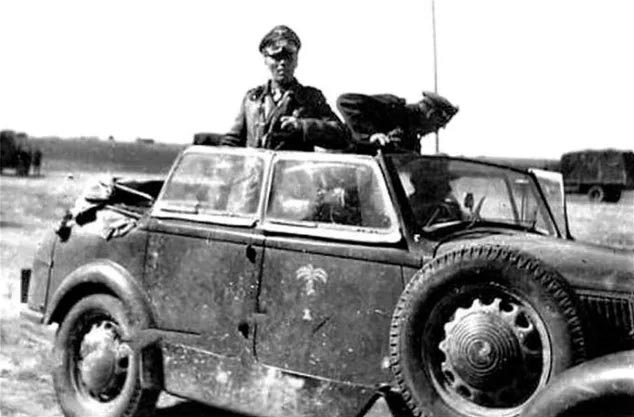
Development
The Alfa-Romeo 2500 Coloniale was born from the development of the civilian Alfa-Romeo 2500 6C model (Sport and Turismo versions), to the specifications of the Ministry of War.
Research for a military version for use in the colonies began in 1938, and testing of the two prototypes began in Africa at the end of 1939, on the rough tracks of Ethiopia and Eritrea. In particular, studies were conducted on the carburetion at altitude and engine cooling at high temperatures.
Since the tests were not entirely satisfactory, development of the vehicle continued throughout 1940 and 1941. The definitive version appeared in 1941, featuring good engine power, a locking differential, good off-road capabilities, and a long range (expandable with reserve cans and jerry cans).
The car was also sent to Russia, first to accompany the C.S.I.R. and then the A.R.M.I.R.; given its unique operational nature, a version with a closed metal cabin was developed for winter use at low temperatures, of which no examples survive.
The Soviets captured some of these vehicles during Operation Saturn (winter 1942-43) and then used them to transport their high-ranking officers (in late 1944, two were spotted in Nisch – on the Bulgarian border – in the closed-cabin version and painted dark red).
After the Armistice of September 1943, at least 44 more were produced for the German occupation troops and the RSI.
An Alfa-Romeo plan to equip the car with all-wheel drive and a reduction gearbox remained on paper.
A total of 150 Coloniale vehicles were produced between 1941 and 1943 (in addition to the two prototypes and the forty or so German-built vehicles). Among others, the vehicle was used by Mussolini in Albania in 1941 and by Generals Gambara (in North Africa) and Messe (on the Eastern Front).
The vehicle remained in service after the war, transporting high-ranking military officials.
The Alfa 6C 2500 Coloniale

In 1938, the Ministry of War asked Alfa Romeo to develop a colonial car based on the civilian 6C 2500 model. In 1939, two prototypes were built, and trials began in October of that year in Ethiopia and Eritrea. During these trials, led by Giambattista Guidotti, the vehicle traveled from Asmara to Addis Ababa in two stages at an average speed of 71 km/h, and from Dire Dawa to Addis Ababa at an average speed of 74 km/h. On both routes, most of the roads were not paved; they were mostly tracks and rocky terrain.
Design

The 6C 2500 Coloniale differed from the 6C 2500 Turismo in several respects. The chassis was reinforced, the wheelbase reduced to 3100 mm, and the tire diameter increased to improve ground clearance. The all-metal torpedo body was designed by Castagna. To improve performance in hot weather, the battery was relocated under the seats, the engine was fitted with a dry sump lubrication system and a separate oil reservoir, and the radiator's heat exchange surface was enlarged. The carburetor's air intake, equipped with a mixture control, was fitted with an oil bath filter.
To increase the vehicle's range, two 25-liter auxiliary fuel tanks were added behind the rear fenders, while two additional 10-liter triangular tanks were used to secure the spare wheels, which were partially recessed into the front fenders. Attachment points for shovel and pickaxe were added under the trunk. A few more modifications were made in 1940-41 before arriving at the final model: in particular, the rear auxiliary tanks, which were simple parallelepipeds on the prototype, were redesigned to integrate with the body lines on the production models.
(
The vehicle measured 4700 mm total (5,100 mm Turismo) with a wheelbase of 3,100mm (3,250 mm Turismo) and a width of 1570 mm (1780 mm Turismo). The Front/Rear Track were 1450mm/1470 mm and height 1,600 mm with the tarpaulin mounted (versus 1,580 mm Turismo). Ground Clearance for both was 260 mm. Its unladen Weight was 1,725 kg versus 1,620 kgs. on the Turismo and the crew Capacity when from 5 to 4 (1 driver, 1 passenger fwd, 2 passengers rear).
Mobility
The Axle Configuration of the 6C 2500 Comoniale was 4x2, so a double train at the rear. It was powered by a 6-cylinder carbureted Alfa Romero gasoline engine rated for 2,433 cc or 2.4 liters. It had an output of 87 hp at 4600 rpm. The Power to liter ratio was 37 ps (36 hp) and Power to weight 55 ps (54 bhp) per ton. It had tires 5.50-18 in size for an unladen weight of 1,725 kg, up to 1,850 kgs fully loaded. Carrying capacity could be raised to 6 with the tarpauling removed or seated in the open trunk at the rear.
The 6c 2500 Coloniale had a transmission of the 4x2 type with 4 gears plus reverse and it could climb a maximum gradient of
25% or reach on flat a top speed of 127 km/h, making it like a military sportscar. It was thus well appreciated by VIPs of the axis. Range was a generous 850 km with the main tank only as it had a main tank capacity of 120 liters (plus 70 liters in four additional tanks of 25 liters and 10 liters and jerrycans. This was also well appreciated for desert roads and great distances.
Operational use
Production of the vehicle for the Italian Army totaled 150 units (in addition to the two prototypes), with 83 produced in 1941 and 67 in 1942. After September 8, 1943, at least 44 Alfa Romeo 6C 2500 Coloniales were produced for the Wehrmacht.
The Alfa Romeo 6C 2500 Coloniale entered service in 1941 in North Africa and on the Eastern Front. While some of its users in North Africa found its suspension too stiff and its tires unsuitable, the CSIR command deemed it perfectly adequate for covering long distances on unpaved roads. However, users on the Russian front requested a version with an enclosed passenger compartment to cope with winter temperatures.
This is how the colonial chiuso model came about, the 50 examples of which, ordered in December 1941, were obtained by converting as many torpedo-class vehicles. Some of the examples used by the 2nd Army in the Balkans were fitted with armor plates.
In 1943, Alfa Romeo considered developing a 4x4 version of the 6C Coloniale, with a wheelbase shortened to 2760 mm, a track widened by 200 mm, low-pressure tires with deep treads, and non-permanent all-wheel drive. However, the armistice brought this project to a halt.
Alfa 6c 2500 Coloniale specifications |
| Dimensions | 4.87 m (192 in) long, 1.83 m (72 in) wide, 1.75 m (69 in) high |
| Wheelbase | 3.10 m (122 in) |
| Weight | 1650 kg (3638 lbs) curb, max 1,725 |
| Crew | Convertible, 4 (6 optional) |
| Propulsion | Alfa Inline 6 2.4 l (149 ci/2443 cc) 90 ps (89 bhp/66 kw)/4500 rpm |
| Top speed | 130 kph |
| Payload | 150 kgs |
| Transmission/suspension | 4 speed manual, rear wheel drive |
| Range | 850 km+ |
| Armament | None |
| Production | 150 |
Reference illustrations
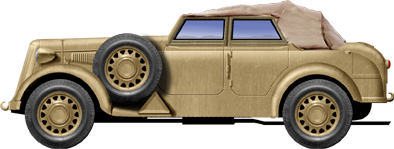 In desert livery, Libya 1941
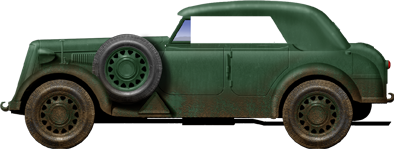 Personal Vehicle of General Graziani, tetto rigido (hardtop) 1942
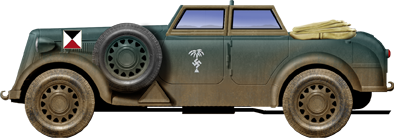 Personal Vehicle of Rommel, 1942
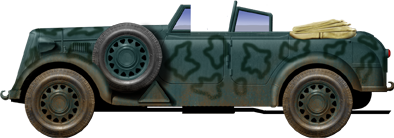 Personal vehicle of Mussolini when he was captured in 1945
Photos
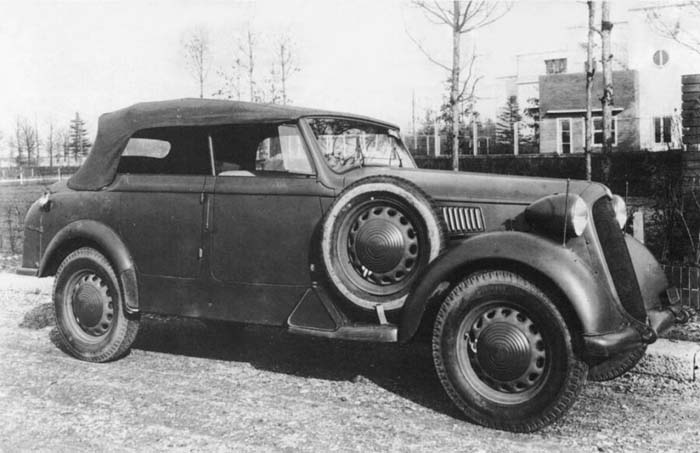

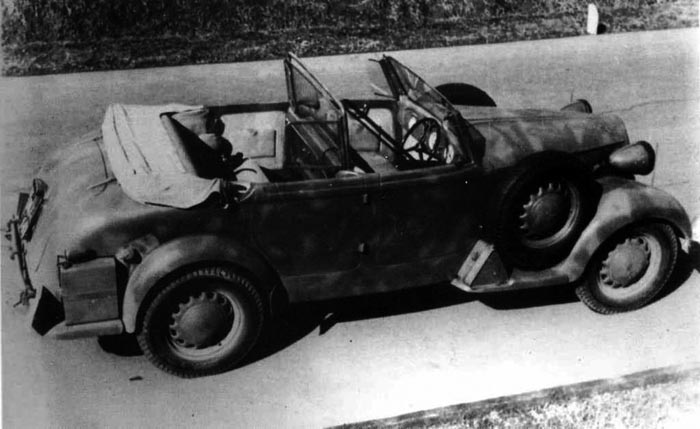 Prototype
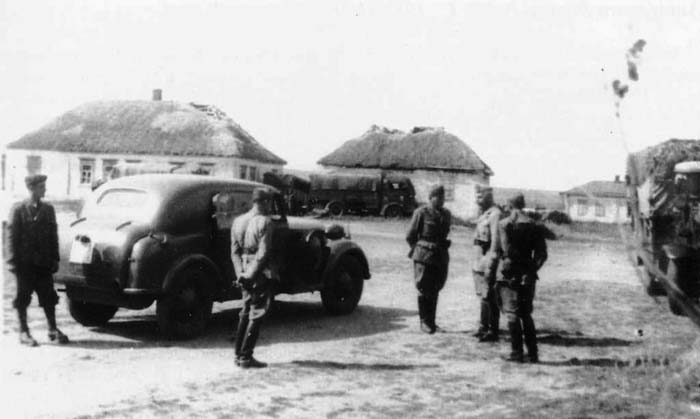 In the Balkans
 Lanca Aprilia staff car
 Another 1943 staff car, a Fiat 2800C MC berlina
Links about the Alfa 2500 6c Coloniale
Gli Autoveicoli tattici e logistici del Regio Esercito Italiano fino al 1943, vol. II, Stato Maggiore dell'Esercito, Ufficio Storico, Nicola Pignato e Filippo Cappellano, 2005.
Gli Autoveicoli del Regio Esercito nella Seconda Guerra Mondiale, Nicola Pignato, Storia Militare.
Gli Autoveicoli tattici e logistici del Regio Esercito Italiano fino al 1943, tomo secondo, Nicola Pignato & Filippo Cappellano, Stato Maggiore dell'Esercito, Ufficio Storico, 2005
Gli Autoveicoli da combattimento dell’Esercito Italiano, Volume secondo (1940-1945), Nicola Pignato & Filippo Cappellano, Stato Maggiore dell’Esercito, Ufficio Storico, 2002
Gli Autoveicoli del Regio Esercito nella Seconda Guerra Mondiale, Nicola Pignato, Storia Militare, 1998
Ruote in divisa, I veicoli militari italiani 1900-1987, Brizio Pignacca, Giorgio Nada Editore, 1989
Alfa Romeo, Tutte le vetture dal 1910, Luigi Fusi, Emmeti grafice editrice, 1978
Alfa Romeo 1910-2010, Maurizio Tabucchi, Giorgio Nada Editore, 2010
Les belles italiennes, tous les modèles des origines à nos jours, Ornella Sessa, Alessandro Bruni, Massimo Clarke, Federico Paolini & Jean-Pierre Dauliac, Gründ, 2007
Les voitures italiennes de collection, Patrick Lesueur, EPA, 2010
site internet Registro internazionale Alfa Romeo 6C 2500
6c2500.org
esercito.difesa.it
centoventesimo.com
it.wikipedia.org/
o5m6.de/wehrmacht/alfa_2500c
o5m6.de/wehrmacht/re_na_lightspecial
italie1935-45.com (1)
italie1935-45.com (2)
fastestlaps.com
facebook galaxyonwheels
web.archive.org (no longer exists)