VW Typ 87 Kommandeurswagen (1940)
 Germany (1939-45) - Staff Car - 564* built
The Volkswagen Typ 87 Kommandeurswagen, is a World War II, four-wheel-drive light vehicle, a car derived from the KDF, at the origin of the legendary Volkswagen "Beetle" from 1934 to 1939. This 2/x4 staff car was produced from 1941 to 1944 in a first military version by the Volkswagen plant for high officers of the Wehrmacht. The waffenamt classified it as the "Kommandeurswagen", but more precisely as the "leichter geländegängiger PKW, 4-sitziger, 4-radgetriebener Geländewagen Typ 87". Which translates at "light off-road passenger car, four seat, four-wheel drive offroad vehicle Type 87". After the KDF was abandoned in 1939 due to war production, Porsche used the chassis of the Type 82 Kübelwagen and mixed many elements of the VW Typ 166 Schwimmwagen. In all, 564 Kommandeurswagen were produced as VW. It was stopped in 1944 due to allied bombardments. By November 1946 under British control, the plant resumed production from spare parts from stores, making two prototype that granted the company greenlight to relaunch civilian mass production and the iconic "Beetle" we know today... after a first false start under the Swastiska.
Development: Hitler's People's Car
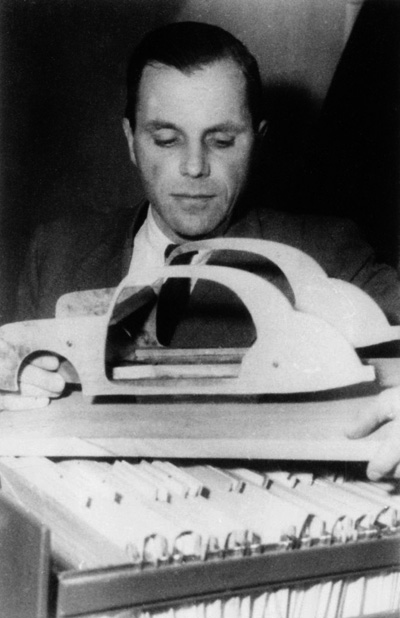
In the name "National-Socialism", accessing power in 1933, the first aspect seems obvious to most casual observers about the IIIrd Reich, but the second aspect is often overlooked. But "socialist" measures were taken as a counter to communist influence, soon totally eradicated by political repression and accompanied large scale state-sponsor works, like the first autobahns to ease traffic. It went to a way to tie ebery aspects of the worker to the regime, and in general many measures apparently in direction to the working class albeit in a rigid frame. One of these efforts was to create an affordable car for the masses. Hitler saw his projected Autobahns criss-crossing the country ran by thousands of a new, mass-produced, affordable car, inspired in part by what Ford did in the US. Some brands produced small and simple cars that were affordable, such as the Opel Kadett of 1936, but this was still a luxury product for most employees and workers.
Initial Concept (1933-34)

Hitler already in 1933 wanted a "people's car", which would be inexpensive, simple, and mass-produced to get the cost down so much it would be affordable to any worker, and to go the with new auto-road network as a way to control the worker's flow. The one engineer contacted for this task was no other than legendary engineer Ferdinand Porsche. His design team began created a working draft and model, albeit most of the fundamental design concept went down to Béla Barényi in 1925. The Hungarian-born Austrian created indeed a prototype that predated Posrche's by almost ten years for Mercedes-Benz. However it was only ready by 1939, but never entered production unlike Porsche's Volkswagen Type 1. The latter claimed the paternity of the concept ever since.
The Volkswagen brand, wanted also by Hitler (The name lit. means "people's car") was initially slated for production in 1939, but the outbreak of war meant it was delayed at least in its civilian form. The Type 1 was marketed postwar as the "Volkswagen" until 1968. Before December 1972 when he retired, Barényi published more than 2000 patents, most related to car safety, notably inventing crush zones and non-deformable passenger cell and other concepts that made Mercedes the self-claimed world's safest cars manufacturer.

Back to Porsche, he worked on the KdF-Wagen from instructions received from a top direction meeting with Hitler by May 1934. The base requirement was to accommodate two adults and three children and consuming less than 7 litres of fuel per 100 km. Components were designed for a quick and inexpensive part exchange and the engine was decided upon to be air-cooled as much simpler to produce, operate and maintain. Any driver could even in theory fix his own car without the need of a workshop and with simple tools. On 22 June, Ferdinand Porsche received the development contract from the Verband der Automobilindustrie for the first prototype. It started development as the Type 60 and the engineering team comprised Erwin Komenda (bodywork), Josef Kales (engine design), under Karl Rabe as chief engineer and Josef Mickl, Franz Xaver Reimspiess as marketing and communication team, the latter credited to iconic Volkswagen badge.
Development of the KDF (1935-39)
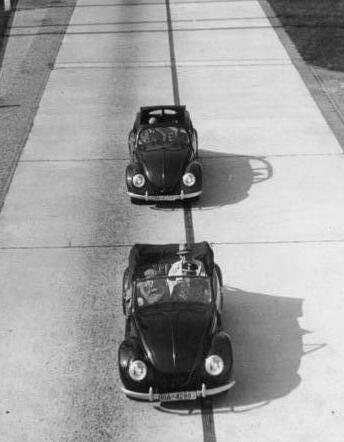 Two KDF cabriolet variants on the Authobahn in 1943
In October 1935 the first two Type-60 prototypes, a Versuch 1 (sedan) and Versuch 2 (convertible) were tested. The testing of three additional V3 prototypes started on 11 July 1936, inclusing one driven to the Obersalzberg to be inspected by Hitler. Two V3s were sent to Berlin in August to be tested by Nazi Party officials. By June 1936 they performed 50,000 km (31,000 mi) of testing on all terrains and this was followed by an order for thirty W30 development models manufactured by Daimler-Benz and startng testing by early April 1937, cranking up a total of 2,900,000 kilometres (1,800,000 mi). They all had in common their monocorps, rounded body (the chassis and body were one single unitary part), and air-cooled, rear-mounted engine with forward bonnet storage and spare wheel.
A further 44 VW.38 were ordered as pre-production cars, produced in 1938 with split rear windows, then fifty VW.39 cars completed in July 1939. However gasoline costs meant in reality no private citizens could afford a car, even this one right now, still very expensive, due to mass-production being not ongoing. Indeed, only 210 civilian KdF-Wagens were manufactured by the end of the war in May 1945 and purchased by a selected few private individuals and some Nazi Party officials. Mass production would have taken place at the massive plant at Fallersleben (now Wolfsburg), founded in May 1938, but it was still unfinished when the war broke out.
Swap to the Military and the Kommandeurswagen
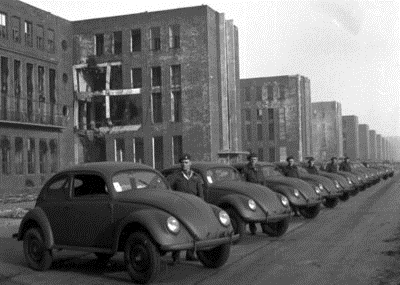
If the civilians were about to have nothing of it due to fateful timing, the military were enthusastic about the car and wanted immediately changes. The KdZ initial name came from "Kraft durch Freude" or German for 'Strength Through Joy' which was one of the key concept of the Nazis at the time. Many Germans already had a savings plan to buy one in 1939 at a time there were only 500,000 registered cars in Germany, less than Western countries. However the start of the war in September meant 330,000 KdF savers never got their vehicles. For those happy few that could afford it from the start, wartime rationing of gasoline meant they had often to convert their car in "Holzbrenner" (wood-burner), fueled with wood logs.
Instead VW was ordered to convert its facilities to military productions, and Porsche concentrated in the Kübelwagen (Type 82) and Schwimmwagen (Type 166) which both borrowed many aspects to the KdZ. The Vw.39 was not forgotten and there were plans to convert a next production bactch into the Kommandeurswagen (Type 87), featuring a Type 1 body mounted on the robust chassis of the four-wheel-drive Type 86 Kübelwagen prototype. The VW Typ 87 became a true Frankenstein monster, "populated" with parts of other Porsche models.
Design of the Kommandeurswagen
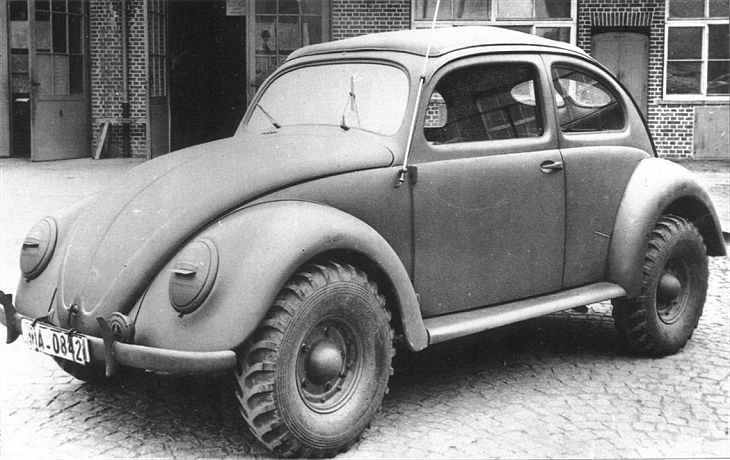 First production Vehicle.
The original KDF featured a rear-located and air-cooled 4-cylinder, boxer engine with a classic rear-wheel drive to gain space (no trnsmission tunnel), in a two-door bodywork. It had a first a flat front windscreen, then splitted, and could accommodate four passengers (with less space on the rear seats) and had space for luggage storage under the front bonnet and behind the rear seat. The iconic rounded monocorps body-chassis had an excellent drag coefficient of Cd=0.48. The bodywork was however still separate from the chassis, but attached with eighteen bolts. This was a flat platform chassis with a central structural tunnel. The front and rear suspension had modern torsion bars and front stabiliser bar, for independent suspension at all wheels, hence the military interest s ths vehicle was provided with off-road capabilities from the start. The front axle was designed with double longitudinal trailing arms and the rear axle had a swing axle. The engine was made of light alloys as the transmission and cylinder heads.
The VW 87 was essentially the same vehicle seen superficially, but it was militarized and ruggerized, and very different than the Civilian vehicle apart the appearance:
-First it had the Type 86 Kübelwagen prototype (The Type 87 was next in line) with all its off-road suspension features.
-It had a specific portal axle and a Vw 166 Schwimmwagen drivetrain.
-It had oversized Kronprinz 5.25-16 all-terrain tires and thus, wider fenders.
The production of the Kommandeurswagen was however a drop in the water in VW production, having low priority, being a staff car. Production went on until 1944 until halted due to the extensive damage resulting frome Allied air raids.
Technical deep dive of the Kommandeurswagen

The vehicle was featuring 4 adult seats in a configuration that was rated as a "limousine", Geländewagen. A metal strip was added to the inside of the fenders to accommodate this; the running boards are also correspondingly wider. Under the front hood, where the spare tire is normally located, a 20-liter jerrycan is housed in addition to the fuel tank. The spare tire sits above the 40-liter fuel tank, whose filler neck was angled to accommodate it. The body is bolted to the chassis. Almost all vehicles had a folding sunroof.
The command vehicle has a floor assembly very similar to the KdF-Wagen but featuring a larger central tube for the driveshaft to the front-wheel drive. The front wheels are independently suspended by two trailing arms each, top and and bottom, and with torsion bar springs, wheeras the rear axle is a portal swing axle, guided by trailing arms. It had reduction gears on the outer half-shafts. The front axle is given steering knuckles to accommodate drive shafts.
The Steering is done via a helical steering system with a rear differential that is self-locking. Power goes through a single-plate dry clutch, to a manually operated four-speed gearbox. It has a low-range gear, engaged with the front-wheel drive via a second shift lever in the center of the vehicle. In that case, it could climb at 10 km/h a 75% grade. However its all-wheel drive is limited on-road use due to absence of center differential.
Engine
The engine is an air-cooled and rear-mounted, four-cylinder and four-stroke, boxer gasoline like the standard Vw.39, with the same displacement of 1131 cc for a rated output of 24.5 hp (18 kW), making for a top speed of 80 km/h, perfect for an Autobahn. The Volkswagen air-cooled engine was a "flat-four" with horizontal cylinders ans a spark-ignition (Otto) system. It was air-cooled using a fan and the
Valvetrain was of the OHV types, the fuel system used a Carburettor Solex 26 VF3. The firing order was 1-4-3-2. The Bore and Stroke were 75 mm × 64 mm (3.0 in × 2.5 in). The rated power was 18 kW (24 hp) at 3,000 rpm.
This power was passed on through a Single disc dry clutch Fichtel & Sachs K10, 4-speed gearbox with additional offroad and reverse gear. There was a rear wheel drive with switchable front wheel drive and locking differentials for off-road drive. The flat chassis similar to the Kübelwagen had a large backbone tube, front torsion bar and rear springs with a stering calling from a worm and nut system. The Brake were of the drum types, and the Tyres, front and rear were the dedicated 5,25-16 or 200-16. Ground clearance was seuperior to the civilian vehicle at 255 mm (10 in) but the wheelbase of 2,400 mm (94 in) remained the same. The tracks were wider however due to the larger tires, at 1,356 mm (53.4 in) front and 1,360 mm (54 in) at the rear. The turning radius was 5 m (16 ft) fr a maximul allowed weight of 1,240 kg (2,734 lb) and max. payload of 450 kg (992 lb).
Fuel consumption was 8.5 L/100 km and oil consumption 0.12 L/100 km with a fuel tank of 40L plus an optional 20L canister and aside the top speed of 80 km/h (50 mph), the range was around 600 km at moderate speed. The Battery was a lead-acid, 6 V, 75 Ah type, and the Starter was a Bosch EED 0,4/6, with a Generator Bosch REDK 130/6/2600. Windows opened manually.
The Kommandeurswagen in combat
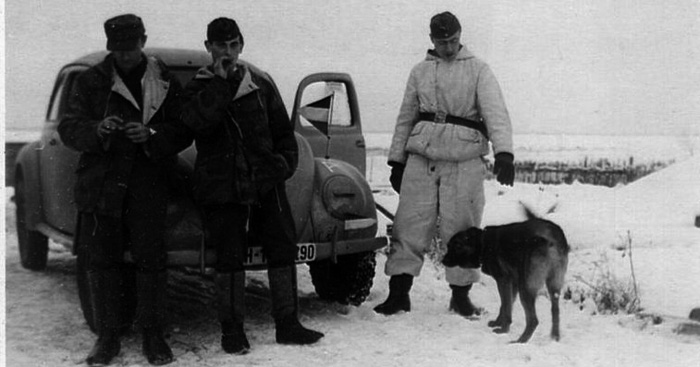
The Kommanderswagen unlike other vehicles delivered by VW, saw a very limuted production and thus it was a rare sight, not planned to be organic to any frontline Wehmacht combar unit, but as the name suggested it was used rather for liaison between HQs carying top brass behind the front line. It was used in an ad hoc way, but the first were seen used in the Balkans, and those delivered to the German Afrika Korps were tropicalized, with a special dust protection for the fuel supply as well as the air filter and electrical system at large, and included 200-16 balloon tires for sand driving when available. They were dubbed the "Crown Prince" tires after the manufacturer. They were also used in Italy, and in Northern Europe at large, down to the last ditch combats in great cities like Prague and Berlin. According to Georgano, 667 Type 87 command vehicles were built during the war with extra ones produced from remaining stock. The other figure is 564, perhaps focusing on new-built vehicles outside conversions. Two from 1946 are still around, portayed in WW2 liveries. Note that the Typ 82/82E was converted from Kübelwagen chassis, not new built. They were distinguished by notably an optional roof stowage bin.


| VW 87 specifications |
| Dimensions | 3,830 x 1,62 x 1,72m |
| Weight | Max. 1,24 ton |
| Crew | 1 driver, 3 passengers |
| Propulsion | Flat (Boxer) 4-cyl. Otto 1.1L 15 Kw/18 hp |
| Top speed | 80 kph |
| Payload | 450 kgs |
| Transmission | 4+1 gearbox diff 2x4/4x4 |
| Suspension | Torsion Bars fwd, Leaf pring aft |
| Range | c600 km |
| Production | c600, see notes |