Horch 108 (1935)
 Germany (1935-42) - Heavy Personal Carrier - 8,135 built
Horch Zwickau started production of the heavy cross-country standard staff vehicle Horch 108 in 1937, and until 1942 delivered a total of 8,135 in five different versins (Kfz). That included 1901 of the EG Typ from Ford Köln. That large 4x4 "staff-car" was on the upper scale in the Werhmacht inventory and could accomodate as much as 8 men. The combat vehicle was the Kfz. 18, the heavy personnnel transporter was the Kfz. 21, and the artillery tractor for light guns Kfz.69. The Mannschaftskraftwagen or personnel carrier Kfz. 70 ("Mannsch. Kw. (Kfz. 70)"), was the common among the Einheitsfahrgestell II für s. Pkw. or "standard chassis II for heavy passenger car". Notably compared to the Einheitsfahrgestell II für s. Pkw. Typ 40. Outwardly it was closed to the Krupp Protz Kfz. 69 in many respects. Each man could carry 100 kg of personal equipment, with 250 kg remaining for weapons, ammunition or equipment not belonging to the vehicle itself. Improvements led to Type 40. The four-wheel steering and supporting-wheels were discontinued as too complex and costly. It had a single spare-wheel stored inside of the body. Its initial shortcoming of a high dead weight compared its the small payload remained present on the Type 40.
Design development

The Reichswehr started limited in size and scope by the Versailles Treaty frame in the 1920s, add to a morose economic situation anyway. The transport needs of the army were covered by off-the-shelf commercial vehicles of all types, cheap and reliable. Personnel carriers were also based on commercial car chassis with an open body of the Kubelsitzer (literally "bucket-seater"), giving the nickname of the most renown of these, the VW Kübelwagen or lit. Bucket car. It was designed for simplification and flexibility in mind, with a strong chassis and front end with the standard engine under bonner, but sturdy metal seats secured to the chassis frame and the rest was free to adapt.
In 1925-27 these simple military vehicles had each time a forward folding windshield but no side or top cover apart a large tarpaulin, and often canvas screens instead of doors. Cross-country performance was still very limited, but that type of small utility personnel carriers were becoming popular ion the Wehrmacht. To improve cross country performances these early military vehicle had large section tyres, strengthened springs, plus lower axle ratios than in the civilian market to negociate rough terrain, and more torque when possible. In the late interwar, they saw wider use, coming from more manufacturers, Horch, Mercedes, Opel, VW, and started to perform a veriry of roles like light gun tractors, staff cars, radio cars, command cars or artillery spotters, signal vehicles, and overall personnel carriers for motorized infantry. State trials in 1930 alerady established Daimler-Benz, Adler and Wanderer had the best chassis for future developments.
From 1933, a true re-armament and massive expansion and mechanisation of the growing army led to use standard cars adapted from commercial chassis and a standard was set in place with the Leichte Personnenkraftwagen (light passenger car) typically powered by a 1.5L engine, but also the Mittlerer Personenkraftwagen (medium passenger car) as a 3 liter engine category, and eventually the Schwerer Personenkraftwagen (heavy passenger car) above 3 liter engine capacity. This is the one category we are interested here.
The Horch 108 was one of the most common in the latter category of the "heavy staff cars", as an interwar German all terrain heavy passenger car still produced in World War II until 1942. The first prototypes were built in 193-36 with serial production starting in 1938, lasting until 1941. The Horch 1A was developed for the needs of the German armed forces, which, along with its rapid growth after 1933, aimed at obtaining a universal, light and possibly reliable passenger-off-road vehicle. The Horch plant met these needs by developing the vehicle presented below. The vehicle uses such solutions as, for example, all-wheel drive, independent suspension of each wheel or the possibility of turning all wheels. Anyway, the last solution turned out to be highly unsuccessful in the course of operation. It is worth noting that already in the course of World War II, the design of the car was simplified, which was manifested by, for example, the abandonment of the recesses in the fuselage for spare wheels. Horch 1A served in the German armed forces on virtually all fronts until 1945.
The Schwerer geländegängiger PKW or Heavy off-road passenger car category defined for the Wehrmacht comprised several manufacturers's model. The Horch plant in Zwickau, which was part of Auto Union AG and using V8 830 CC engines produced in 1936 a prototype answering a specification for such vehicle, the second factory involved being Ford in Cologne based on their own 3.6-liter V8-51 truck engines.
From the end of 1940, the Horch 108 and Ford EG entered production as the "Type 40," but both variants were manufactured by Horch in Zwickau. However, for the Ford, components and engines were supplied from elsewhere.[6]
In total, little more than 10,000 vehicles were produced. The cars had an unladen weight of 3,300 kg (3,200 kg without all-wheel steering). In 1940, this type also lost its all-wheel steering and the two centrally mounted spare wheels. Although the aforementioned shortcomings also occurred here, and the vehicle's difficult handling drew criticism, the heavy off-road passenger car was the most popular of the three types in the standardized passenger car program.
Design
 The radical 2 cm Flak 38 Luftwaffe SPG variant
The Horch 108 was much larger and heavier than the VW Kübelwagen, albeit they shared the same base concept of open vehicles with tarpaulin. This absence of roof forced the use of a strenghtened chassis, especially able to deal with off-road conditions on all terrain. The Horch 108 measured 4.85 m overall, 2.04 m high at the top of the frames, and 2 meters wide. Generous dimensions making enough for room for eight men, including a drive and co-driver, and six men seated behind, on benches facing inwards. There were two "suicide doors" forward and two standard doors (forward hinges) aft of the rear compartment. Both had welded steps to help climbing in. At its rear was located a large storage boot with a set of two doors opening outwards. Above the deck was located the large tarpaulin composed of a serie of frames holding the roof main frame, hinged above the hull at the level of the rear mudguard and attached to the forward windhsield. The latter was composed of a split window, all flat, hinged dowards. There were rear mirrors of either side and simple elextriuc windshields on the top windshield frame. More importantly in the early production version, spare wheels were carried on the side panels flanking the first and second rows of seats. They were fixed on free axis and protruded downards, so acting like extra wheel support when crossing jagged terrain.
The rear mudguards were buried into the hull, whereas the forward ones were more open due to the hull inflexing inwards to meet the bonnet. The latter housed the large truck style engine (see later), covered by a split cover with four series of louvres and side ones for cooling. The split radiator forward was quite large. There was a bumper lower and a shock support bar anchored above and in front of it, also protecting the radiator. Two blackout lamps were mounted either side of the front mudguards, and a notek light was installed on the right fender. There was no winch but a spare wheel was mounted inside the hull, located on left side. There were twin brackets for standard K.98 rifles, a single twin in the forward compartment and two twin at the rear on either side. Tools were generally carried on the front fenders, a pincer/cutter and pickaxe on the right and and axe and shovel on the left one. The main fuel tank access and its fuel filler was originally inside the hull, but it was relocated to the outside of the body later in prod. in a recess of the lower hull, right side. The open hull sides could be completely covered by optional canvas and plastic panels attached to the tarpaulin's frame and to the hull.
The curb weight of the Horch 108 was up to 3,6 ton, and it was driven by a 4-arm wheel, connected through a shaft to the forward direction. Below the hood was a single, 8-cylinder Auto-Union engine with a capacity of 3.8 liters, rated to 81 HP. The more reloable and simpler, cheaper Ford engine produced in Germany was more used in WW2, rated for 78 HP. The schwerer geländegängiger Personenkraftwagen (s. gl. Einheits-Pkw) or "heavy cross-country standard-passenger car" from both Horch and Ford could vary between four-wheel steering and front axle steering only. The steering of the rear axle could be shut off in the former case.
Improvements were introduced with the type 40 which supporting wheels on both sides were dropped and only one spare wheel left, stored inside the body and later the four-wheel steering was dropped as well. In 1942 most served as personnel carriers and towing vehicles for light guns (see later). Ambulances with closed superstructures were also frequent on the eastern front, but very few Komandeurwagen or commander’s cabriolets were made based on the s. gl. Einheits-Pkw. The also rare amplifier motor-vehicle shared the same closed superstructure as the ambulances as was the searchlight carrier.
The Luftwaffe transformed the vehicle into the sole self propelled gun of the type, a 2 cm FLAK carrier based on the chassis of the s. gl. Einheits-Pkw. They had a small platform and dropsideslike the Sd. Kfz. 10/4. Four-wheel armoured cars were even created, such as the
Sd.Kfz.247 Ausf.B Staff Car based on the chassis of the s. gl. Pkw. called the Horch Leichte Panzerspahwagen on Einheitsfahrgestell I & II. They covered a family comprising the Sd.Kfz.221 and 222 from Auto-Union wich shared many elements with the Horch 108.
Production

Production models:
Early versions were the Horch 108 Type a, Horch 108 Type 1a, Horch 108 Type b, Horch 108 Type 1b, Horch 108 Type 1c armored vehicles based on Type 1a, Horch 108 Type 1c armored vehicles based on Type 1b, Ford Type EGa, Ford Type EGb, and Ford Type EGd:
- Horch 108 Typ a 1937-1938 4-wheel steering. Horch total 8,135.
- Horch 108 Typ b 1937-1938
- Horch 108 Typ 1a 1939-1940: 4-wheel steering
- Horch 108 Typ 1b 1939-1940.
- Horch 108 Typ 40 produced 1940-1942
- Ford Typ EGa produced 1939-1940, 4-wheel steering by Ford: 1,901
- Ford Typ EGd produced 1939-1940, 4-wheel steering, without supporting wheels
- Ford Typ EGb produced 1939-1940
- Ford EG Typ 40 Produced 1940-1941
Designation, Abbreviated:
Both were first destined to the signal corps as radio vehicles, as well as telephone vehicles (Kfz. 23) and repeater vehicles (Kfz. 24). Another variant became the ambulance (Kfz. 31), limber vehicle for light artillery as the Kfz. 69), but the most famous and common was the troop carrier Kfz. 70. The most fearsome became the light anti-aircraft vehicle Kfz. 81. There was also the searchlight vehicle for AA defense Kfz. 83 I and 83 II. A small series of commander's vehicles, convertible, were also manufactured by Horch, documented but not identified. Several versions were produced using different chassis.
- Funkkraftwagen (Kfz. 19) mit Einheitsfahrgestell II für s. Pkw. (Fu.Kw.(Kfz. 19))
- Schwerer geländegängiger Personenkraftwagen (Kfz. 21) mit Einheitsfahrgestell II für s. Pkw. (s. gl. Pkw. (Kfz. 21))
- Fernsprechkraftwagen (Kfz. 23) mit Einheitsfahrgestell II für s. Pkw. (Fsp. Kw. (Kfz. 23))
- Verstärkerkraftwagen (Kfz. 24) mit Einheitsfahrgestell II für s. Pkw.(Verst. Kw. (Kfz. 24))
- Krankenkraftwagen (Kfz. 31) mit Einheitsfahrgestell II für s. Pkw.(Kr. Kw. (Kfz. 31))
- Protzkraftwagen (Kfz. 69) mit Einheitsfahrgestell II für s. Pkw.(Protzkw. (Kfz. 69))
- Mannschaftskraftwagen (Kfz. 70) mit Einheitsfahrgestell II für s. Pkw. (Mannsch. Kw. (Kfz. 70))
- Leichter Flakkraftwagen (Kfz. 81) mit Einheitsfahrgestell II für s. Pkw. (l. Flkw. (Kfz. 81))
- Leichter Scheinwerferkraftwagen I (Kfz. 83) mit Einheitsfahrgestell II für s. Pkw. (l. Scheinw. Kw. I (Kfz. 83))
- leichter Scheinwerferkraftwagen II (Kfz. 83) mit Einheitsfahrgestell II für s. Pkw. (l. Scheinw. Kw. II (Kfz. 83))
- 2 cm Flak 30 als Selbstfahrlafette auf Einheitsfahrgestell II für s. Pkw.
- leichter Schneepflug Typ E (l. Schn. Pfl. Typ E)
- Peilkraftwagen a, b, c mit Einheitsfahrgestell II für s. Pkw. (Peil. Kw. a, b, c)
Horch 108 specifications |
| Dimensions | 4,85 x 2 x 2.04 m (wheelbase 3m) |
| Tracks, Ground Clearance | Front/rear 1,646m - 25 cm |
| Weight | 4.3 ton |
| Chassis | Box type |
| Crew | 8 (1 driver, co-driver, +6 pass.) |
| Propulsion | Horch V108 6-cyl. 3,823 cc. |
| Bore/stroke/Comp. ratio | 78/100mm/6,1:1 |
| Carburettors | 2x Solex 30 BFH |
| Top speed | 60 kph road, 30 kph off-road |
| Payload | 1 tonne |
| Transmission | 5 speed fwd +1 reverse |
| Brakes | Hydraulic drive |
| Suspension | Leaf springs ft. and rear |
| Range | 32/42L/100 km cons. 120 liters: 375 km road. |
| Armament | Towed ordnance, and the Luftwaffe 2cm FLAK 38 carrier |
| Production | 8,135 Horch+Ford |
The Horch 108 in combat
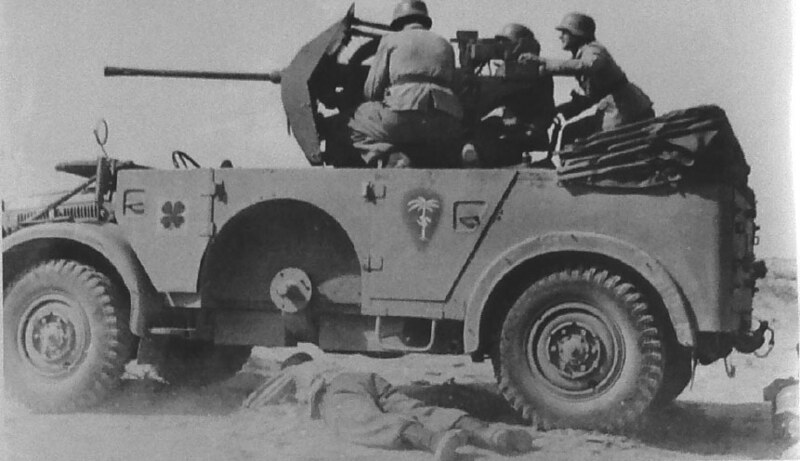 Probably the most famous variant, the Luftwaffe 2 cm FLAK 38 SPG of the Afrika Korps.
The common Kfz.70 main purposes was to double as towing vehicle for guns such as the PAK 36 antitank or 75mm leIG 18 light howitzer, as well as its crew. However the vehicle in wartime proved too vulnerable and fragile overall, notably for the eastern front, and ts heavy use if challenging conditions purposes led to abnormal high strains. In many cases it had to carry ten crewmen instead of height, plus the shells of the towed guns insode the rear boot, plus all the personal weapons and gear of the crew. In general the design was considered too complicated and too vulnerable in combat. Its dead weight of more than 3.2 tons, out of proportion compared to its payload of around 1 ton.
Later personnel carriers based on 1 ton lorries from Mercedes Benz, Phänomen and Steyr showed far better performances and proved to be more steady and simpler to build, maintain and repair in the field. Even the 1936 three-axled lorry Krupp-Protze used for similar tasks had better performance across the board than the Horch 108, like a dead weight of around 2.5 tons, payload of 1.1 ton. Thus, this mimited the number of tasks the Horch 108 could be used and it became more specialist, avoiding overtaxing its chassis and these configurations and care, it became indeed an acceptable vehicle with appropriate handling and maintenance standardsn albeit it was rarely possible under combat conditions esecially on the eastern front.
However in general, the vehicle performed in all German infantry divisions and on all fronts from the Polish to the French campaign, the Balkans in 1941, the eastern front 1941-44, Italy, and especially North Africa where wheeled vehicles excelled. To see how these vehicles were integrated here is a
scheme of the Sonderkommando "dora" in June 1942.