Jackal (2008)
 Open Modular 4x4 Recce Vehicle: 580+ manufactured 2008-today.
The Jackal or MWMIK (from "Mobility Weapon-Mounted Installation Kit") is a family of vehicles developed by Supacat Ltd at Honiton, Devon for the British Army and RAF Regiment. For the army it was designed for deep battlespace reconnaissance, rapid assault and fire support, or convoy protection. A few were demonsrated at the Honiton factory but after orders placed in 2008 by the MiD it production was assigned to DML (Babcock Intl. Group), Plymouth. 100 in 2008 and then a futher 72 and then in 2010 140 additional "Jackal 2" for a grand total of 500 when production ended.
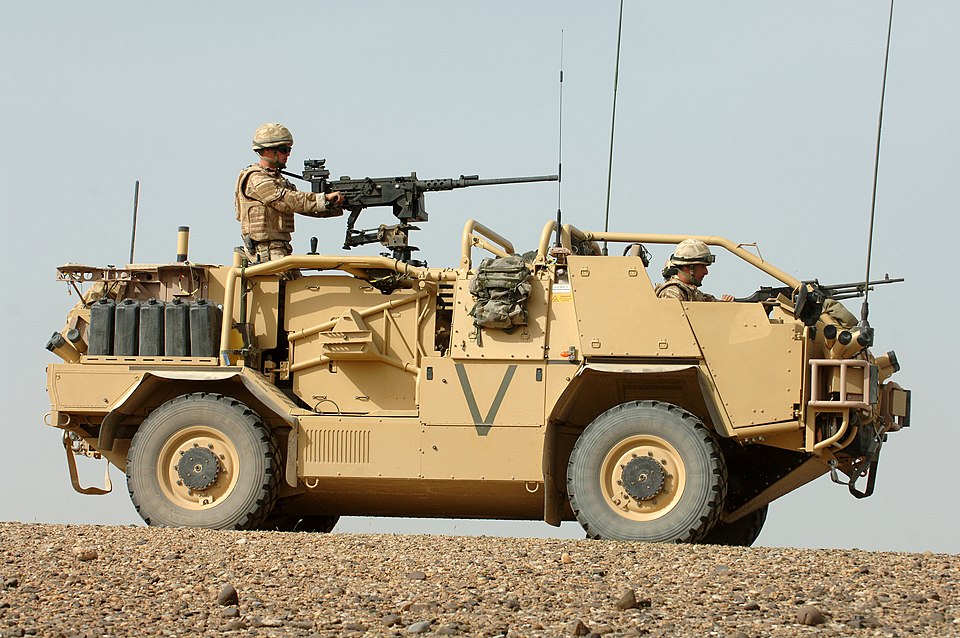
The need: Mobility and Modularity
The MWMIK is not the first vehicle from Supacat, and it was designed to carry a greater payload and extra fuel compared to its predecessor, while being modular enough to offer a great diversity to install additional equipment and protection over longer distances. The vehicle is very much a SAS style self-sufficient support for its crew, adapted for venturing over distances beyond 500 mi (800 km).
Until then indeed, Supacat (Now SC Group) proposed to replace the Land Rover , used in specially tailored special operation versions for British or Foreign Operatives and special forces. The company already modified the Land Rover 110 into modular, lighweight versions, but it was recoignized by all that a more modern platorms was needed for the 1990s. After all, the Land Rover, as legendary as it was, dated back the late 1940s and was more or less a British equivalent of the Jeep. Not only its base technology did not evolved much, but there were limits to its speed, endurance and above all, modularity. Special Operatives were all fully aware that the vehicle had been pushed to the very limits of its original base concept and could not be upgraded more, even in some spectacular variants like the Australian 6x6 Perentie.
About Supacat, the ATMP and HMT
SC Group (Supacat Ltd until 2015) was established in 1981, located on the Dunkeswell Aerodrome. In time, the group absorbed SC Innovation, Proteum and Blackhill Engineering. From the start it was known for the design and development of military and civil "high mobility vehicles". Its portfolio included after a while also all specialized vehicle for harsh environments in the marine, renewables, mineral exploration, oil & gas or nuclear power. In 2014, the company started to purchase many actors of the marine sector, leadng to the creation of Proteum in Hamble. To this was added the Exeter-based Blackhill Engineering for heavy duty vehicles and parts.
All Terrain Mobility Platform
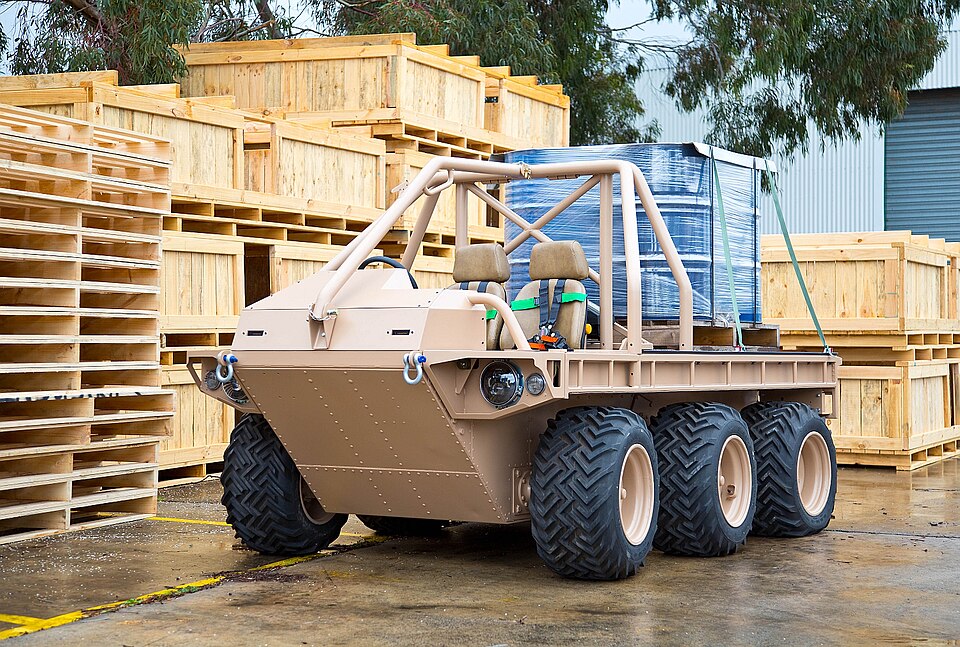
The first success of the company was the "All Terrain Mobility Platform" (ATMP), a 6x6 all terrain vehicle, produced along 4 generations, with 200 supplied to various military users since 1982, such as Canada, Malaysia, Mexico and the UK. Then came the High Mobility Transporter (HMT) in three variants, 400/600 (4x4/6x6 chassis) and "Extenda" that could be reconfigured in either of the two formulas. The HMT 800 (8x8) was also marketed. The 4x4 was designed in mid-1999 and by 2004, Lockheed Martin purchased the licence for North America.
High Mobility Transporter
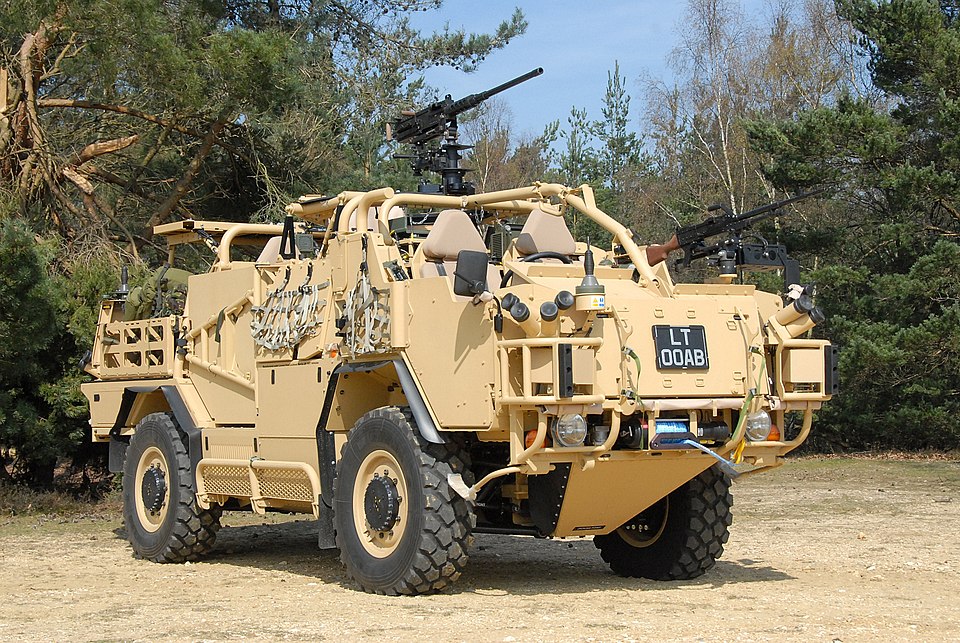 Jackal Mark II
The HMT 400, a more mature vehicle than the ATMP, was developed for British Special Forces under "Project Minacity" to replace the venerable
Land Rover 110 Desert Patrol Vehicle. Contract was awarded in 2001, for 65 vehicles seeing action in 2003–2004 in Afghanistan and the the U.S. Delta Force (47, named "Marauders") delivered until 2005. In 2006, the Danish Army Hunter Corps ordered 15 HMT Extenda, in 2007, the Australian Army Special Air Service Regiment ordered 31 HMT Extenda (SOV-SR) active from 2011 followed in 2014 by the 2nd Commando Regiment's 89 HMT Extenda MK2 (SOV-Cdo), hihly reconfigurable. In 2015, the Norewegian Forsvarets Spesialkommando also ordered the HMT Extenda delivered 2017-2019. In 2016, the New Zealand SAS ordered also the HMT Extenda delivered from late 2017.
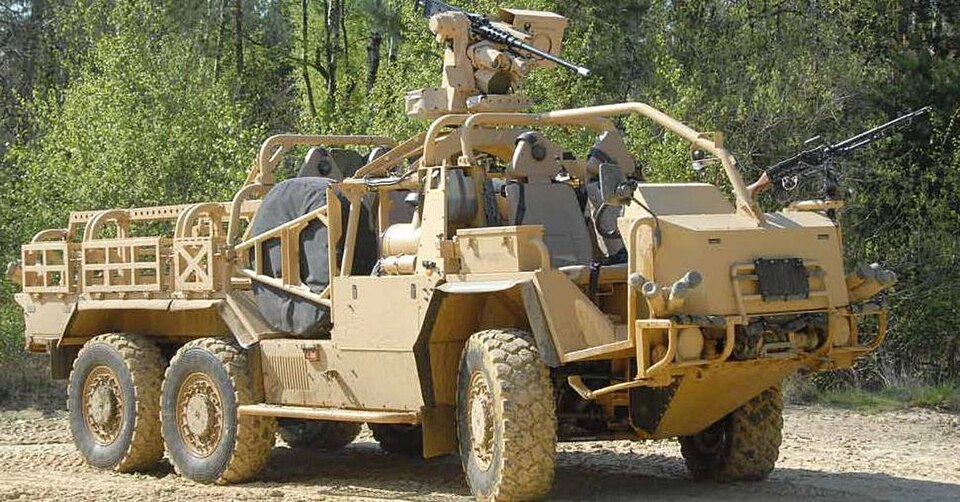 The HMT Extenda, an export success
The British Army had orders for the same from 2007 to late 2010 (HMT 400), renamed the "Jackal" as well as the HMT 600, the "Coyote"for a total of 575 vehicles. The MoD also purchased a number of specialist variants of the HMT through Project Soothsayer and the Lightweight Mobile Artillery Weapon System Gun (LIMAWS(G)), but both were cancelled in 2007. The HMT 600 became the primary carrier for the Watchkeeper UAV project.
The Supacat HMT 400 Jackal
Our subject is about the 4x4 HMT 400 Jackal Mark I and II. The vehicle core concept, later narmed "MWMIK", was to provide British forces in Afghanistan an off-road patrol and fire-support vehicle supplementing the Land Rover Wolf WMIK and Snatch Land Rover already in service for that role. The Snatch Land Rover had been modified to withstand small arms fire, but was found vulnerable to improvised explosive devices (IEDs) to such extent it was called a "mobile coffin" there.
The Ministry of Defence wanted Supacat's HMT 400 to be built to meet the British Army, to be an agile well-armed and light patrol vehicle. It was also precise an optional armour kit, hence the fact the vehicle is here and not on tank-afv.com. The core principle was a high level of off-road mobility for troops to avoid routes which that can be ambushed, to performed in depth-reconnaissance.
General Layout and configuration
The base is the HMT 400 high-mobility 4×4 design from Supacat,also built under licence by Lockheed Martin. The chassis is manufactured by Universal Engineering Ltd. The engine is provided by Cummins, the transmission comes from Allison. The suspension shock absorbers are from Fox Racing Shox. The electronics are from Fujitsu, and Smartgauge Electronics. The vehicle had a very modular and open arthitecture, without roof or doors, for rapid ingress and exit, roll bars for protection from the nose to the tail allowing also to strap any pintle mount for any type of universal light machine gun, and a flexible mount in the middle for a standing operator (see below). The vehicle has no protection agains small arms or shrapnel, but could receive armour packages, and is protected against mines (see below) and has smoke dischargers forward. The driver is on the left, co-driver/front gunner on his right, followed by a standing operator, and four optional bunks used as storage but that can double as seating. The vehicle has sand boards and a winch to be towed away of any bad situation.
Mobility and Performances
Despite of being unarmoured and open to the elements, the Jackal still weights seven tonnes in battle order, fully equipped, which is more than any Land Rover. It is much larger as well, but still, it need some serious outpout, and for this, a 5.9 litre Cummins ISBe Euro3 six-cylinder diesel is installed under the hood, rated for 185 bhp (138 kW). It is linked to an allison 4+1 manual transmission with selectable two wheels or four wheels drive. It is equipped with Independent double wishbone, air operated springs with external bypass shock absorbers, two per wheel station, with variable ride height, which is the state of the art for 4x4 tech.
One of the key point indeed for the platform is having an height-adjustable air suspension system that can be lowered onto the bump-stops, in order to provide a stable firing platform when stationary. But it could also raised it to a maximum 380 mm (15 inches) of ground clearance to clear large obstacles or ford deep water.
Its range is up to 800km, or more given the number of jerrycans that can be strapped around the hull, for a top speed of 80mph (130km/h) on roads, and impressively, 55mph (89km/h) over rough terrain.
However to keep the range, the vehicle needs to keep off-road speeds of up to 49 mph (79 km/h).
Armament
The Jackal can be fitted with a range of light machien guns on various points attached to roll bars pillars in a very modular way. In practice, one forward (co-driver); one for two passengers behind, plus the central standing operator ring for a 12.7 mm Browning M2HB heavy machine gun, 7.62 mm general purpose machine gun (GPMG) and/or 40 mm automatic grenade launcher.
Protection
The Jackal is soft-skinned apart floor protection and comes with optional blast and ballistic armour packages. It has by default blast mitigating seating from Jankel Armouring Ltd. It features also armour plating beneath the crew compartment and optionally on the sides, plus attenuating seats absorbing shock from mine blast. Nevertheless, in operations, crews suffered a number of IED attacks and some were fatal.
⚙ 4x4 specifications |
| Weight | 6,650 kg (14,660 lb) |
| Dimensions | 5.39 x 2 x 197 (17 ft 8 in x 6 ft 7 in x 6 ft 6 in) |
| Propulsion | 5.9l Cummins 6-cyl. diesel: 185 bhp (138 kW) |
| Speed | 130 km/h (81 mph) |
| Range | 800 km on road, see notes |
| Armament | 1 GMPG, 1 cal.30 M2HB or M48 grenade launcher |
| Protection | Optional packages, floor, seats, see notes |
| Suspensions | Independent double wishbone, air operated springs, bypass shock absorbers |
| Crew | 3: Driver, co-driver/LMG, HMG operator. +4 optionally seated in the back. |
Variants
Jackal 2
An updated version, the Jackal 2 was ordered with extra seats for a crew of four, main armament gun ring moved forward for a better arc of fire, chassis upgraded, to handle a greater payload and armour, better resilience against roadside bombs. This extra weight is compensated by a 6.7 L engine for no gain in speed. In 2009 "around 110" were ordered, with final deliveries taking place by February 2010. A further 140 Jackal 2A were ordered on 23 June 2010, featuring a blast protection upgrade.
Jackal 3
Latest iteration introduced in the summer of 2024. By September 2024, the MoD placed an order for 53 Jackal 3 added to the 70 ordered in the spring.
Coyote
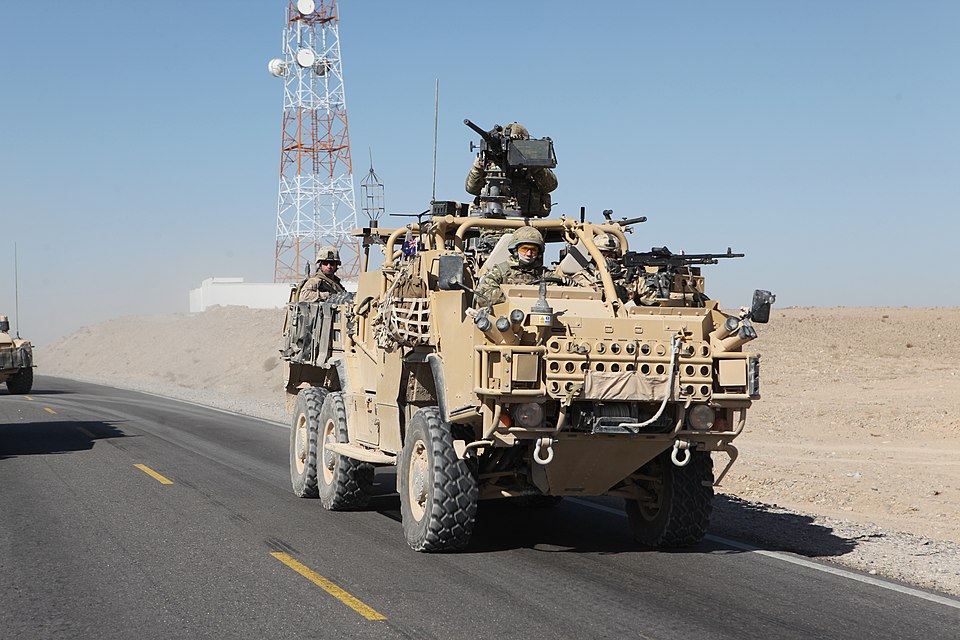
Tactical Support Vehicle variant with a 6×6 design: 70 ordered as medium load carriers and artillery tractors. Also called TSV light, based on the HMT 600 6×6 chassis, a larger derivative of the Jackal 2 but complementary. 10,500 kg (10.3 long tons; 10.5 t) and a role of supply and equipment carrier (3,900 kg (3.8 long tons; 3.9 t)) at great speed over similar terrain.
The Jackal in Action
War in Afghanistan: Jackal had its operational debut in
Operation Herrick on 8 April 2008 wuth the 16 Air Assault Brigade and Royal Marines 3 Commando Brigade. Users compared ot to the "dune buggy". It was fitted by all armour packaged and praised for its protection. On September 2009, a Royal Marine survived a direct mine explosion in one Jackal. By August 2009, 13 British soldiers were however killed inside the vehicle, resulting in widespread criticism.Critically it was caused by a very powerful IED. Despite of it, on the ground it remained the favoured patrol vehicles for British troops according to MoDM Quentin Davies. 110 upgraded Jackal 2 and 70 Coyotes were thus ordered by April 2009, the first arriving in units by July.
The vehicles were also used by the RAF Regiment and deployed in the September 2012 raid on Camp Bastion. There, a Taliban RPG struck a Jackal, wounded the crew, but Sergeant Geddes rallied his team, defend their position, for which he was awarded the Military Cross. Despite the end of the War in Afghanistan and withdrawal of the US and its allies according to art. 5 of NATO, the vehicle remained in inventory with the British Army. After the Army 2020 restructuring, three light cavalry regiments adopted ot for light reconnaissance, deployed by Light Dragoons in Poland since 2016 in support of NATO's Enhanced Forward Presence. In 2021, the same and the 1st The Queen's Dragoon Guards sent them to Mali as part of Operation Newcombe. In 2020, the MoD loaned four to the Estonia also using it in Mali until March 2021, replaced then by Coyotes. As of 2026 the vehicle might be deployed in Poland as part of units rotations. Its high off-road spedd might be an advantage for the Ukrainians if deployed in the summer of 2026 as well. Drones indeed could have a hard time to keep up.
Operators
British Army: 312 (100 initially +72 2008, 140 2010). February 2023: +70 Extenda Mk2 (Jackal 3) and option for 240, total 431 Jackals and 72 Coyotes for the Army. The Royal Air Force Regiment uses it also (no detail) and the Royal Marines as well.

Estonian Special Operations Force: 4 loaned from the UK in Mali.