Toyota Fortuner
 Mid-Range Police SUV. Japan & Thailand 2004-Today
Toyota split its markets according to the respective audience of its 4x4 vehicles, the Hilux for the US market, and based on it, the Fortuner for Asia. Also known as the Toyota SW4, this mid-size SUV manufactured since 2004 featured two/three rows of seats and selectionable rear-wheel/four-wheel drive configuration. Intended for the civilian market, many were chosen by various police services in Asia and beyond, including the Indian Police in Kashmir when a few were lost in action.
The Fortuner was developed as a pure civilian vehicle, with a first-generation Fortuner developed in Thailand by Thai and Japanese engineers as they designed a specific facelifted version, whereas the Hilux and Innova were designed by Toyota Australia, also crating the second-generation. The Fortunate is present in the medium body-on-frame SUV segment alternative in Asia to the Hilux Surf/4Runner common to Japan and North America or the Land Cruiser Prado for Europe and Australasia.
Central and South American countries as well as Oceania are proposed the Fortuner alongside the 4Runner and Prado. Police and law enforcement agency generally choosses the powerful 5L-E diesel engine variant developed for government agencies and also UN organisations where the white vehicles takes their place alongside the Prado, Hilux, HiAce, and 70/200 series Land Cruisers.
Design
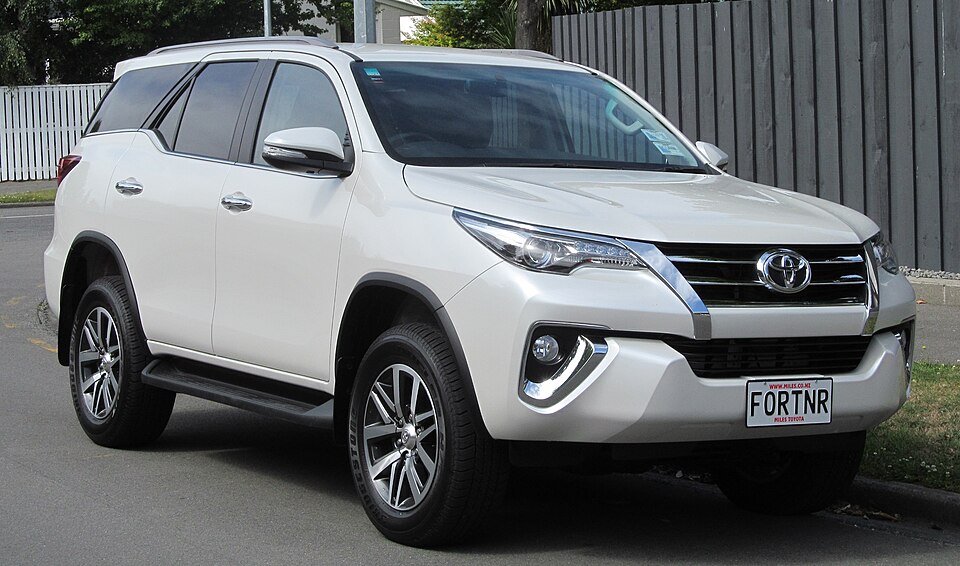 A basic civilian 2015 NZ version
Layout
The Fortuner shares the same chassis as the standard Hilux, but the body is different, not so much specifications. Its Overall Length is 4,795 mm for a width of 1,855 mm and height of 1,835 mm for stability but it varies slightly by market. Thos used police forces are generally taller above the roofline due to the installation of utility racks, gyrolights, projectors, loudspeakers and other accessories when present.

The Wheelbase is 2,745 mm, not enough to gap a trench, but to deal with most obstacles on the road. Ground Clearance indeed varied considerably between 225 and 279 mm depending on the variant and market as well as user's requiements and workshop modifications. It's the seating Capacity that makes it attractive with a "demi-platoon" of policemen and their officers all seated and four doors plus the hatchback.
The seven passengers consists of the driver and co-driver forward (the officer generally) and three seated immediately back and two more on jump seats in the boot. It has a minimum turning radius of 5.8 to 6.2 m and a cargo Space 296 L for personal gear behind the 3rd row but this varies by interior configuration. Generally the 3rd row is reserve for arrested "guests" with an intermediate grid in some case.
 3-star generals and their personal VIP Fortuna (pinterest)
Needless to say the vehicle is softskin, no armour package had been planned so far, and unarmed, apart personal service weapon of the 7-crew, mission dependent. No roof hatch for example. The tyres are standard, no run-flat types, and there is no central inflation system, albeit a deflation sensor is present on the dashboard. Amphibious capabilitie are the standard 60 cm water deep, albeit a snorkel type exhaust could be mounted optionally to increase this. There is also air conditioning and heating as standard.
Motorization and Powerplant
The Fortuner is offered with multiple engines globally either diesel and petrol depending on market. Generally less constrained by budgetary reasons and ooking for a fast deployment vehicle, the most powerful engines, most often diesels, are chosen by Police forces for compatibility with the rest of their fleet.
2.4 L Diesel (2GD-FTV)
Type: Inline-4, turbocharged, common-rail diesel. Displacement: 2,393 cc. Power: 147 – 150 hp @ 3,400 rpm.
Torque: 400 Nm @ 1,600-2,000 rpm.
2.8 L Diesel (1GD-FTV)
Type: Inline-4, turbocharged common-rail diesel. Displacement: 2,755 cc. Power: 204 hp @3,400 rpm. Torque: 500 Nm @1,600-2,800 rpm. This 2.8 L diesel is the most powerful diesel offered in many markets, known for strong torque suited to towing and off-road use.
Petrol Engine Options
It has a 2.7 L Petrol (2TR-FE) Inline-4 petrol with Dual VVT-i rated for 122 kW (166 hp) and a Torque of 245 Nm.
4.0 L V6 Petrol (1GR-FE)
Power 238 hp @5,200 rpm, Torque: 376 Nm @3,800 rpm
⚙️ Transmission & Drivetrain
For all are proposed either a 6-speed automatic or 6-speed manual depending on variant. The Drive Options includes the economic road mode or Rear-Wheel Drive (RWD/2WD) still offering moderate off-road capabilities, and the Four-Wheel Drive (4×4) with part-time transfer case on 4WD models. This is the one almost always done by law enforcement agencies as stated by Toyota Defence Motors.
🛞 Performance & Chassis
 Dubai Police Vehicle (pinterest)
Front Suspension uses Double wishbone suspensions and the rear Suspension is a 4-link system with coil springs.
The Brakes are Ventilated discs front & rear. The Tires and Wheels are Typically 265/60 R18 or 265/65 R17 but it is market and trim dependent). The Fuel Tank Capacity is 80 L making for a range of 600-800 km depending on the use, road or off-road. For the most powerful diesel variants, top speed can reach 175 km/h. The most torquy engines provides a 0–100 km/h in Around 13 s for older 2.4 L models but it varies by engine & drivetrain. Newer 2025 models like the Fortuner "Neo Drive" are now traded with 48V mild-hybrid assist systems for improved efficiency, without changing the core internal-combustion specs significantly.
Users
 Brazilian Police Vehicle (pinterest)
the Toyota Fortuner is used by some police and law-enforcement agencies around the world, especially in regions where rugged terrain and reliability are priorities. The Fortuner is favored in many regions for off-road ability, reliability, and durability, making it suitable for rural policing, border areas, or highway patrol work. Police versions may be locally modified with sirens, lights, radio and communication gear, and sometimes specialized equipment, depending on the force — not all Fortuner police vehicles are factory-built police models. In some places, Fortuners appear in unofficial police livery or are even misused with lights/plates, which can cause confusion with genuine patrol vehicles.
It is used by Police/Law-Enforcement actors across the globe:
 Armenia
The police in several Armenian provinces have been equipped with Toyota Fortuner SUVs as frontline cruiser vehicles, selected for their capability and suitability to local policing requirements.
 Brunei
The Royal Brunei Police Force lists the Toyota Fortuner (AN50/60) among its standard patrol vehicles, used for regular duties.
 Colombia
The National Police of Colombia include Toyota Fortuner models in their transport fleet (alongside Toyota Prado SUVs) used to move officers and for rural operations.
 Indonesia
While not always a primary patrol car, the Indonesian National Police use Toyota Fortuner vehicles for traffic escort duties and some specialized patrol/traffic roles.
 Brazil (Military Police)
Several units within the Brazilian Military Police use Fortuner models as “response” or tactical vehicles in various states.
 India (Paramilitary & Protection)
Toyota Fortuner SUVs have been used by the Indo-Tibetan Border Police (ITBP) for rugged high-altitude patrols, fitted with communication gear and modified for operational duties (though strictly speaking this is a paramilitary border force rather than standard urban police). Fortuners also form part of the Special Protection Group’s motorcade when escorting VIPs like the Prime Minister of India, used to transport security personnel alongside heavily armored vehicles (this is a security detail rather than regular police patrol use).
The most transformed Indan parmilitary versions are Unique Toyota Fortuners with Satellite Dishes on Top. These viral images of multiple Toyota Fortuners with a unique bulge on top. They have been specially designed and developed for the Indian military and paramilitary. All of these Toyota Fortuners are finished in matte olive green, a color that only the Indian military can use.