M548
 Tracked cargo carrier: +5,000 manufactured
The M548 is a tracked cargo carrier based on the M113 armored personnel carrier, but unprotected, and built by the same FMC Corp. at its San Jose, California, and Charleston, West Virginia facilities. Several thousands were manufactured, used in Vietnam, seeing action on the Yom Kippur War, Iran–Iraq War, Gulf War, Iraqi Civil War (2014–2017) and Israel-Hamas war (2023-present). It is still in service in 19 armies.
Development
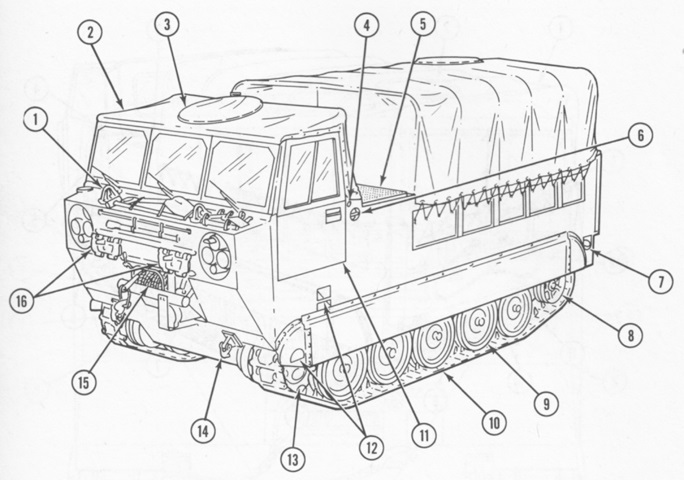 1. Lifting eye. 2. Cab cover. 3. Cab hatch cover. 4. Aft bilge pump outlet. 5. Air intake grille. 6. Fire extinguisher outside handle. 7. Fuel filler cap. 8. Idler wheel. 9. Road wheel. 10. Track. 11. Cab door. 12. Cab step. 13. Drive sprocket. 14. Towing eye. 15. Winch. 16. Spare track shoe. (Picture from TM 9-2350-247-10 Driver's Operation and Maintenance Manual Carrier, Cargo, Tracked, 6-ton: M548 (2350-00-078-4545).)
The M113 became the most affluent of armoured personal carriers with 100,000 manufactured over the years. It was designed by the Food and Mach. Corporation, and a well-known figure of the Vietnam war. But the chassis was cheap and also proved adaptable, leading to scores of variants. Some were specialized and unarmoured. This was the case of the M548 Cargo Carrier, answering the need for a tracked supply vehicle for the rear lines. From the start it was called to be used as a general purpose tractor and supplier with a payload of 5.4 tonne capacity. Unlike trucks used from 1960 it had a better off-road capabilities due to its lower ground pressure, helped by its aluminium and composite chassis. It was derived not fropm the first variant, but from the improved M113A1 APC, and using its drivetrain and running gear. It could be transported by fixed and rotary-wing aircraft and was amphibious (it could float without preparation).
This led to a mass production but exact figures remains ellusive as the vehicle evolved as the M548A1 in 1981 (entry into service), with the engine and suspension improvements found in the M113A2. M548s were newly-constructed or rebuilt from M548s, and they were 110.75" (281.31cm) tall over the canopy bows. The came the Cargo Carrier M548A3, which entered service in 1994. M548 and M548A1s started to be rebuilt into M548A3s with the RISE enhancements of the M113A3 APC. Their new powertrain made the air brake kit ureduntant, and the cab heater was now permanent, and replacing the winch. It has also an NBC protection (nuclear, biological, and chemical) air filtration system. The M548A3 was the last production version, as the cold war ended, and it started to be exported as well.
Design
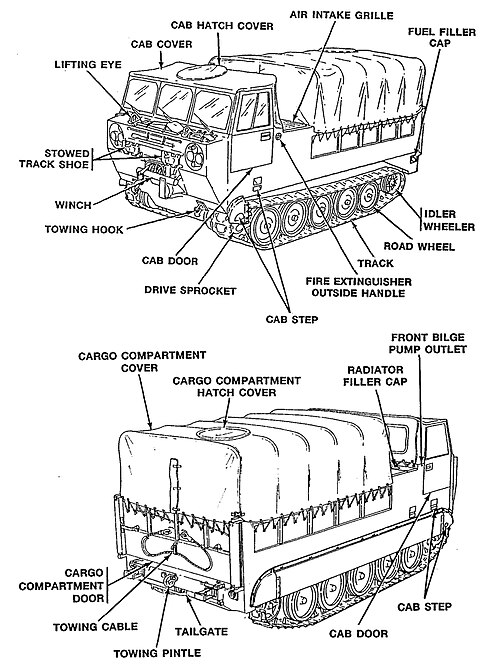
Layout of the M548
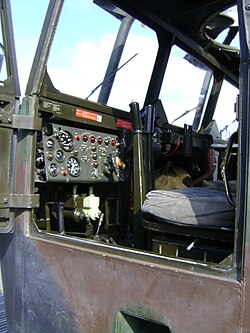
The original M113 chassis had a light weight frame enabling the use of a relatively small engine which was in the first version developed in 1959, a 6V53 Detroit two-stroke six cylinder diesel, coupled with an Allison TX-100-1 three-speed automatic transmission. The final vehicle presented itself with a M113 base chassis and drivetrain, with front drive sprocket, rear idler, five roadwheels, but a brand new hull partly in aluminium was buiot over it. The engine was relocated under a tall hood in a COE configuration (Cab over Engine) with a classic glassed cabin featuring a three-framed front windshield, all folding forward, canvas doors with plastic windows and a removable tarpaulin. The cab hatch cover on top closed the MG-gunner position.
The vehicle was equipped with a bilg pump in order to cross water obstacles. It was provided a manual fire extinguisher but had no smoke dischargers.
The first variant had a front-mounted winch to unditch the vehicle. Its cable was .625" (1.59cm) thick, and 200 feet (60m) long, and could be unfurled at 15-30'/min (4.6-9.1m/min) with a line pull of 20,000lb (9,000kg), and ultimate load limit at 1.8'/min (.55m/min) at 24,000lb (11,000kg).
Several kits could be installed depending on the missions:
-Material handling kit for ammunition support
-Air brake kit for towing equipment with air brakes
-Turn signal kit.
-Three different types of primary heater kits for the cab (primary for the cargo area, secondary for the cab/cargo) with engine coolant heater kit for polar use.
Armament
The M548 had no armor protection, but it was not defenseless. It was provided with a centrally-mounted ring mount similar to those featured by US military trucks of the time, and featuring either a 7.62mm machine gun M60 and M66 mount kit or the M49A1 ring mount for Browning M2 .50cal, still compatible with the M60 (mounting kit). 660 rounds carried in that case. The default was a .50cal M2HB MG, with 300 rounds in store, 360° in raverse and +85° to -15° elevation, all manual. It was manned by one of the three non-driving crew in cab.
Engine and Performances

The M548 driveline was the same as the M113 with a front sprocket with 10-tooth front drive, five dual roadwheels with rubber rims, and rear tensioner. It made use of the same T130 tracks, 38cm wide, 15cm, pitch, with a center guide, single pin, steel with detachable rubber pad. These were shock absorbers on the first and last road wheels/track. The Ground contact had a lenght of 111 inches or 282cm. No support rollers due to the relatively light track. While off-road the driver had to keep the track tension constant. The vehicle could still operate wth a failed torsion bar.
The M548 was powered by a General Motors 6V53, 6 cylinder, 2 cycle, vee diesel capable of 202 at 2800 rpm located behind the cab, with a high hood and exhaust pipe. Fuel capacity was 100 gallons or 380L. It was coupled with a transmission Allison TX-100-1, 3 ranges forward, 1 reverse. The Steering called for a DS200 controlled differential with steering levers. The vehicle had motor drives for the transfer gearcase, a generator and cooling for the differential and steering gear. The transfer gearcase could be used on a separating clutch when towing it. It was used to reduce the motor's speed. The power transmission followed the torque converter, with an automatic lock-up clutch.
Performances wise the M548 had a top speed of 38 mph or 61 kph and max water speed when swimming of 3.8m ph or 6.1 kph. It could cross a trench up to 66" or 170cm, negociate a max grade of 60%
and a side slope of 30%, clear a max vertical obstacle of 24" or 61cm. Its turning diameter was 28 feet or 8.5m. Its cruising range was ~300 miles on roads (480 km).
The cab kit could be adapted for cold temperatures weighting 140lb (64kg), replaced by an insulated fiberglass cover kit and added thermal (hard) windows, cloth seat covers, and foam insulation sheets. The cargo compartment could also received insulated fabric cover, and plywood floor covers, cloth seat covers ifseats were installed, as well as foam cargo door insulation panels. This cargo compartment kit weighted 85lb (39kg).
M548 (1960) |
| Dimensions (L-w-h) | 5.89 x 2.686 x 2.81m (19 ft 4 in x 8 ft 9.7 in x 9 ft 3 in) |
| Curb weight | 12.8 tonnes (14.1 short tons; 12.6 long tons) |
| Payload | 5 t Cargo |
| Crew | 4: Driver, 3 passengers in the cab |
| Propulsion | Detroit Diesel 6V53, 6-cyl. diesel 204 hp |
| Transmission | Allison TX-100-1, 3 ranges forward, 1 reverse |
| Suspension | Torsion bar, 5 road wheels |
| Top speed | 61 km/h (38 mph) |
| Armament | M2 Browning machine gun in ring mount |
| Maximum range | 480 km (300 mi) |
Variants
 M548 and its loading gimble.
M548 (1960)
Base vehicle on the M113A1 APC chassis, same drivetrain and running gear, constructed from 5083 aluminum. Inner dimensions, bed: 130.625" (331.788cm) long and 63.75" (161.9cm) wide. The flatbed floor could be raised thanks to side sponsons, for 96.5" (245cm) wide overall. Payload capacity was a baseline 12,000lbs (5,400kg). Front mounted winch, tarpauling roof. But there was a hardtop kit with fixed side windows and heater system.
M548A1 (1982)
NATO Stock Number (NSN) 2350–01–096–9356, same improvements as M113A2. Improved suspension and cooling system. Part were newly-constructed but most were rebuilt from M548s. The overall height of the rear compartment was made taller at 110.75" (281.31cm) due to new canopy bows. Details about the winch changed, as well as the ring mount, which legs sat on the short bonnet.
M548A3 (1993)
There is no M548A2. The A3 was the last variant, with the RISE enhancements of the M113A3. Its diesel was the same but of the improved Model 5063-5392, turbosupercharged. NATO Stock Number (NSN) 2350-01-369-6081. The winch is replaced by a cab heater and NBC protection system. The fiberglass roof and later cab were standards. The M548A3 was also justfied by the use of the "Volcano" minelayong kit founr in US Army engineer units, with kist installed and removed by operators at will. In short, the A3 introduced the BCIS, a Water/Ration Heater, PLGR Brackets, Relocation of the Decontamination system and an an improved Cold Start Kit. The driver benefits from an automotive-type steering yoke and foot brake arrangement improving control and lessening fatigue while simplifying driver training.

M1015
Modified M548 used as Electronic Warfare Shelter, housing a 60W, 400hz power system with ground rod driver. Carrying the AN/MLQ-24 TACJAM, and AN/TSQ-138 Trailblazer Direction Finding systems.
 Swiss M548:
-Raupentransportwagen 68 (Rpe Trspw 68) M548 Munitionstransport
-Raupentransportwagen 88 Model 88 (1986-1988, 54 units) with the "Fleckentarnanstrich" ("stain camouflage pattern") and improved diesel heating.
-Raupentransportwagen 68/05 ammunition transporter, supplying the M109 Swiss Kawest howitzer. It is also used by the tank mortar unit 16/5, with ten pallets of eight 155 mm charges and detonators handled by an electric hoist.
 British M548:
The British Army used the M548 as logistical support in the 1991 Gulf War, basis for the Tracked Rapier SAM (never delivered to the Iranian Army). On 25 February 1991, two M548s belo,ging to the Royal Electrical and Mechanical Engineers in support of the 16th/5th The Queen's Royal Lancers were attacked by an Iraqi Type 59 tank. One M548 was disabled while the second M548 returned fire with small arms, but Sergeant Dowling, MM and Lance Corporal F. Evans, REME were killed in the action.

M548A1 Swimmin' Screamin' Jimmy with addon-on anti-drone cage armour proposed for the Ukrainian front.
Operators

Argentina: 28 M548A1 in service.

Australia

Bahrain: Used from 1972 to 2002

Canada

Chile: M548A1 in service.

Iran: To be delivered to the Pahlavi regime but cancelled

Iraq: M548A1 in service.

Israel: Local designation M548 Alfa.

Italy: 210 M548 in service.

Kingdom of Saudi Arabia

Francoist Spain.

New Zealand.

Norway: Local designation NM199. in long term storage

Portugal, used under the Estado Novo & National Salvation Junta.

South Korea
Switzerland
United Kingdom

Ukraine

United States